Home Blog Page 33

Prompt Engineering Guide

Welcome to our guide to prompt engineering. Here, we provide all you need to know about prompts to shape the outputs of Artificial Intelligence (AI) language models like Generative Pre-trained Transformer (GPT). Through precise guidance, we unlock the potential to produce relevant and coherent expressions of thought. Join us as we explore the fundamentals of prompt engineering and its applications in leveraging AI technology effectively.

At its core, prompt engineering involves creating specific inputs that guide AI models to produce desired outputs. The process begins with understanding the objective—whether it is generating creative text, answering a question, or performing a specific task… Continue reading.

Prompt Engineering Techniques

Prompt engineering techniques encompass a range of strategies employed to guide AI language models in generating desired outputs. Among these, “zero-shot prompting” stands out as a method where a single prompt or instruction is provided to the model without any additional training examples. For instance, if one were to request a language translation without specifying prior examples, the model would rely solely on the provided prompt to generate the desired output.

On the other hand, “few-shot prompting” refers to giving the model only a limited quantity of training samples together with the suggestion to enhance its learning process. Few-shot prompting, as opposed to zero-shot prompting, allows users to provide a restricted number of instances to aid the model in producing outputs that are more accurate and suitable for the given context. The model will use examples to enhance its translation, for instance, if someone requests a translation in a certain language and provides some sample translations for advice.

Chain-of-Thought (CoT) Prompting

This method includes posing a set of interrelated questions in a logical order, leading the interviewee through a connected line of reasoning. Every subsequent question encourages the interviewee to further explore their thoughts, experiences, or knowledge about a specific topic. It is commonly used for delving into intricate topics or revealing the underlying rationale behind an individual’s actions or beliefs. It has the potential to be a strong tool for acquiring an understanding of an individual’s thought process and information processing.

Tree of Thought prompting

Just like chain-of-thought prompting, tree-of-thought prompting consists of questioning that leads in different directions, creating a “tree” of ideas or concepts. Every question results in several additional questions, forming a network of conversation. This method enables the examination of various aspects of a subject, revealing diverse viewpoints or levels of comprehension. It is especially handy for brainstorming, problem-solving, or delving into intricate issues with many aspects.

Best Practices for Writing Prompts

  1. Your prompt needs to be precise and detailed, giving AI sufficient clarity to comprehend what is required of them. Unclear or indefinite prompts may cause confusion and indecision.
  2. Ensure that the prompt aligns with the task at hand and the objectives of writing the prompt. 
  3. Refrain from combining multiple questions into a single one. As an example; “What are X and Y?” is complex as opposed to “Define X.” It is preferable to divide them into individual prompts.
  4. Foster creativity and curiosity by leaving the prompt open-ended. Refrain from using prompts that are too limiting and restrict the variety of potential responses. Instead, offer a structure that permits various understandings and methods.
  5. While it is important to be concise, ensure your prompt is not too brief to the point of being unclear. On the other hand, make sure it is not too lengthy to the point of being difficult to read.

Tools and Resources for Prompt Engineering

Agenta

Agenta is an extensive AI assistant tool that prioritises generating interactions that are more personalised and accurate. It uses sophisticated prompt engineering methods to customise conversations and actions according to user preferences and histories. Designed for individual use, support services, and virtual assistant functions, Agenta marks a significant advancement in AI interactions, becoming more intuitive and human-like.

Open Prompt

OpenPrompt is a set of tools created to streamline the process of prompt design for language models. It provides a framework that is open-source and aids in the development, testing, and deployment of prompts for different models and tasks. Its flexibility and wide range of features attract researchers and developers interested in exploring and refining interactions with AI systems using prompts.

OpenAI

One of the most prominent tools in prompt engineering is OpenAI’s GPT series. These models, particularly the latest versions, are highly advanced and capable of understanding and generating human-like text based on the prompts provided. They are used for various applications, including content creation, customer service, and virtual assistants. 

Emergent Mind

Emergent Mind is a state-of-the-art prompt engineering tool made for streamlining the creation and organisation of AI-generated content, with a focus on boosting creativity and efficiency. Emergent Mind emphasises simplicity and adaptability, allowing users to utilise AI for creative projects without requiring extensive technical expertise.

Google Cloud AI

Google Cloud AI provides various tools to enable users to analyse text, and understand sentiment and syntax. Google’s robust infrastructure and advanced machine learning tools support effective prompt engineering, facilitating the development of AI applications that require nuanced text processing and generation.

Applications of Prompt Engineering

Content Generation: Prompt engineering methods are useful for producing varied and logical writing in fields like content production, narrative creation, and conversational platforms. Developers can direct the generation process by creating carefully worded prompts to ensure the outputs meet desired criteria, like style, tone, or topic relevance.

Dialogue: Prompt engineering is crucial in conversational AI applications like chatbots and virtual assistants to create responses that are relevant to the context and to keep conversations interesting. Developers can enhance the quality of dialogue system interactions by creating prompts that encourage users to share appropriate information or context.

Summarisation: Prompt engineering helps in text summarisation tasks, which aim to shorten a longer text while retaining important information. Carefully constructed prompts can lead the summarization process and guarantee that the produced summaries are informative and cohesive.

Code Generation: Prompt engineering is becoming more common in tasks involving code generation, where AI models are directed to create code snippets, functions, or complete programmes. By offering precise and clear prompts, engineers can direct AI models to produce code that meets the required functionalities, thereby simplifying the process of software development and automation.

Academics: Prompt Engineering uses educational tools and platforms to offer tailored learning experiences for students. Prompt engineers can guide AI models to create personalised educational content, exercises, and assessments for each student by crafting prompts that align with their learning goals and skill levels. 

Benefits of Prompt Engineering

  • Prompt engineering requires skilled practitioners to design effective prompts, which can be time-consuming and complex.
  • Poorly designed prompts can introduce or reinforce biases, resulting in unfair or harmful outputs.
  • Prompts tailored for specific tasks may not generalise well across different contexts or applications, reducing their flexibility.
  • NLP models can be highly sensitive to slight changes in prompts, leading to unpredictable or inconsistent outputs.
  • Creating and refining prompts for numerous tasks and applications can be challenging and may not scale well.

Feel free to dive into these articles to expand your knowledge and expertise in prompt engineering.


What is Prompt Engineering?

Imagine a world where you could have a seamless conversation with a machine, receive tailored responses to your most intricate questions, or generate creative content effortlessly. This is not a distant future; it is the marvel of today’s technology, made possible through an innovative field known as prompt engineering. As we find ourselves leading the way in artificial intelligence and natural language processing, prompt engineering has become the guiding force, directing these smart interactions.

What is prompt engineering, and why is it becoming crucial for Artificial Intelligence (AI) progress? This intriguing domain blends art and science, crafting the very questions and commands that guide AI systems to understand and respond like never before. 

In this exploration, we will unravel the essence of prompt engineering, ascertain how it works, and explore its application in diverse domains. 

How prompt engineering works

At its core, prompt engineering involves creating specific inputs that guide AI models to produce desired outputs. The process begins with understanding the objective—whether it is generating creative text, answering a question, or performing a specific task. Prompts must be carefully crafted to include relevant context and clear instructions, which help the AI model comprehend and respond accurately.

Types of prompts

Prompt engineering relies on various techniques and methodologies to optimize prompts for better performance. Some common approaches include:

  • Inputting prompts without any examples, depends only on the model’s pre-existing knowledge to determine the right answer.

Examples 

  • What is the best way to store perishable goods?
  • Write a short story about nature.
  • List the best places to visit in the world
  • Providing a few examples within the prompt to illustrate the desired output format. This helps the model understand the context and patterns needed for generating accurate responses.

Examples

  • Provide clear and concise explanations for the following math concepts suitable for a 10th-grade student:

‘Quadratic Equations’

‘The Pythagorean Theorem’

‘Probability Basics’

  • Generate a summary of this patient case note suitable for a medical professional:

‘The patient is a sickle cell carrier and is currently experiencing a crisis. Complains of occasional pains in the joints. Blood pressure readings are consistently around 120/70 mmHg.’

  • Iteratively refining and tweaking prompts based on the model’s outputs to achieve more accurate and relevant results.

Notes

  • Effective prompt engineering requires a balance of context and specificity. Including too little context can lead to vague or irrelevant responses, while overly detailed prompts can constrain the model’s creativity. Prompts must be balanced.
  • Prompt engineering is often an iterative process. Initial prompts are tested and the outputs are evaluated to identify areas of improvement. Adjustments are then made to the prompt structure, language, or context to enhance the quality of responses. This cycle of testing and refining continues until the prompts consistently produce the desired outcomes.
  • It is essential to comprehend the advantages and disadvantages of the AI models in use. The ability of various models—such as ChatGPT series—to comprehend context, produce logical text, and adhere to commands varies. Effective prompting engineering takes these factors into account to maximize the model’s potential.

Applications of Prompt Engineering

Customer Service

Prompt engineering is crucial to improving AI-powered customer service platforms. Through the development of well-constructed prompts, businesses can produce chatbots and virtual assistants that offer precise responses tailored to specific situations. These AI systems are able to manage customer questions, solve problems, and provide customized suggestions, which enhances overall customer happiness and decreases the requirement for human involvement.

Education and E-Learning

Educational platforms benefit from prompt engineering by creating intelligent tutoring systems. These systems can provide personalized learning experiences, answer student queries, and generate practice problems. AI-driven tutors can adapt to individual learning styles and paces, offering explanations and feedback tailored to each student’s needs.

Healthcare

In the field of healthcare, timely engineering helps in creating AI systems that can support diagnosing patients, providing care, and conducting medical research. As an illustration, AI is able to create brief overviews of patient files, recommend potential diagnoses depending on symptoms, and offer details on available treatment choices. This app improves the effectiveness and precision of healthcare providers.

Business Intelligence and Data Analysis

Prompt engineering enables AI to assist in business intelligence by analyzing vast amounts of data and generating insightful reports. AI can identify trends, perform predictive analysis, and offer data-driven recommendations. This helps businesses make informed decisions and develop strategic plans.

Entertainment and Media

Prompt engineering is utilized in the entertainment sector to develop AI systems that are capable of producing scripts, song lyrics, and game scenarios. AI can customize content suggestions according to individual preferences, thus improving the user’s experience.

Research and Development

Researchers utilize prompt engineering to harness the power of AI in a range of areas, such as academia and scientific research, social sciences, and technology advancement. AI helps them with examining literature, coming up with hypotheses, and analyzing data, thereby speeding up the research and innovation process.

Marketing and Advertising

In marketing, prompt engineering helps create AI systems that generate ad copy, analyze consumer behavior, and personalize marketing campaigns. AI can suggest product recommendations, craft targeted advertisements, and optimize marketing strategies to increase engagement and sales.

Tools for Prompt Engineering

Agenta

Agenta is an extensive AI assistant tool that prioritizes generating interactions that are more personalized and accurate. It uses sophisticated prompt engineering methods to customize conversations and actions according to user preferences and histories. Designed for individual use, support services, and virtual assistant functions, Agenta marks a significant advancement in AI interactions, becoming more intuitive and human-like.

Open Prompt

OpenPrompt is a set of tools created to streamline the process of prompt design for language models. It provides a framework that is open-source and aids in the development, testing, and deployment of prompts for different models and tasks. Its flexibility and wide range of features attract researchers and developers interested in exploring and refining interactions with AI systems using prompts.

OpenAI

One of the most prominent tools in prompt engineering is OpenAI’s Generative Pre-trained Transformer (GPT) series. These models, particularly the latest versions, are highly advanced and capable of understanding and generating human-like text based on the prompts provided. They are used for various applications, including content creation, customer service, and virtual assistants. 

Emergent Mind

Emergent Mind is a state-of-the-art prompt engineering tool made for streamlining the creation and organization of AI-generated content, with a focus on boosting creativity and efficiency. Emergent Mind emphasizes simplicity and adaptability, allowing users to utilize AI for creative projects without requiring extensive technical expertise.

Google Cloud AI

Google Cloud AI provides various tools to enable users to analyze text, and understand sentiment and syntax. Google’s robust infrastructure and advanced machine learning tools support effective prompt engineering, facilitating the development of AI applications that require nuanced text processing and generation.

Pain Points

  1. Creating prompts that are clearly defined and straightforward can be difficult. When a prompt lacks clarity or is broad, the AI might produce outputs that deviate from the engineer’s expectations.
  2. It is an iterative process, which can be time consuming
  3. Sometimes AI provides inaccurate information, engineers need to make sure that AI-produced content is dependable, precise, and clear to establish and uphold user confidence
  4. AI algorithms might occasionally produce surprising or irrelevant answers, causing annoyance for prompt developers aiming for particular results.
  5. Finding the perfect equilibrium between consciousness and thoroughness can pose a challenge. A prompt should be brief to prevent users from feeling overwhelmed, yet still provide enough information to steer the AI in the right direction.

What to anticipate in the future

  • AI will improve in its ability to comprehend and react to instructions, leading to more precise and pertinent interactions.
  • AI will customize answers according to each user’s preferences, enhancing customer service and other uses.
  • It will be simpler for anyone to generate and perfect prompts with the help of new tools, even if they lack technical expertise.
  • I will combine text, images, audio, and video to create richer interactions and more comprehensive responses.
  • Prompt engineering will experience adoption across more fields, including education, healthcare, and creative industries.

Prompt Engineering Salary

As businesses in different sectors continue to turn to advanced Artificial Intelligence (AI) technologies, the need for experienced engineers is rapidly increasing. The increase in need has resulted in competitive pay and appealing benefits, turning prompt engineering into not only a satisfying career option but also a financially lucrative one. This article will delve into the factors impacting prompt engineering salaries, share average pay ranges, and give advice on how to boost your earning potential in this dynamic and thrilling industry.

For more information on the mechanics of prompt engineering, its practical uses, and resources for success in a prompt engineering career, visit here.

Factors influencing prompt engineering salaries

Factors influencing prompt engineering salaries are varied and complex, each playing a critical role in determining how much professionals in this innovative field can earn. Let us dive into the key elements that shape these salaries.

Experience Level

Level of expertise gained through practical involvement and exposure.

Experience plays a significant role in determining salary. Newly hired engineers at entry level typically make lower salaries than more experienced engineers. Nevertheless, as they acquire more expertise and enhance their abilities, their potential earnings see a substantial rise. For instance, a seasoned prompt engineer with extensive experience and a demonstrated history can demand a significantly higher salary because of their skills and capacity to manage intricate projects.

Learning and professional qualifications

Acquiring a more advanced education can lead to higher earnings opportunities. Employers frequently favour individuals with higher education in artificial intelligence, machine learning, or computer science, such as a master’s or PhD, and are ready to offer them higher salaries. Moreover, qualifications in specific AI fields and efficient engineering can bolster a professional’s expertise. These certifications show a higher level of expertise and skill, making these people more desirable to employers.

Technical skills

The critical skills and knowledge a prompt engineer has are essential. 

In the industry, having expertise in natural language processing (NLP) libraries, a strong grasp of AI and machine learning algorithms, and proficiency in Python and Java programming languages is greatly appreciated. Engineers who have a solid understanding of these areas can tackle tougher challenges and develop advanced solutions, leading to higher earning opportunities.

Industry demand

Various sectors require engineers to respond quickly to different extents. Industries like technology, finance, healthcare, and e-commerce usually provide higher salaries due to the essential use of AI and machine learning in their functions. These sectors are ready to offer higher salaries for adept individuals who can promote innovation and productivity, resulting in improved products and services.

Geographic Location

Salaries are greatly influenced by where an individual is located geographically. Primary technology centres such as Silicon Valley, New York, and London typically provide increased salaries in comparison to other areas because of the large number of tech companies and the higher living expenses. Yet, as remote work becomes more prevalent, the significance of geographic location in determining pay scales may diminish, possibly resulting in more uniform compensation rates regardless of region.

Size and type of the organisation

Salaries are also influenced by the size and type of company. Bigger companies and industry leaders typically possess greater resources, enabling them to offer higher wages. An engineer working at a major firm like Toyota may earn a larger salary than an individual employed at a smaller startup.

Job Role and Responsibilities

Specific job roles within prompt engineering come with different responsibilities and corresponding salary ranges. For instance, a research scientist working on cutting-edge AI research might earn more than an application developer focused on integrating existing solutions. Roles that involve more complex or critical tasks generally offer higher pay because they require a greater level of expertise and responsibility.

Understanding these factors can help aspiring prompt engineers and current professionals strategically plan their careers. By recognizing the elements that affect their earning potential, they can make informed decisions about their education, skill development, and job choices to maximise their salaries in the dynamic and evolving field of AI and prompt engineering.

Prompt Engineering Jobs and their salaries

Junior Prompt Engineer

A junior prompt engineer assists senior engineers in creating and testing prompts, conducts basic data analysis, and contributes to project reports. Necessary skills for this position involve a fundamental understanding of AI and NLP, proficiency in programming (specifically Python), problem-solving capabilities, and a strong focus on detail.

Salary Range –  Average of $60,000k to $65,000k annually

Apply Here

Senior Prompt Engineer

An experienced senior engineer overseas engineering projects, guides junior engineers, creates and enhances complex prompts, analyses data thoroughly, and ensures project objectives are achieved. In order to qualify as a senior prompt, one must have a deep knowledge of AI and NLP, strong programming abilities, familiarity with machine learning frameworks, and project management experience.

Salary Range –  Average of $180,000k t0 $185,000 annually

Apply Here

Prompt Optimization Specialist

An optimization specialist examines and improves current prompts to enhance performance, pinpoint improvement areas, execute and evaluate optimization techniques, and provide performance metric reports. These professionals need to have skills in natural language processing, data analysis, and programming languages like Python and R. They need to possess strong expertise in optimization algorithms, and have analytical minds.

Salary Range –  Average of $180,000k t0 $185,000 annually

Apply Here

AI Research Scientist

An AI Research Scientist engages in cutting-edge research on prompt engineering methods, creates novel algorithms, works closely with academic and industry collaborators, and shares discoveries in scholarly publications. Necessary qualifications consist of a doctorate in AI or a similar area, proficient coding skills, familiarity with research methods, and processes.

Salary expectations –  Average of $100,000k t0 $150,000 annually

Apply Here

Prompt Data Analyst

Similar to regular data scientists, swift data analysts examine data produced from swift experiments, generate visual representations of data discoveries, detect trends and patterns, and provide data-informed insights to assist in decision-making. Data analysts must have strong skills in utilising data analysis tools like excel and structured query language (SQL). They also need strong statistical skills and solid experience using data visualisation tools such as Power BI.

Salary expectations –  Average of $90,000k to $110,000 annually

Apply Here

Machine Learning Engineer

Machine learning engineers are highly important individuals within the burgeoning field of prompt engineering. Their responsibilities consist of creating and executing machine learning models for generating prompts, examining and confirming the effectiveness of models, incorporating models into operational systems, and keeping models current. In order to excel in the position, these engineers need to have advanced programming abilities, be familiar with machine learning frameworks, have a good grasp of NLP, and possess strong problem-solving skills.

Salary Range –  Average of $140,000k to $200,000k annually

Apply Here

NLP Developer

An NLP Developer’s role includes implementing complex text processing algorithms and incorporating NLP components into larger systems for smooth functioning. Furthermore, they make sure that NLP models meet predetermined performance criteria. For success in this position, a proficient NLP Developer must possess knowledge in NLP and proficient programming abilities in languages such as Python and Java. Having experience with NLP libraries is also important, just as having a strong grasp of linguistics is necessary for effectively analysing and processing language data.

Salary Range –  Average of $130,000k to $190,000k annually

Apply Here

Prompt Engineering Consultant

Similar to consultants in other fields, quick engineering consultants offer specialised guidance on quick engineering initiatives, create tailored solutions for customers, lead training sessions, and assist clients in executing quick engineering tactics. Qualifications needed for this position involve a deep background in AI and quick engineering, effective communication abilities, prior project management experience, and the capability to collaborate with a variety of clients.

Salary Range –  Average of $170,000k annually

Apply Here

AI Product Manager

AI product managers set up product specifications, supervise project timelines and results, supervise the development and application of AI products, and assist in coordinating efforts between technical and business departments. They can achieve this by their profound knowledge of AI and machine learning principles. Additional skills necessary for success in this position comprise experience in product management, solid organisational abilities, and the capability to explain technical ideas to individuals without technical backgrounds.

Salary Range –  Average of $160,000k to $280,000 annually

Apply Here

Prompt Engineering Instructor

A Prompt Engineering instructor’s responsibilities include creating and teaching thorough courses on prompt engineering. This involves developing interesting and educational teaching materials and evaluating student advancement to guarantee successful learning results. Remaining current with the most recent developments in prompt engineering is essential in order to maintain the curriculum’s relevance and up-to-dateness. In order to excel in this position, a Prompt Engineering Educator needs to possess a thorough comprehension of AI and prompt engineering principles. Having teaching experience is crucial, as well as the skill to produce educational content of high quality that can simplify difficult concepts. In order to effectively communicate information and connect with students, strong communication skills are essential.

Salary Range –  Average of $70,000k to $110,000 annually

Apply Here

Tips on improving your earning potential

  • Always develop yourself. You can do this by taking certification courses and technical workshops to enhance your skill set.
  • Develop expertise in specific industries where AI and prompt engineering are in high demand, such as healthcare, finance, or e-commerce. Specialised knowledge can make you more valuable to employers.
  • Build a strong professional network and online presence in professional platforms like linkedIn as they can provide decent job opportunities  and collaborations. 
  • Investigate established norms in the field and get ready to talk about your individual abilities and achievements to support a request for a higher salary.
  • Consistently ask for feedback and take advantage of performance evaluations to talk about salary increases and advancements. Showing your importance to the company can lead to an increase in your salary.

Prompt Engineering Jobs

Prompt engineering blends art and science, crafting the very questions and commands that guide Artificial Intelligence (AI) systems to understand and respond like never before. Prompt engineering is essential in improving conversational AI, refining search engines, and perfecting recommendation algorithms as it plays a central role in these developments. 

To learn more about how prompt engineering works, its  applications, and tools to excel in a career journey on prompt engineering, visit here.

Jobs

Junior Prompt Engineer

A junior prompt engineer assists senior engineers in creating and testing prompts, conducts basic data analysis, and contributes to project reports. Necessary skills for this position involve a fundamental understanding of AI and Natural Language Processing (NLP), proficiency in programming (specifically Python), problem-solving capabilities, and a strong focus on detail.

Senior Prompt Engineer

An experienced senior engineer overseas engineering projects, guides junior engineers, creates and enhances complex prompts, analyzes data thoroughly, and ensures project objectives are achieved. In order to qualify as a senior prompt, one must have a deep knowledge of AI and NLP, strong programming abilities, familiarity with machine learning frameworks like TensorFlow and PyTorch, and project management experience.

Prompt Optimization Specialist

An optimization specialist examines and improves current prompts to enhance performance, pinpoint improvement areas, execute and evaluate optimization techniques, and provide performance metric reports. These professionals need to have skills in natural language processing, data analysis, and programming languages like Python and R. They need to possess strong expertise in optimization algorithms, and have analytical minds.

AI Research Scientist

An AI Research Scientist engages in cutting-edge research on prompt engineering methods, creates novel algorithms, works closely with academic and industry collaborators, and shares discoveries in scholarly publications. Necessary qualifications consist of a doctorate in Artificial Intelligence or a similar area, proficient coding skills, familiarity with research methods, and the ability to release scholarly articles.

Prompt Data Analyst

Similar to regular data scientists, swift data analysts examine data produced from swift experiments, generate visual representations of data discoveries, detect trends and patterns, and provide data-informed insights to assist in decision-making. Data analysts must have strong skills in utilizing data analysis tools like excel and sql. They also need strong statistical skills and solid experience using data visualization tools such as Power BI.

Machine Learning Engineer

Machine learning engineers are highly important individuals within the burgeoning field of prompt engineering. Their responsibilities consist of creating and executing machine learning models for generating prompts, examining and confirming the effectiveness of models, incorporating models into operational systems, and keeping models current. In order to excel in the position, these engineers need to have advanced programming abilities, be familiar with machine learning frameworks, have a good grasp of NLP, and possess strong problem-solving skills.

NLP Developer

An NLP Developer’s role includes implementing complex text processing algorithms and incorporating NLP components into larger systems for smooth functioning. Furthermore, they make sure that NLP models meet predetermined performance criteria. For success in this position, a proficient NLP Developer must possess knowledge in NLP and proficient programming abilities in languages such as Python and Java. Having experience with NLP libraries like spaCy is important, just as having a strong grasp of linguistics is necessary for effectively analyzing and processing language data.

Prompt Engineering Consultant

Similar to consultants in other fields, quick engineering consultants offer specialized guidance on quick engineering initiatives, create tailored solutions for customers, lead training sessions, and assist clients in executing quick engineering tactics. Qualifications needed for this position involve a deep background in AI and quick engineering, effective communication abilities, prior project management experience, and the capability to collaborate with a variety of clients.

AI Product Manager

AI product managers oversee the creation and implementation of AI products, facilitate communication between technical and business departments, establish product specifications, and supervise project schedules and outcomes. They can achieve this by their profound knowledge of AI and machine learning principles. Additional skills necessary for success in this position comprise experience in product management, solid organizational abilities, and the capability to explain technical ideas to individuals without technical backgrounds.

Prompt Engineering Instructor

A Prompt Engineering Educator’s responsibilities include creating and teaching thorough courses on prompt engineering. This involves developing interesting and educational teaching materials and evaluating student advancement to guarantee successful learning results. Remaining current with the most recent developments in prompt engineering is essential in order to maintain the curriculum’s relevance and up-to-dateness. In order to excel in this position, a Prompt Engineering Educator needs to possess a thorough comprehension of AI and prompt engineering principles. Having teaching experience is crucial, as well as the skill to produce educational content of high quality that can simplify difficult concepts. In order to effectively communicate information and connect with students, strong communication skills are essential.

Steps to take for aspiring prompt engineers

  • Get a Good Education: Start by getting a degree in computer science, AI, or a similar field. Take classes that teach you about how machines learn, understand, and process language.
  • Learn to Code: Make sure you are excellent with programming languages like Python and Java. These are the tools you will use to create and work with AI programs.
  • Understand How Computers Process Language: Focus on learning about NLP. This is how computers understand and work with human language. Study things like how computers break down sentences and recognise important words.
  • Get Practical Experience: Practice by working on real projects. Try creating simple chatbots, analyzing text for sentiment (like figuring out if a review is positive or negative), or processing large amounts of text data.
  • Learn About AI Tools: Become acquainted with commonly used AI tools and libraries like TensorFlow and spaCy. These software tools assist in constructing and evaluating AI models.
  • Keep Up with New Developments: AI and prompt engineering are fast-moving fields. Read the latest research drafts, attend workshops or conferences, and join online forums to stay updated on new techniques and tools.
  • Create a collection of projects for your portfolio: Gather and record your tasks. Develop a collection showcasing your projects, problem-solving approaches, and achieved outcomes. This will come in handy when you are searching for employment.
  • Connect with other professionals in your field: Engage with individuals in the AI and NLP field. Get involved in groups, go to meetups, and engage in discussions on the internet. Networking offers valuable guidance, mentorship, and employment prospects.
  • Take Specialized Courses: Consider taking additional courses or certifications in prompt engineering or advanced NLP. Many online platforms offer these courses and they can help you gain deeper knowledge and skills.
  • Apply for Jobs: Start looking for jobs related to AI and NLP. Entry-level positions like AI researcher, NLP engineer, or machine learning engineer are good starting points. These roles will allow you to apply what you have learned and gain more experience.

By adhering to these instructions, you can acquire the expertise and understanding required to excel as a proficient engineer specializing in prompts, a profession that is gaining significance with the expansion of AI technology.

Future prospects for practitioners

The potential uses of prompt engineering are wide-ranging and diverse – from making more intelligent digital assistants that can predict our requirements, to creating AI-powered educational resources that adjust to individual learning preferences, to transforming customer service with bots that can effortlessly manage complicated inquiries. But the thrill does not end there, as a prompt engineer, you are a trailblazer in an industry that presents fresh challenges and prospects daily. You will be given the opportunity to contribute to revolutionary projects, partner with top experts in AI, and constantly challenge the limits of what is achievable. The challenges you will address involve creativity as well as technical skills, demanding you to think creatively and innovate regularly.

Additionally, your work’s influence reaches well beyond the technology sector. You are advancing education, entertainment, healthcare, and other fields by improving AI’s ability to understand and produce human language. This indirectly makes the world a more accessible and understanding place where people all around the world live better lives.

Starting a career in prompt engineering today means taking on a position with unlimited opportunities for development, education, and influence. This profession offers more than just thrill and creativity; it also provides the rewarding feeling of making a tangible impact on society.

ENGINEERING APPLICATIONS OF ARTIFICIAL INTELLIGENCE (AI)

As we all know, change is the only constant element in life. Artificial Intelligence (AI) advancements are revolutionising all facets of our existence, particularly the engineering field.  This can be seen in AI’s recent trend of using big data and synthesis of information from patterns, to make autonomous decisions, making what was once thought impossible possible. This article touches on the riveting area of Engineering Applications of Artificial Intelligence that is shaping things in design, optimisation, predictive maintenance, robotics, structural health monitoring, genomics, and much more. Study the transformational power of AI in engineering and the future of technology and infrastructure as they are reshaping.

AI in Design and Optimisation

AI in Design and Optimisation

In recent times, the ability of engineers to tap into a large area of possibilities in design aimed at enhancing performance and eventually making general optimisation easier has been made easier through AI modules in algorithms, machine learning, and computational modelling. AI is changing and, at the same time, enhancing the way of designing and optimising in a number of ways, namely:

Generative Design

Artificial Intelligence (AI) in generative design produces solutions based on certain unique constraints and objectives, using algorithms to plot and present several design choices. Iterative (repetitive) assessment, design, and idea improvement can reveal fresh approaches that were missed using more conventional methods.

Simulation and Analysis

AI-enabled simulation and analysis tools also serve as predictive measures, which give engineers a sneak peek at how a complex system is most likely to act and the performance that a designed system will likely produce under different operating conditions. Furthermore, machine learning algorithms are also able to analyse the outcomes of simulation by marking patterns and, at the same time, optimising design parameters with the aim of realising the desired outcomes.

Product Customisation

Another renowned area of AI operation is product customisation, where the product designs literally change on the spot, in real time, pointing to the wants and demands of a specific individual. AI algorithms can generate personalised design variations through user data and related feedback that fit within the specific needs, preferences, and constraints of the users in question.

AIDriven Optimisation

The drive of AI is towards optimum solutions within vast and complex design spaces. That is, they keep checking and revisiting, on an iterative basis, the fine-tuning of design parameters towards objectives of performance maximisation,  or any other specified objectives.

Design for Manufacturability

AI tools help analyse the constraints of the manufacturing process and the requirements soon enough before the design is put in place to ensure its manufacturability and cost-effectiveness. It helps in doing design optimisation both for the manufacturing process and the properties of the material. This, in turn, reduces cost and minimises waste, while enhancing product quality.

Essentially, AI in design and optimisation gives engineers the required tools and methodologies imperative for addressing complex design challenges, innovation, finding new solutions, and coming up with approaches to optimise engineering systems for better performance, efficiency, and sustainability. As AI technologies keep getting better, it can well be expected that soon, the new AI emerging will bring forth more innovation and efficiency in all engineering disciplines.

AI in Predictive Maintenance

Prediction using algorithms

In engineering, predictive maintenance is a proactive maintenance strategy that uses data analytics and machine learning techniques to predict when equipment failure is likely to occur. AI in this regard empowers engineers to create innovative solutions and enhance performance across various domains. Predictive maintenance uses AI-driven analytics to detect equipment anomalies and prevent downtime. By forecasting equipment failures, AI enables efficient maintenance scheduling and maximises asset uptime. 

AI in Robotics and Automation

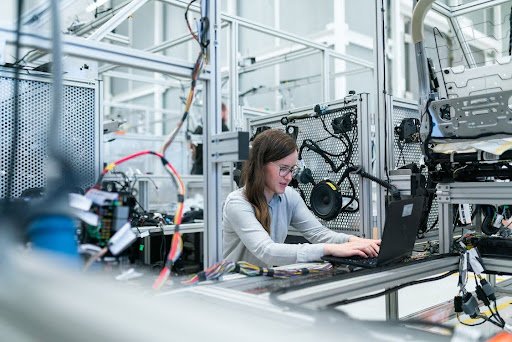
Engineer working with robots in a factory

Industries globally are increasingly adopting robotic automation systems to streamline processes and improve efficiency. AI in robotics and automation aids these processes by bringing about bots equipped with autonomous decision-making, learning, and adaptation. By leveraging AI algorithms, robots can perceive their environment, make intelligent decisions, and perform complex tasks with greater efficiency and accuracy. This integration has revolutionised various industries, including manufacturing, logistics, healthcare, and agriculture, by enabling automation of repetitive tasks, enhancing productivity, and improving safety. AI-powered robots can perform tasks such as assembly, picking and packing, surgical procedures, and crop harvesting with precision and speed, leading to increased operational efficiency and cost savings.

AI In Autonomous Vehicles and Drones

Drone aiding in surveillance

Artificial Intelligence (AI)-powered autonomous vehicles and drones are also transforming aerial operations and transportation by providing accurate object detection, efficient navigation, traffic management, and collision avoidance. These technologies optimise routes, improve situational awareness, and guarantee safety by utilising complex algorithms and sensor data processing. 

Asides enhancing traffic efficiency and reducing gridlock, self-driving cars work in tandem with centralised systems to modify routes on the fly. 

Similarly, AI-enabled drones provide timely monitoring in farms, for instance, reconnaissance, and surveillance, yielding valuable data for security, crop management, and disaster relief. These drones also help in logistics by providing safe package transportation and optimum routes for deliveries. All things considered, AI-powered drones and autonomous cars promise revolutionary advantages for a variety of businesses, bringing in a new era of effectiveness, security, and ease.

AI in Structural Health Monitoring

Structural Health Monitoring

In engineering, the importance of carrying out structural integrity tests on structures cannot be emphasised enough. Through improved structural defect and damage detection, assessment, and prediction, AI in structural health monitoring transforms infrastructure management. 

AI systems study data from several sources, including sensors, cameras, and Internet of Things (IoT) devices, to monitor the state of bridges, buildings, and other vital infrastructure through sophisticated machine learning algorithms and sensor technologies. This lowers the likelihood of catastrophic failures and improves public safety. AI also helps with structural behaviour prediction and modelling, which enables engineers to plan ahead for maintenance requirements and allocate resources as efficiently as possible. 

By providing infrastructure managers with meaningful insights, AI in structural health monitoring helps them make well-informed decisions and ensures the durability and resilience of civil infrastructure assets.

AI-based solutions for environmental monitoring and management

AI powered bulb

Concerning the environment, AI hovers like a silent guardian, with its sensors and satellite imagery probing deep into the natural world, aiming to ensure a delicate balance. Sensors, integrated with AI, keep a constant watch on land, air, and sea, ready to set off  alarms at the first indication of a problem.

But AI has been much more than a passive onlooker; it is an active, positive force for change. Machine learning pumps computation full of AI to sort through vast lakes of data, pulling out secret patterns and predicting futurity with a striking accuracy rate. This would in turn arm up the conservationists with the necessary knowledge on ways through which vulnerable ecosystems can be put under a shield from the impacts of human activity—how human activity can further be offset and how the future can be put in place for coming generations.

They also provide the application for vast centres in conservation of wildlife, monitoring environmental changes, and management in cases of disaster. Ranging from the identification of species to programs that can save them from annihilation, and anti-poaching initiatives, correcting genetic deficiencies that threaten the existence of a species can be done through different innovations of AI. Such innovations give power to stakeholders in terms of informed decision-making and sustainability.

Challenges and Future Directions

As the integration of AI into engineering applications continues to evolve, several challenges and future directions emerge, shaping the trajectory of this field.

The major challenge is the ethical and societal implications of AI in engineering. Concerns about privacy, bias, and job displacement raise questions about responsible AI implementation. Future directions in this regard involve developing ethical frameworks, ensuring transparency, and promoting inclusive decision-making processes.
The complexity and interpretability of AI models present another difficulty. Comprehending and explaining AI-driven decisions is essential in engineering applications where safety and dependability are critical. In the future, engineers should concentrate on creating AI models that are understandable, creating reliable validation processes, and improving AI-human cooperation.

Data quality and availability pose additional challenges, particularly in domains with limited or unstructured data. Future directions may involve developing innovative data collection techniques, leveraging domain knowledge, and exploring transfer learning approaches to address data scarcity.

Interdisciplinary collaboration and talent acquisition are other key factors in advancing AI in engineering. Encouraging collaboration amongst engineers, data scientists, and domain specialists, in addition to advocating AI education and training initiatives, will be an effective measure in the future.

Summarily, the potential of AI to transform engineering applications can be fully realised by resolving ethical issues, improving model interpretability, overcoming data limits, optimising computational resources, and encouraging interdisciplinary collaboration.

Summary 

Engineering Applications of Artificial Intelligence (AI)Data
Predictive MaintenanceUtilises AI algorithms to predict equipment failure before it occursMinimises downtime and reduces maintenance costsEnhances equipment reliability and operational efficiency
Design and OptimisationAI-driven tools ensures rapid prototyping and design optimisationImproves product performance and efficiencyStreamlines the design process and reduces development time
Robotics and AutomationAI-powered robots are utilised for manufacturing, logistics, and service industriesEnhances productivity and precisionEnables autonomous operation and adaptive behaviour
AI in Autonomous Vehicles and DronesUtilises AI algorithms for navigation, obstacle detection, and decision-makingPromotes safer and more efficient transportationSupports applications in delivery, surveillance, and exploration
AI in Structural Health MonitoringUtilises AI for real-time monitoring of structural integrityDetects defects, cracks, and potential failuresEnhances safety and prolongs the lifespan of infrastructure
AI-based Solutions for Environmental Monitoring and Management,Utilises AI for analysing environmental data, predicting trends, and identifying risksFacilitates early warning systems and resource allocationSupports sustainable management of natural resources

Design Thinking Templates

Think of design thinking templates as problem-solving simplified! Picture having a blueprint set that transforms your thoughts into actuality, regardless of how outlandish they may be. Design thinking templates are specifically focused on that exact purpose. They function as enchanted maps that lead you through the labyrinth of creativity, assisting you in discovering optimal solutions for any obstacle. Read on as we delve into and explore how these templates can transform your most pioneering ideas into practical strategies. 

What are Design Thinking Templates?

Design thinking templates are organized structures or presentations that aid individuals and teams in the design thinking process. They offer a structured method for solving problems by dividing intricate concepts into smaller steps. The templates generally consist of visual components, prompts, and inquiries that help users navigate through all phases of the design process, from problem comprehension to prototyping and testing solutions.

Consider design thinking templates as guides that direct you from identifying the problem (point A) to implementing a solution (point B) efficiently and creatively. They make brainstorming, idea generation, collaboration, and decision-making easier for individuals of all levels of expertise, thus increasing accessibility to the design process.

Design thinking templates offer a structured method for innovation, helping you unleash creativity and unlock new possibilities when facing a business challenge, developing a new product, or improving a service.

Benefits of Design Thinking Templates

The Design Thinking Process template functions as a kind of road map for coming up with original and practical solutions to issues. This is why it is quite beneficial:

  1. After conducting an in-depth investigation and comprehending their stories, it enables you to truly get to know the people you are attempting to assist.
  2. After examining all the data you have collected and developing profiles of the individuals you are attempting to assist, it assists you in determining the primary concerns.
  3. It promotes unconventional thinking, which helps you generate a wide range of solutions for the issues you have recognised.
  4. By creating basic versions of your ideas and evaluating their effectiveness, you get to test your ideas. This allows you to make changes and improvements before committing to a final solution.
  5. It is all about making things better over time. You keep trying out new ideas, getting feedback, and making improvements until you find the best solution possible.

Overall, the design thinking process template is like a readymade guide for problem-solving that helps you understand people’s needs, come up with great ideas, and make things easy and better step by step.

Popular Design Thinking Templates

Journey maps

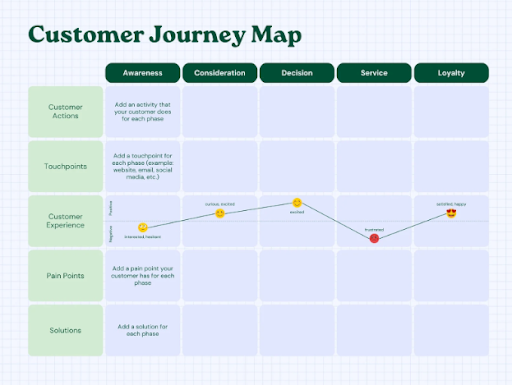
Journey maps, as their name suggests, illustrate the user’s experience with a product or service, showing their actions, touchpoints, experiences, pain points, and solutions from start to finish. Researchers gather data through interviews or observations to understand the  user’s awareness and considerations, then plot their journey along a timeline with stages or touchpoints. Summarily, these maps help teams gain insights, identify pain points, and find opportunities for improvement by highlighting areas of challenge or frustration. 

Templates vary in format, but a typical example can be seen below.

customer Journey maps

https://www.canva.com/p/templates/EAFauQ3r_rA-pastel-blue-and-green-modern-colorful-customer-journey-map-graph/ 

Empathy Maps Template

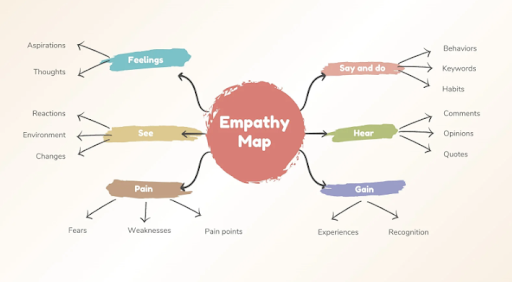
Empathy map templates are structured tools divided into various quadrants, in no particular order- “See,” “Hear,” “Gain,” “Think,” “Say and Do,” and “Feel,” representing different aspects of the user’s experience. Each quadrant captures specific information about the user’s thoughts, feelings, actions, and needs,  enabling teams to gain deeper insights into user needs and preferences.

Empathy map templates vary in format, but a typical example can be seen below.

Empathy Maps Template

https://www.canva.com/p/templates/EAFlKOBK7tM-empathy-map-mind-map/ 

Persona Templates

Creating personas is just like creating characters/ avatars like those in a storybook, but these characters represent different types of people who might use a product or service. These “personas” help teams understand who they are designing for and what those people need and want. To make a persona template, you gather information about real people who might use the product or service. Then, you organize their information into a template that describes the personas’ traits, like their age, job, and hobbies. Teams use these personas to guide their design decisions.

A typical example can be seen below.

Persona Templates

https://www.canva.com/p/templates/EAFdz7MQheo-brown-and-cream-modern-minimalist-user-persona-brainstorm/ 

Ideation Templates

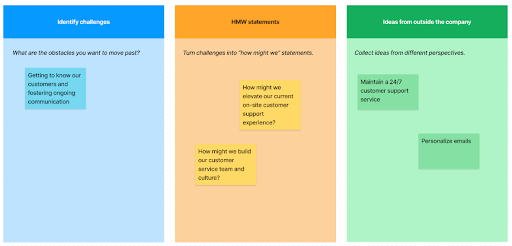
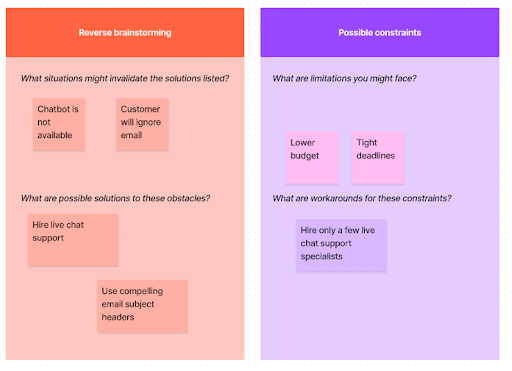
Think of ideation templates like blueprints for coming up with new ideas. They are structured guides that help teams brainstorm and think creatively about solutions to problems. To use an ideation template, you gather a group of people and give them the template. Then, you follow the prompts in the template to brainstorm ideas. You might use techniques like drawing diagrams or writing down thoughts to generate lots of ideas. Templates vary in format, but a typical example can be seen below.

Ideation Templates
Ideation Templates

https://www.figma.com/file/fQykM4snYnzCVEpjKBlzrm/Untitled?type=whiteboard&node-id=0-1&t=iyNTSnq4EgR9QBrH-0 

Prototyping Templates

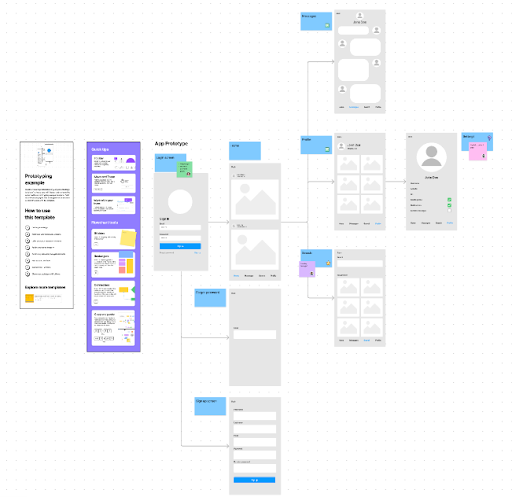
Prototyping templates are like rough sketches of a product or service. They are simple versions that help teams visualize their ideas and test them out before making the final product. To create a prototype, you use a template to sketch out your idea. Then, you can test it with people to see if it works well and get feedback. Based on that feedback, you can make improvements. An example is shown below

Prototyping Templates

https://www.figma.com/file/eCB4g1KNEIL2D68fqiNBRV/Untitled?type=whiteboard&node-id=0-1&t=pk8RKQERoRTshNBH-0 

Design Thinking Book

The discussion regarding design thinking processes sometimes leaves the confines of the internet and finds itself in the unfolding pages of a book. Books have emerged as a safe haven, a sanctuary where minds roam freely and ideas take flight. The subject of this web content, design thinking books, serves as a portal to boundless creativity and innovation. They tend to unlock the deep seated imagination in our minds, which in turn begets exploration, experimentation, and discovery. With design thinking books, you get to learn all there is to know about design thinking processes, the tools associated with them, and their impact on the business landscape as a whole.

Design Thinking Process

The design thinking process is a method for coming up with innovative solutions to problems while keeping users’ and consumers’ wants and preferences in mind. To understand more about how this process works, visit here.

Design Thinking Books

  1. “Design Thinking: The handbook” by Falk Uebernickel, Li Jiang, and Walter Brenner

Get the book here- https://www.amazon.com/Design-Thinking-Handbook-Falk-Uebernickel/dp/9811203504 

This manual offers a comprehensive look at the principles and techniques of design thinking. It delves into the various stages of the design thinking process, providing helpful frameworks, tools, and practical instances to help people address complex issues and encourage innovation. The book equips readers with the necessary skills to effectively implement design thinking. By leveraging the expertise of professionals in the field, it stimulates reader creativity for their own businesses. Regardless of your level of experience, this book always has something new to learn.

  1. “Design Thinking: Understanding How Designers Think and Work” by Nigel Cross

Get the book here- https://www.amazon.com/Design-Thinking-Understanding-Designers-Think/dp/1847886361 

Nigel’s book provides a direct examination of the design thinking procedure. It offers insight into designers’ approach to addressing challenges and uncovering innovative solutions. The book breaks down complex concepts into easy-to-understand language, helping readers grasp the essence of design thinking efficiently. Using authentic case studies and practical examples, Nigel demonstrates how design thinking can be applied practically in a variety of industries to solve issues in an efficient manner. 

  1. “Change by Design: How Design Thinking Transforms Organizations and Inspires Innovation” by Tim Brown

Get the book here-  ​https://www.amazon.com/Change-Design-Transforms-Organizations-Innovation/dp/0061766089  

“Change by Design” serves as a guiding beacon for establishments navigating change, leveraging design thinking to ignite innovation. Simply put, it shows how design thinking can turn dull and obsolete processes into dynamic and innovative ones. By sharing compelling narratives and useful illustrations, Brown illustrates how design thinking can revitalize companies, stimulating creativity and fueling a drive for innovative ideas. 

  1. “The Design of Business: Why Design Thinking is the Next Competitive Advantage” by Roger L. Martin

Get the book here-https://www.amazon.com/Design-Business-Thinking-Competitive-Advantage/dp/1422177807 

In basic terms, this book illustrates how design thinking can act as the superhero necessary for your business to overcome the obstacles of today’s environment. Martin demonstrates how design thinking has the potential to turn average companies into exceptional ones through compelling storytelling and clever observations. Therefore, if you are willing to uncover the untapped potential of your business and surge ahead of competitors, this book is your pass to the realm of creativity and success.

  1. Design Thinking for Dummies: 1st edition by christian Muller Rotenburg

Get the book here-https://www.amazon.in/Design-Thinking-Dummies-Krijn-Soeteman/dp/1119593921 

This book by Christian Müller-Roterberg is akin to having a knowledgeable companion share brilliant insights with you. It transforms the intricate realm of design thinking into an enjoyable and thrilling journey accessible to all. This book is broken down to the least possible to ensure ease, and it will guide you to unleash your creative potential with clear instructions and vibrant illustrations.

  1. “Design Thinking for Strategic Innovation: What They Can’t Teach You at Business or Design School” by Idris Mootee

Get the book here- https://www.amazon.com/Design-Thinking-Strategic-Innovation-Business/dp/1118620127 

The book “Design Thinking for Strategic Innovation” by Idris Mootee will definitely ignite your imagination as it offers perspectives that go beyond what traditional business or design training can offer. It will also teach you how to apply design thinking to overcome obstacles and provide creative solutions so that you can thrive. Take this book and let your imagination soar if you are ready to embark on a journey of discovery and transformation!

  1. Sprint: How to Solve Big Problems and Test New Ideas in Just Five Days, by Jake Knapp with John Zeratsky and Braden Kowitz

Get the book here- https://www.amazon.com/Sprint-Solve-Problems-Test-Ideas/dp/1442397683 

Picture yourself being able to address your most significant obstacles and release your innovative abilities in only five days. Yes, its possible. From the initial define stage in design thinking, to the creation of a prototype, this book gives you the tools and methods you need to quickly realise your ideas. So fasten your seatbelts and get ready to explore a world of seemingly endless possibilities!

  1. The Field Guide to Human-Centered Design, by IDEO.org

Get the book here- https://www.amazon.com/Field-Guide-Human-Centered-Design/dp/0991406311 

This guide is an invaluable tool for comprehending user-centred solutions! This guide serves as your compass, guiding you through the nuances of human-centered design concepts and teaching you how to overcome obstacles in the process of developing solutions that are meaningful for people. So prepare for an unparalleled exploration journey by grabbing your pencil and donning your explorer hat!

  1. Creative Workshop: 80 Challenges to Sharpen Your Design Skills, by David Sherwin

Get the book here- https://www.amazon.com/Creative-Workshop-Challenges-Sharpen-Design/dp/1600617972 

“Creative Workshop” is your passport to an enjoyable circus of design obstacles! With David Sherwin leading the way, you will explore 80 exciting tasks that aim to bring out your creative side. From generating ideas to practical activities, this book is the perfect resource for improving your design abilities and refining your art. All you have to do is indulge yourself in the book, and be ready to unleash your imagination in this incredible world of creativity!

  1. Creative Confidence: Unleashing the Creative Potential Within Us All (Hardcover)

Get the book here- https://www.amazon.com/Creative-Confidence-Unleashing-Potential-Within/dp/038534936X 

“Unlocking the treasure trove of creativity hidden within you is as simple as wielding your magic wand of Creative Confidence!” Written by David and Tom Kelley, this captivating book serves as your roadmap for unlocking the limitless possibilities that are inside you. By engaging in compelling narratives and hands-on activities, you will discover how to eliminate self-doubt and fear, creating a path towards a multitude of opportunities. It is a very insightful read, grab yours now.

Web 3.0 Marketing

With Web 3.0, marketing is seeing a digital revolution as creativity and technology merge to produce more personalised and engaging customer experiences. Web 3.0 marketing extends the past marketing methods, it uses decentralized technologies like blockchain, Artificial Intelligence (AI), and Internet of Things (IoT) to create customized, transparent, and safe marketing experiences. Web 3.0 marketing utilizes these advancements to promote businesses effectively. This modification will allow marketers to move past just videos and ads, creating interactive, focused, and community-driven content.

What Web 3.0 brings to our timeline

Web 3.0 marketing brings loads of perks for businesses looking to step up their online game and connect better with customers. First, it enables the curation of super personalised ads, that is, the provision of ads that are made just for you. That is how Web 3.0 utilises its advanced technology, such as artificial intelligence. As an illustration, if you enjoy swimming, you will most likely come across advertisements for the best beaches or pools while surfing the internet.

Secondly, Web 3.0 marketing brings about safe data handling. Instead of companies holding all your information in one big database, Web 3.0 spreads it out using cool tech like blockchain. This means your data is safer from hackers and gives you authority over who gets to see it.

There is also more fun stuff to explore. Ever tried those Virtual Reality (VR) games where you feel like you are in a different world? Web 3.0 brings that kind of fun to marketing, too. Businesses can create virtual experiences that make you feel like you are part of the action, like trying out a new product before buying it.

Strategies for Web 3.0 Marketing

With Web 3.0 marketing, traditional tactics will not cut it anymore. Here are some savvy strategies to thrive in this new digital landscape;

  • Adopting data analysis and AI methods. This will allow businesses to strengthen connections with customers by adapting their marketing messages based on each person’s interests and behaviors.
  • Businesses can use VR and Augmented Reality (AR) technologies to develop engaging brand experiences. This is to enable customers to interact with the products in virtual environments or host virtual events that engage and entertain.
  • Businesses can also brainstorm methods to use blockchain technology for increased visibility, protection, and confidence. They should think about integrating loyalty programmes based on blockchain technology or utilising blockchain to authenticate their products.
  • Firms can encourage a powerful feeling of togetherness among their brand by promoting content created by users, supporting interactions between peers, and acknowledging loyal customers for engaging.
  • Remain flexible and able to adjust to fast-changing technological developments and evolving consumer tastes. Be prepared to try out new platforms, tools, and strategies, and adapt rapidly using real-time feedback and data.
  • Businesses must show their dedication to ethical and sustainable business methods, as more and more consumers are focusing on brands that match their beliefs. They get to utilise Web 3.0 technologies for increased visibility in their supply chain and ecological footprint.

By embracing these strategies, businesses can position themselves for success in the dynamic and ever-evolving landscape of Web 3.0 marketing.

Web 3.0 marketing examples

Various corporations and businesses alike have adopted Web 3.0 marketing strategies in their operations, which has yielded maximum efficiency. A notable example of this is Nike, which utilised AR technology to design a virtual sneaker release for the debut of its exclusive shoes. Customers have the option to utilise their smartphones to engage in an AR encounter that projects virtual renditions of the sneakers into their physical surroundings, enabling them to preview the appearance and fit of the shoes prior to buying.

CryptoKitties is another example. CryptoKitties is a virtual cat breeding game on the blockchain where users can purchase, trade, and mate their cats as unique Non-Fungible Tokens (NFTs). The game went viral, showcasing how NFTs can establish one-of-a-kind digital assets with actual value for users.

Challenges

  • Using fancy new tech like blockchain and augmented reality sounds cool, but it can be tough to figure out. It might mean spending a lot of time and money to understand and use these tools properly.
  • Keeping various consumer data safe can be strenuous. In an attempt to make marketing super personalised, businesses deal with a lot of people’s information. That means they have to be extra careful about keeping it safe and not doing anything shady with it. 
  • Integrating marketing tools are sometimes difficult. Sometimes, the tech you want to use does not like working with other tech. That can make things messy and make it hard for your marketing tools to work together smoothly.
  • The government is currently struggling to determine how to handle the influx of new technology, resulting in ambiguous rules. Ensuring compliance with regulations and following proper procedures can be a source of frustration.

Future Trends

In the upcoming years, marketing will continue to grow more personalized, tailoring ads and content to fit your individual interests. AI and machine learning will help businesses analyze data and effectively send out specific campaigns. Augmented reality is set to deliver engaging brand interactions, while blockchain will guarantee openness and reliability. Optimising for voice search will be crucial, and the integration of social media with e-commerce will persist. Key components will include sustainability and ethical practices, while virtual events will provide novel opportunities to engage with audiences. In general, marketing is expected to be increasingly interactive, customised, and driven by technology.

Best Web 3.0 Stocks to Invest in 2025

Imagine what the capacity to invest in the early stages of the internet will bring, before it transformed communication, commerce, and entertainment. This is the type of chance that Web 3.0 stocks offer right now. While these technologies are creating a path to a more linked, protected, and clever internet environment, they are also providing exceptional opportunities for development and creativity. Now is the right moment to put money into Web 3.0 stocks, as this is not only a development, but a significant change in progress.

How to Invest in Web 3.0 Stocks

Prior to getting involved in investments, it is essential to grasp the implications of Web 3.0. 

  1. Become acquainted with these ideas and their impact on changing various sectors. Web 3.0 spans various sectors, including finance, and healthcare. Research the companies that are leading the charge in these areas. Some notable Web 3.0 technologies to look into include blockchain platforms like Ethereum, Decentralised Finance (DeFi) companies, Artificial Intelligence (AI) innovators, and Internet of Things (IoT) companies.
  2. Select a trustworthy firm that offers Web 3.0 stock investment alternatives. Verify that the platform is reputable, user-friendly, and provides the resources required for trading and research.
  3. Study the Web 3.0 market and invest in profitable stocks like AI and Non Fungible Tokens (NFTs). This is help you to avoid making losses
  4. Web 3.0 is set to experience significant expansion in the upcoming years. Think about embracing a strategy for long-term investment in order to maximise this potential. Exercise patience and refrain from making hasty decisions driven by temporary changes in the market.

Factors to consider before investing

The choice of what Web 3.0 stocks to invest in is comparable to choosing which modern technological device to purchase: you want to be positive that you are receiving the best value for your money. Here are some things to consider:

  1. Similar to keeping up with the newest releases in fashion or music, take a look at what people are discussing in relation to Web 3.0 stocks. When a large number of individuals show enthusiasm for something specific, it may indicate potential for expansion.
  2. Verify that the business you wish to invest in is successful and does not have a high debt load. A corporation that is in good health has a higher likelihood of long-term success.
  3. Seek out businesses that consistently innovate and enhance their offerings. This indicates their commitment to maintaining their lead.
  4. Diversification is very important. In the same way that you would not place all of your money on one horse in a race, distribute your investments among several Web 3.0 businesses. In this approach, the others can help maintain equilibrium if one performs poorly.

Challenges in Web 3.0 Investing

  1. Decentralized systems can still be vulnerable to security risks. Smart contract weaknesses, cyber attacks, and security breaches present substantial dangers to individuals and companies involved in the Web 3.0 environment. If strong security measures and protocols are not implemented, decentralised networks can be susceptible to compromises in integrity and trustworthiness.
  2. People may find the complexity of Web 3.0 technologies overwhelming if they are used to centralised systems. The adoption is hindered by unfamiliar interfaces, complex wallet setups, and the lack of user-friendly applications. 
  3. The stocks in Web 3.0 markets fluctuate wildly, due to variables such market manipulation, a lack of transparency, and ambiguous legislation, investors should be cautious because it can be challenging to predict and manage investment risks.
  4. Many transactions occurring simultaneously cause congestion on blockchain, which results in sluggish transaction rates and expensive fees. Users who expect speedy and reasonably priced transaction processing may find this annoying.
  5. The lack of explicit laws presents Web 3.0 with yet another significant obstacle. Governments are uncertain about the best way to categorise and control decentralised technologies such as cryptocurrency and blockchain. Due to their concerns about potential legal repercussions, investors and companies may be dissuaded from fully using Web 3.0.

Top Web 3.0 Stocks to Watch

Ethereum (ETH)

ETH INTRO

Ethereum, being one of the renown, biggest, and most preferred stocks amongst investors, as it serves as a fundamental base for decentralised applications (dApps) and smart contracts. Owning Etherium enables you to be a part of the Ethereum network’s achievements and its numerous projects that are essential for multiple Web 3.0 applications.

Solana (SOL)

Solana

Solana is a blockchain platform with fast transaction speeds and low fees, recognized for its high performance. By emphasizing scalability and offering user-friendly development tools, Solana has gained a larger community of developers, investors, and users.

Polkadot (DOT) 

polkadot

Polkadot is a blockchain platform with multiple chains that enables integration among different blockchains. Polkadot aims to establish a decentralized internet where individuals can freely exchange assets and data, utilizing cutting-edge technology and strong community backing.

Chainlink (LINK)

chainlink

Chainlink enables safe and dependable interactions between blockchains and third-party data sources. Businesses utilising Chainlink’s technology may be eligible for passive investment prospects.

Uniswap

uniswap

Uniswap facilitates wallet-to-wallet cryptocurrency trading. Due to its permissionless structure and automatic market-making mechanism, Uniswap has gained popularity as a decentralised trading option. The token is available for direct purchase on cryptocurrency exchanges.

What statement about the design thinking process is true?

Many times, in the fast paced business world, companies are fraught, with challenges, thought-provoking and complex problems that sometimes leave even major corporations feeling stuck, unable to move forward. Recognising this issue across domains, a solution emerged –design thinking problem solving process. Reputable and noteworthy organisations have embraced this method, and it has been revealed to be very effective. Organisations in this category include IBM and Netflix.  Design thinking process helps them understand what their users want and respond in such a manner. However, several misconceptions follow the design thinking process, which further clarity will be made on in this article. 

Design Thinking Process

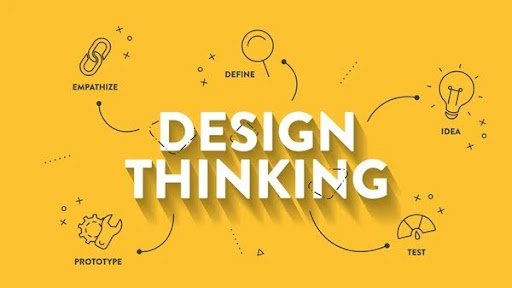
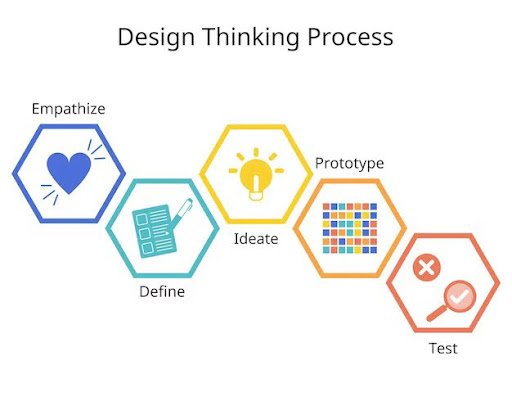
The design thinking process is a method for coming up with innovative solutions to problems while keeping users’ and consumers’ wants and preferences in mind. 

process for design thinking

The design thinking process follows a similar method to the creativity process. In a creative process, first there is preparation, where you prepare, and understand the problem. Then comes incubation, where you imagine and generate various ideas and concepts. Next is illumination, where you refine and develop your ideas further. Finally, you illustrate and verify your creative ideas.  

The design thinking process works in a similar manner. The first step is to empathize with your users. This simply means understanding them on a deeper level. Here, you meet with some of your users and relate to them, you can even carry out various interviews and explore with them to gain a deeper understanding of what the problem is. It is similar to putting yourself in another person’s position to understand situations from their viewpoint. 

The second stage is to define what you have learned from your exploration so far. Here, you ask yourself the “Five Whys” – What the problem is, who it is affecting, where the problem is most felt, why the problem matters, and when it occurs. It is akin to finding patterns in your empathetic journey and providing answers to the questions arising from your exploration. Upon completing this stage, you begin to ideate. It is a flexible and collaborative process that encourages trying new things and learning from your mistakes. With design thinking, you brainstorm numerous ideas, create prototypes to test them, and continually improve until you find the optimal solution.

After the ideation stage comes the prototyping stage. This is similar to the illustration stage in a creative process. Here, you illustrate the solution you arrived at or your desired product. It should be mentioned that design thinking is applicable to a wide range of problems, including those involving the creation of new products, the improvement of existing services, and societal difficulties. In general, it centres on thinking creatively to find workable and approachable solutions.

Finally, the last step is testing and verifying your ideas, products, or solutions to ensure they meet the needs of consumers as envisioned.

Common Misconceptions

Despite its increasing popularity, misconceptions about the design thinking process are common. Let us dispel a few frequent misconceptions:

Misconception 1: Only Designers Can Use Design Thinking.

This misconception is definitely not true. Using the design thinking process does not require you to be a designer. You can use it even as an individual because it is a problem-solving technique that everyone can learn and utilise, regardless of background or job position.

Misconception 2: Design thinking is just about making things look pretty.

This is wrong. The design thinking process goes beyond making things visually appealing. It is about understanding what people need and creating solutions that work well for them.

Misconception 3: Design thinking does not produce results.

This is very wrong. By incorporating this method, major corporations like Apple have been able to remain at the forefront of their industry for so many years now. Other corporations, like Airbnb and IBM, also use it to effectively meet the needs of their consumers.

Misconception 4: Design thinking is only for physical products.

Not only can the design thinking process be applied to physical products, but to many other areas as well. It can enhance procedures, services, and even user experiences, such as accessing an application or website.

Misconception 5: Design thinking is a very complex problem and needs experts.

This is very wrong. It is not necessary to be an expert to apply design thinking process. It is more about collaborating with others, trying new things, and maintaining an open mind.

To put it simply and clear up doubts, the design thinking process is an adaptable and inclusive approach to tackling problems. By letting go of these misconceptions, whether you are creating a new product, enhancing an existing one, or just managing day-to-day problems, the design thinking process is the method to use.

True Statements about the design thinking process

The design thinking process is like a gentle breeze in the world of problem-solving, bringing a sense of openness and collaboration. Join us, as we take a stroll through some true statements about this process:

Design thinking nurtures collaboration

The design thinking process is about unitedly collaborating to find solutions to problems. It invites individuals with diverse backgrounds – be they designers, engineers, or regular people – to collaborate together towards a common objective. The cooperative atmosphere fosters a supportive setting where all contributions are appreciated and honoured.

Design thinking begins with Empathy

Empathy is a must in design thinking. This involves comprehending the emotions and experiences of others and acting on them. By comprehending these experiences, we can gain a valuable understanding of what they require and want. This compassionate method guarantees that our solutions are based on true compassion and comprehension.

Design thinking brings about continuous improvement

The design thinking process continually guides us towards enhanced performance. It supports the idea of progressively making tiny, moderate progress rather than immediately aiming for perfection. We develop prototypes, collect feedback, and make adjustments gradually during the process. This gradual iterative process enables us to develop our ideas smoothly, without hurrying or pressuring ourselves.

In design thinking, failure is met with compassion

In the design thinking process, failure is an opportunity to do better rather than a harsh critic. Failure is understood as a normal aspect of the creative process. Every mistake is approached with a curious mindset and a readiness to absorb new knowledge, leading us towards kinder and stronger solutions.

Design thinking births creativity

The design thinking process is comparable to a gentle whisper of inspiration, guiding us gently towards creative solutions. It inspires us to engage in play, discover, and envision fresh opportunities. By utilising soft approaches such as brainstorming and doodling, we access our natural creativity and generate gentle, original concepts.

To sum up, the design thinking process is an illustrative method for approaching problems while embracing collaboration, empathy, failure, creativity, and growth. By adopting this process, we can create solutions that are conscious and satisfactory to the world.

Key Takeaways

  1. The design thinking process is an all-encompassing problem solving approach.
  2. The design thinking process is a team-oriented method that requires gathering people with different experiences to collaborate on a shared objective.
  3. The design thinking process has five (5) stages, namely; empathy, define, ideate, prototype, and testing.
  4. The process starts by practicing empathy, in which designers aim to comprehend the needs and experiences of the individuals they are creating for.
  5. In the design thinking process, failure is accepted as a normal aspect of the creative process, offering important chances for learning and shaping the creation of stronger solutions.
  6. The design thinking process promotes innovative problem-solving by questioning traditional thought and investigating different viewpoints.
  7. User feedback is essential in steering the incremental development of solutions, making sure they are focused on users and in line with actual needs and preferences.
Site logo

* Copyright © 2024 Insider Inc. All rights reserved.


Registration on or use of this site constitutes acceptance of our


Terms of services and Privacy Policy.