Home Blog Page 2

Disney Sends Google Copyright Warning

Before delving into this dispute, it is worth noting an almost poetic irony: Disney, a 102-year-old entertainment giant, is now accusing 27-year-old Google of using its creations without permission. One of the oldest storytelling companies in the world is challenging one of the youngest, and most powerful tech platforms. That generational gap sets the stage for a dramatic clash between tradition and technology.

The Walt Disney Company has sent a formal cease-and-desist letter to Google, alleging that the tech giant’s artificial intelligence (AI) systems are violating Disney’s copyrights “on a massive scale.” The dispute highlights growing tensions between traditional entertainment powerhouses and Silicon Valley platforms as AI becomes more capable of reproducing copyrighted content. 

What Disney Is Saying

According to the letter, Disney claims that Google has been using protected Disney content without permission to train and develop its AI models and services, and that those systems have begun commercially distributing images and videos that replicate Disney’s characters and creative works.

Disney alleges that Google’s AI tools, including image and video generators and its Gemini assistant, have produced unauthorized representations of beloved characters such as Elsa (“Frozen”), Simba (“The Lion King”), Ariel (“The Little Mermaid”), Deadpool, and characters from “Star Wars,” “Toy Story,” and “Marvel’s Avengers.” Disney says many of these outputs even display Google branding, creating the false impression that Disney’s iconic library is being used with its approval. 

In the letter, Disney’s lawyers, from the law firm Jenner & Block, argue that Google is effectively acting as a “virtual vending machine” that reproduces, renders, and distributes Disney content at scale, using its AI services to profit from works that Disney created and owns. They demand that Google stop using Disney’s material in any AI training or outputs and implement technical safeguards to prevent future infringement. 

Google has neither admitted to nor denied the allegations but expressed a willingness to engage with Disney on the issue. A Google spokesperson emphasised the company’s long relationship with Disney and noted that Google trains its AI on publicly available information from the open web. Google also pointed to copyright control tools such as its Content ID system on YouTube, which allows rights holders to manage how their content is used.

Disney has taken similar action in the past. In recent months, the company has sent cease-and-desist notices to other AI services like Meta and Character.AI and has joined other major studios in litigation against companies like Midjourney and Minimax over alleged copyright violations by generative AI tools.

These moves reflect a broader industry effort to define how AI companies can legally use existing creative works without eroding the value of intellectual property or disrespecting the rights of creators.

A Billion-Dollar Deal With OpenAI Comes at the Same Time

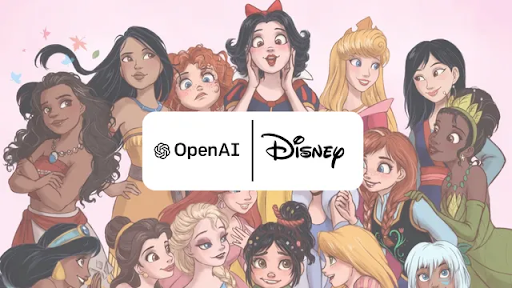
Interestingly, Disney’s legal action against Google coincides with a major strategic pivot toward another AI company. On the same day the cease-and-desist was publicised, Disney inked a $1 billion, three-year deal with OpenAI. Under this partnership, Disney’s library of characters will be licensed for use in OpenAI’s Sora AI video generator, allowing fans to create AI-generated short videos featuring characters from Disney, Marvel, Pixar, and “Star Wars.” 

Disney’s Chief Executive Bob Iger defended this move as part of the company’s effort to modernise its storytelling and find new ways to engage audiences while still defending its intellectual property. At the same time, some critics have raised concerns about how safe it is to expose children to AI platforms that create content based on beloved characters, even with licensing agreements in place. 

This clash raises important questions about how copyright law applies in the age of generative AI. If Google’s AI is found to be trained on copyrighted material without permission, it could set a precedent affecting how all AI developers build and distribute their models. Many media companies are already concerned that large AI platforms could erode creative control and revenue for artists unless far clearer rules and licensing frameworks are established.

Moreover, as AI becomes embedded in everyday tools, voice assistants, search engines, social apps, and video platforms, the line between inspiration and unauthorized use becomes harder to draw. Disney’s legal move signals that major content owners are no longer willing to cede ground without a fight.

At this stage, neither company has indicated whether the dispute will escalate into formal litigation. What is clear, however, is that as generative AI continues to grow, the question of how to balance innovation with copyright protection will remain a major battleground in the technology and entertainment industries.

Disney Allows OpenAI to Generate AI Videos

Anyone who has ever wished they could animate a short scene with Mickey Mouse, make Iron Man deliver a custom message, or create a tiny Star Wars clip from scratch, without infringing copyright, is suddenly a lot closer to that reality. 

In a groundbreaking, industry-shifting partnership, Disney has signed a multi-year deal with OpenAI, giving its advanced video-generation model Sora legal access to produce short AI-generated videos featuring Disney’s most beloved characters.

This is more than a corporate agreement, it marks a historic moment where a century-old storytelling empire opens its creative universe to one of the most powerful AI engines ever built. With this deal, fans, creators, educators, animators, indie filmmakers, and hobbyists may soon be able to generate personalized Disney-themed video clips using simple text prompts. The partnership promises a new era of interactive creativity where professional-quality character animations are no longer limited to massive studios with multimillion-dollar budgets.

A New Frontier for Storytelling

Under the agreement, fans will soon be able to use more than 200 beloved characters from Disney, Pixar, Marvel, and Star Wars to create short, user-prompted videos through OpenAI’s generative video tool, Sora. This includes classics like Mickey and Minnie Mouse, Cinderella, Simba, and Ariel, as well as superheroes and galaxy-far-far-away favourites like Black Panther, Iron Man, Darth Vader, and Yoda.

Rather than merely generating static images, Sora will weave characters into up to 20-second AI-generated clips based on whatever creative prompts users provide. Imagine a tiny scene of Baymax cheering up Buzz Lightyear, or a short story about Moana and Simba crossing paths at sunset.

“It puts imagination and creativity directly into the hands of Disney fans in ways we have never seen before,” said Disney CEO Bob Iger, highlighting how the partnership could expand how audiences engage with stories and characters they love.

Big Money, Big Ambition

This is not just a licensing deal, Disney is also making a $1 billion equity investment in OpenAI, making it one of the company’s key partners and customers. Disney plans to use OpenAI’s technology not only for Sora but also to build new tools, improve Disney+ experiences, and empower internal teams with ChatGPT-powered workflows.

Selected AI-generated fan videos will even be featured on Disney+ starting in 2026, bringing user-made stories into the company’s official content ecosystem.

What Fans Can and Cannot Do

While the licensing agreement opens doors to creative content, it comes with clear limits:

  • Allowed: Fans can generate clips featuring animated or illustrated versions of characters, costumes, props, environments, and iconic elements from Disney and affiliated franchises.
  • Not Allowed: The deal does not include actor likenesses or original voice recordings. That means you will not get videos that sound like the original performers, just the characters as animated visuals.

This distinction matters because Hollywood’s ongoing debates about AI often revolve around protecting performers’ likenesses and creative contributions as AI technologies evolve.

Disney and OpenAI are selling the deal as a model for responsible AI use in entertainment. Both companies say they are committed to safety, respecting creators’ rights, and putting guardrails in place so the technology empowers users without undermining the work of original artists.  OpenAI CEO Sam Altman echoed this, saying the partnership shows how forward-looking tech firms and creative leaders can work together to bring benefits to society while preserving artistic value.

Sora-generated Disney fan videos are expected to roll out in early 2026. The rollout marks one of the first times a major studio has licensed so much of its intellectual property for use in an AI creative tool, a sign of how the entertainment industry is adapting to generative AI’s rapid rise. 

Disney’s move is especially notable because it comes amid other high-profile clashes between studios and AI platforms over copyright use. By crafting a licensed, controlled, and user-centric experience, Disney is positioning itself not just as a defender of its creative works, but also as a pioneer in how those works can be shared and reimagined in the AI era.

AI Milestone: First Model Trained in Space

In what feels like a moment straight out of science fiction, the world has witnessed a historic leap in computing: an artificial intelligence (AI) model has been trained in outer space for the first time. A startup backed by Nvidia successfully ran and trained AI models aboard a satellite orbiting Earth, demonstrating that AI does not need to stay on terra firma to evolve. This milestone could reshape how the generative AI industry thinks about computing power, energy use, and the future of data centers. 

From Earthbound Data Centers to Orbiting AI Labs

Traditionally, training large AI models requires massive data centers on Earth, enormous facilities packed with powerful hardware that demand vast amounts of electricity and cooling resources. These data centers are now facing criticism for their environmental impact and energy consumption as AI models continue to grow in size and complexity. Recognizing this challenge, innovators have begun exploring alternatives beyond our planet.

The company at the forefront of this shift is Starcloud, a Washington-based startup backed by Nvidia. In late 2025, Starcloud launched Starcloud-1, a satellite equipped with one of Nvidia’s most powerful graphics processing units, the H100 GPU, into low Earth orbit. This GPU, roughly 100 times more capable than earlier space-bound chips, was used to both train and run AI models in space. 

Among the AI models processed aboard the satellite were NanoGPT, a compact language model developed by AI expert Andrej Karpathy, trained on the complete works of William Shakespeare, and Gemma, an open large language model from Google that can generate responses like a chatbot. 

Why Training AI in Space Matters

At first glance, training an AI model in orbit might sound like a publicity stunt. But experts and engineers see deeper implications:

  • Energy and Sustainability: Space offers constant access to solar power without the day–night cycle or weather interruptions experienced on Earth. This means future orbital data centers could run AI workloads using near-limitless clean energy. Terrestrial data centers are expensive to cool and require immense energy, sometimes consuming water and producing significant emissions. Leveraging space’s environment could alleviate that burden. 
  • Computing Beyond Earth’s Limits: Training AI in space opens the door to orbiting data centers, giant clusters of computing hardware powered by solar arrays. Starcloud has already proposed plans for a multi-gigawatt orbital data center that could rival or even surpass the capacity of Earth-based facilities.

New Frontiers for AI Infrastructure: The successful demonstration shows that powerful AI workloads are physically possible outside Earth’s atmosphere. It is an early proof of concept that positions space as a potential next frontier for cloud computing and generative AI training. Researchers and technologists are now considering what architectures, cooling systems, and energy storage solutions will be required to sustain such projects long-term.

Challenges Ahead

While this achievement is undeniably groundbreaking, challenges remain. Space is a harsh and unforgiving environment: electronics must withstand radiation, extreme temperatures, and limited possibilities for maintenance. Cooling remains tricky because space lacks air for heat dissipation. Currently, the achievement represents a small-scale demonstration rather than a ready-to-deploy infrastructure. The satellite is about the size of a small refrigerator with a single GPU, very different from a cloud provider’s multi-megawatt data center. 

A New Chapter in the AI Story

Still, the implications are enormous. Training AI models from orbit marks a symbolic and practical milestone in the evolution of generative AI. It expands the imagination of where future AI infrastructure could live, not just in server halls on Earth, but above us in space. As the planet grapples with the environmental and logistical limits of scaling AI on Earth, space-based computing offers a bold alternative. Whether this will become a mainstream strategy or remain a niche research domain will depend on future innovations in space hardware, launch costs, and regulatory frameworks. But for now, one thing is clear: AI’s journey into the final frontier has begun.

Can a Billionaire Save NASA’s Future?

0

National Aeronautics and Space Administration (NASA), the legendary space agency that led humanity to the Moon and aided in uncovering the universe’s secrets, now stands at a crucial juncture. Due to changing priorities, budget issues, and strong competition from private space firms, a critical question emerges: Does NASA require assistance, and if it does, is a billionaire the suitable candidate for that role?

Introducing Jared Isaacman: Billionaire, Aviator, and Space Lover 

Jared Isaacman, a billionaire business leader and private space traveler, has been selected to head NASA. If confirmed, he would be the first NASA administrator lacking government experience but having significant participation in private space initiatives. Isaacman amassed his wealth as the CEO of Shift4 Payments, a company focused on financial technology, yet his enthusiasm for space drove him to finance and lead Inspiration4, the inaugural all-civilian orbital space mission.

In contrast to previous NASA administrators, who usually had backgrounds in government, military, or science, Isaacman is a businessman who adopts a private-sector perspective on space exploration. His strong relationship with SpaceX, having participated in several missions with them, suggests that his leadership might enhance the integration of NASA’s objectives with the aspirations of commercial space leaders.

What’s at Stake for NASA?

NASA is at a crucial juncture. The agency faces increasing pressure to:

  • Maintain its Artemis program, which aims to return astronauts to the Moon.
  • Continue its leadership in climate science and Earth observation.
  • Support deep-space exploration, including the goal of sending humans to Mars.
  • Compete with China’s rapidly growing space program.
  • Balance its partnerships with private companies like SpaceX and Blue Origin.

Although NASA has led the way in space exploration, numerous critics claim that bureaucracy, funding limitations, and outdated regulations have hindered its advancements. Isaacman’s supporters argue that his business expertise and private-sector background could optimize NASA’s functions and bring about more affordable and rapid innovations.

A Boon for Private Spaceflight?

A major question regarding Isaacman’s appointment is its impact on NASA’s ties with private space firms. In the last ten years, NASA has progressively depended on SpaceX, Blue Origin, and various commercial entities to create rockets, transport astronauts to space, and conduct cargo missions to the International Space Station.

Isaacman’s connections to SpaceX, specifically, bring up worries regarding possible conflicts of interest. Will NASA prioritize commercial contracts instead of its internal projects? Will other firms feel neglected?

Moreover, detractors contend that although privatization may enhance efficiency, it must not jeopardize NASA’s autonomy or its enduring scientific endeavors, which may not consistently focus on profit.

Can Isaacman Handle the Politics?

Running NASA is not just about launching rockets, it is also about navigating Washington’s complex political landscape. NASA’s financial support relies on Congress, and previous administrators have had to advocate for budgets, defend costly missions, and manage the interests of various stakeholders.

Isaacman’s absence of government experience might pose a significant obstacle. Although he has guided a prosperous company, overseeing a $25 billion budget and 18,000 employees under governmental oversight presents an entirely different challenge. Persuading legislators to boost financing for NASA’s programs, particularly during a period of political discord, will be challenging.

The Decision: A Danger or a Transformation?

Isaacman’s selection might signify a new age for NASA, in which the distinctions between public and private space exploration become increasingly ambiguous. His guidance might introduce a quicker, more market-oriented strategy to the agency, aiding its competition in the contemporary space race.

However, there are dangers. Should Isaacman favor private enterprises over NASA’s larger scientific objectives, the agency’s autonomy might be in jeopardy. His skills in managing politics, overseeing budgets, and sustaining a balanced perspective for NASA will be challenged.

So, can a billionaire really save NASA?

The answer is not clear yet, but one thing is certain: The space agency is heading into uncharted territory. 

The AI-Bubble Fuss: Why People Are Talking

Agreed, Artificial Intelligence (AI) is the new normal, it is everywhere and because of this explosive growth, investors have poured hundreds of billions of dollars into AI startups, chips, data-center companies, and software platforms.

But alongside all the excitement, there is growing noise about something else:
Are we in an AI bubble?
Are companies overvalued? Are expectations unrealistic? And what happens if the hype cools down?

This article explores why some believe AI is unstoppable and others think a crash is coming.

Why AI Investment Is Booming

Investors are excited for a few big reasons:

1- AI looks like the next major economic revolution

Reports from PwC and McKinsey project that AI could add trillions to the global economy. That is why AI is often compared to the early days of the internet or electricity.

2- Huge demand for AI tools

Every sector including finance, education, healthcare, entertainment, logistics, uses AI in some form. Businesses feel that “if we do not adopt AI, we will be left behind.”

3- The rise of powerful hardware

Companies like Nvidia, AMD, and others power AI models with high-end chips. Because demand is soaring, their stock prices have skyrocketed, convincing investors that AI infrastructure will dominate the future.

4- Productivity promises

AI promises faster coding, better decision-making, automation of boring tasks, and more accurate predictions. Companies see this as a chance to reduce costs and improve performance.

So… a lot of money is flowing into anything labeled “AI.”

But Here is Why People Fear an AI Bubble

Even though AI is powerful, analysts are raising red flags, similar to warnings during the dot-com boom.

1- Some AI companies are wildly overpriced

A few firms are valued at tens or hundreds of billions with very little profit. Prices are based on hope rather than real revenue.

2- Many AI startups have no clear path to making money

Some are building impressive technology, but not a solid business model. They are burning through investor funds without showing long-term sustainability.

3- AI infrastructure is extremely expensive

Running AI systems requires:

  • massive electricity,
  • advanced chips,
  • huge data centers,
  • constant model updates.

If companies cannot monetise their AI tools fast enough, they will run into financial problems.

4- Too many companies doing the same thing

Just like the dot-com era where hundreds of companies built similar websites, now we have:

  • too many AI chatbots,
  • too many copy-and-paste AI tools,
  • too many startups promising the same product.

Competition is fierce, and not all will survive.

5- Regulations and geopolitics could slow AI growth

Chip export restrictions, data privacy laws, and safety standards may limit how fast AI companies can scale.

Put together, these issues make some analysts predict the bubble could burst around 2026, not because AI is not useful, but because the market may have grown faster than reality.

Is It Really a Bubble? Not Everyone Agrees

Tech leaders like IBM and some investment groups say:

“There is no AI bubble, just a temporary overreaction.”

Their reasoning is based on the fact that:

1- AI is already being used in real life

It is not like the crypto hype or the metaverse buzz.
AI is in:

  • hospitals,
  • banks,
  • logistics companies,
  • smartphone apps,
  • cybersecurity tools.

Usage is real and growing.

2- Infrastructure demand is genuine

Cloud providers are struggling to keep up. Data centers are fully booked. Chip manufacturers are at capacity. This means the foundations of AI are solid, not imaginary.

3- Big winners already exist

Companies with profitable divisions: cloud computing, enterprise software, GPUs, could survive corrections easily.

4- A correction does not mean collapse

Even if the bubble bursts:

  • bad companies will fall,
  • strong companies will stay,
  • innovation will continue.

Just like the dot-com bubble, companies such as Amazon and Google came out stronger.

What is the Real Fuss?

AI is not fake. The hype is real, but so are the risks.

We are likely experiencing both:

  • a real technological revolution, AND
  • a short-term investor bubble inflated by hype.

Many AI firms will fail. 

But the ones that survive may shape the future of business, medicine, finance, and everyday life.

Conclusion

The “AI bubble fuss” exists because people are trying to understand something huge:

  • We are in the middle of a technological gold rush.
  • Some companies will become giants.
  • Some will crash spectacularly.
  • And the world will keep adopting AI anyway.

AI is not going away, but the hype around AI might.

Why Billions Are Going Into AI Healthcare

Artificial intelligence (AI) is changing almost every part of our lives but nowhere is the change more dramatic than in healthcare. Yes, every part. Almost every system we use today has an AI layer behind it, from the apps that track our steps to the algorithms that detect diseases. The shift is everywhere if you pay attention.

Over the last two years, investors have poured billions of dollars into AI-driven health and biotech startups. In 2025 alone, these companies attracted record-breaking funding, surpassing previous years by a huge margin.

Why? Because the world’s healthcare system is under stress, and AI is quickly proving it can be part of the solution.

Why Investors Care So Much About AI in Healthcare

1- Healthcare is struggling and AI can help fix it

Hospitals around the world are overwhelmed. Doctors are overworked, staff shortages are increasing, and operational costs are rising. Too much time is spent on tasks like paperwork, billing and filling out forms, things that do not directly involve caring for patients.

AI can automate many of these routine tasks. That frees up time for doctors and nurses, and reduces the crushing administrative load. Investors see this as a major opportunity to modernize a broken system.

2- AI tools are finally good enough to use in real hospitals

For years, AI in healthcare was more futuristic than realistic. Now things have changed. The latest AI systems can:

  • read medical scans
  • predict health problems
  • monitor patients remotely
  • organize hospital workflows
  • reduce medical errors

These tools are not just experimental, hospitals are already using them. Real-world success makes investors confident that their money will lead to real impact, not just research projects.

3- AI is transforming how new medicines are discovered

Creating a new drug usually takes 10–15 years and costs billions. AI can cut this time drastically by:

  • predicting which molecules will work
  • running virtual simulations
  • identifying drug candidates much faster

This is a revolution for biotech companies. Faster drug discovery means faster cures and potentially huge financial returns. So investors are rushing into this space.

4- The world is demanding faster, cheaper, more accessible care

Populations are aging. Chronic diseases like diabetes, cancer and heart conditions are rising. Healthcare costs keep going up. Many countries simply cannot hire enough doctors or build enough hospitals.

AI-powered tools such as telehealth, remote monitoring and smart diagnostic apps, help bring care to more people at a lower cost. Investors know that global demand for these solutions will only grow.

Where the Money Is Going

Investors are focusing on four major areas:

  1. Admin automation: AI handles medical records, billing and documentation. This saves hospitals huge amounts of money and reduces staff burnout.
  2. Drug discovery AI: Startups use AI to find new medicines faster and cheaper. This is one of the hottest investment areas.
  3. Diagnostics and clinical tools: AI reads scans, detects abnormalities and predicts diseases earlier than humans in some cases.
  4. Telehealth & digital care platforms: AI powers apps that monitor patients, give reminders, or help people manage conditions like diabetes or heart problems.

These solutions are already widely used, and that is why investors believe the industry will grow even faster.

What This Means for Patients and Healthcare Systems

If AI keeps improving, patients can expect:

  • earlier diagnosis (which saves lives)
  • cheaper treatments
  • more personalised care
  • shorter waiting times
  • better access, even in rural areas

For healthcare systems, AI means fewer administrative bottlenecks and more efficient operations.

Challenges

Even with the billions flowing in, experts warn that AI is not a magic fix. Problems include:

  • hospitals struggling to integrate new tech
  • lack of regulation for safe AI use
  • data privacy concerns
  • tools working well in the lab but failing in real-world hospitals

Investors understand these risks, but they also see the long-term potential.

The Future: AI as a Core Part of Healthcare

The next decade will likely bring:

  • AI-powered hospitals
  • smarter and faster drug development
  • AI tools assisting doctors in everyday decisions
  • more home-based and remote care
  • stronger regulations to ensure safety and trust

Investors are not just chasing quick profits. They are betting that AI will permanently reshape how the world manages health.

OpenAI vs Google: Responsible AI Lead

AI is everywhere now, in search, chatbots, writing tools, and even medical research. As two of the biggest players in the field, OpenAI and Google are often compared not just on who builds the most capable models, but on who builds them responsibly. Responsible AI means designing systems that are safe, fair, private, and well-governed, and that is what this piece explores, with evidence from official policies and independent analysis.

What “responsible AI” means 

Responsible AI covers several things: clear rules about what AI should and should not do; processes to test and reduce harms; transparency about capabilities and limits; protections for users’ privacy and data; and governance to make sure decisions are reviewed and accountable. It is both technical (how models are built and tested) and organisational (what governance structures exist and how decisions are made).

How Google stacks up: formal frameworks and internal controls

Google has published a set of AI Principles and built an extensive set of internal controls and frameworks to put those principles into practice. The company’s annual Responsible AI Progress Report describes formal review processes (pre- and post-launch reviews), a Secure AI Framework, and a Frontier Safety Framework to manage higher-risk systems, in other words, a layered, institutional approach to safety and risk assessment. Google’s DeepMind research arm also publishes work on threat modelling and privacy-preserving techniques. Taken together, these show a mature, systematised governance approach embedded across product teams and research units.

That structure has strengths: it makes risk-management a routine part of product development, connects safety work to legal/compliance teams, and supports integration of mitigations across widely used products (Search, Workspace, Android). But critics note that a formal framework is only as good as its enforcement and that integrating safety culture across massive product lines is organisationally hard. Independent reporting and controversy tracking suggest that big, integrated companies can sometimes struggle to move quickly on enforcement when commercial pressures are high. 

How OpenAI stacks up: safety focus, governance experiments, and public engagement

OpenAI foregrounds safety and alignment in public materials and runs a visible safety organisation that publishes model-specs, red-teaming outputs, and governance commitments. The organisation promotes a cycle of “teach, test, share” for safety work and has made governance and external engagement a core part of its public identity, including commitments to shape AI governance beyond the company itself. OpenAI also runs internal safety evaluations and staged rollouts (alpha/beta/GA) to monitor behavior before broad release.

OpenAI’s strengths are its public-facing stance on safety and alignment research and its influence on policy debates. However, the company has also faced criticism for rapid commercialisation and occasional model harms that leaked into public debate; governance commentators note the tension between speed of deployment and thorough safety assurance. In practice, OpenAI’s governance is relatively centralised and externally visible, which helps in shaping norms, but does not eliminate the tradeoffs inherent in releasing powerful models. 

Comparing the two (five key dimensions)

Formal governance & internal controls – Advantage: Google.

Google has detailed, documented frameworks and company-wide processes for risk assessment and post-launch monitoring that are explicitly tied to product review cycles. That scale and institutionalisation matter for consistent enforcement across many products. 

Safety research & alignment work – Tie/who leads depends on the metric.

OpenAI invests heavily in alignment research and red-teaming for its models and publishes model specifications; DeepMind and Google Research similarly publish safety research and threat modelling. Both contribute valuable science; OpenAI tends to be more visible in alignment debates, while Google connects safety research more directly to deployed products.

Transparency & external engagement – Advantage: OpenAI (narrowly).

OpenAI often publishes safety notes, model specs, and engages in policy dialogues publicly. Google publishes annual responsibility reports and internal frameworks, but critics sometimes find Google’s public materials more high-level. Both, though, have improved transparency in recent years. 

Operationalisation across products – Advantage: Google.

Because Google’s AI sits inside search, Android, Workspace and more, its frameworks are designed to scale across many product teams, a strength for standardising safeguards but also a challenge in consistent enforcement.

Track record with harms and controversies – No clean winner.

Both organisations have had public controversies: model outputs, safety incidents, data-use questions, or concerns about commercialization vs safety. Independent analyses argue that neither company has a perfect record; both have learned (and been criticized) publicly. Monitoring controversies remains essential to judging leadership in responsible AI. 

Plain conclusion: who leads?

There is no simple answer. Google leads in institutional depth, extensive frameworks, product integration and formal processes make it strong at operationalising safety at scale. OpenAI leads in public engagement and alignment visibility, its model-specs, red-teaming disclosures, and active role in policy debates have shaped norms in the field. Both have strengths and both have visible weaknesses. Ultimately, responsible AI leadership looks less like a race with a single winner and more like a shared task: success requires companies to pair technical safeguards with independent oversight, stronger transparency, and regulatory clarity.

Heat Challenges for Data Centers and AI

The boom in artificial intelligence (AI) and cloud computing has triggered an explosion in data-centre construction around the world. But beneath the dazzling headlines and growth forecasts lies a quietly serious problem: heat. As powerful AI servers crunch massive datasets around the clock, they generate enormous amounts of waste heat. Managing that heat safely and efficiently has become one of the most urgent challenges for the industry. 

Why Heat Has Become a Major Problem

Modern AI hardware draws huge amounts of electricity. That power is converted into computing, but also into heat, much more than traditional servers produced a few years ago. Data centers are densely packed with racks of machines that must remain powered 24/7, and traditional air-cooling simply cannot keep up. 

The stakes are high. If server chips get too hot, they can malfunction or shut down entirely. That is not only disruptive, it can bring down critical services. In late November 2025, a cooling failure at a facility operated by CyrusOne caused a major outage for CME Group, pausing trading across important global financial markets. 

On top of that, keeping data centers cool is extremely energy-intensive: cooling systems alone often account for around 40% of a facility’s total energy use. As AI demand grows, this contributes to rising electricity bills, greater environmental impact, and increased pressure on energy and water resources.

How the Industry Is Responding

To tackle the heat challenge, data-centre operators are turning to new cooling strategies and rethinking how facilities are built:

  • Liquid cooling instead of air cooling: Liquid coolants can absorb and remove heat far more efficiently than air. Some systems are up to 3,000 times better at transferring heat, making them much more effective for high-density AI hardware. 
  • Water-efficient and closed-loop systems: Recognizing water scarcity concerns, companies like Microsoft have begun developing data-centre designs that recirculate coolant water in a closed loop, reducing or even eliminating the need for fresh water.
  • Waste-heat reuse: Some forward-thinking operators capture the heat generated by servers and redirect it to heat nearby buildings or provide district heating, turning a problem into an opportunity.
  • Smarter energy and cooling controls: New hardware and software, including AI-based cooling management, allow data centers to dynamically adjust cooling based on real-time loads and reduce energy waste. 

Some players are even betting that cooling innovation could become a major business area: in 2025, several large acquisitions in the cooling industry signalled that thermal management is now seen as a core infrastructure need. 

The Bigger Picture: Sustainability, Water and Climate

The heat problem is not just technical, it is ecological and social. As data-centre scales rapidly, their energy and water footprints grow. Cooling alone can use vast quantities of water and electricity. 

Experts warn that if data-centre expansion proceeds without sustainable cooling and resource strategies, global energy demand and water stress may rise sharply. But waste-heat reuse and closed-loop cooling offer a better path forward, one where data centers not only minimize damage, but contribute positively to local energy and heating systems. 

Why It Matters Now

For everyone, from individual users to global businesses, reliable, high-performing data centers power everything from video streaming to cloud services to cutting-edge AI. But as demand surges, the invisible challenge of heat threatens to become a bottleneck, risking downtime, higher costs, and environmental harm.

The data-centre industry’s ability to scale sustainably will depend less on raw computing power and more on how well it manages heat, energy, and resources. In that sense, cooling has become just as critical as the brains behind the servers.

If the industry succeeds, it could build data centers that are powerful, efficient, climate-friendly, even helping to heat homes using waste heat. If it fails, overheating risks, rising energy costs, and resource strain could slow the AI revolution before it reaches full maturity.

The Hottest AI Hardware Devices for 2025

When people talk about Artificial Intelligence (AI), they usually think of apps, chatbots, or maybe cool software like image or video generators. But behind every advanced AI model, there is hardware doing hard math fast. Modern AI requires huge amounts of computation, often in real time (e.g., for autonomous drones, smart cameras, robots, or on-device intelligence). Relying solely on remote “cloud” servers can cause trouble: slow response times, privacy concerns, and dependence on internet connectivity. This is where edge AI hardware: specialized chips and devices built to run AI models directly “on-device” becomes a game-changer. 

In 2025, AI hardware is not just for big data centers anymore: it is powering robots, smart cameras, IoT devices, drones, autonomous machines, and even home gadgets. Efficient, powerful, and sometimes tiny, these are the brains behind the “smarter world.”

Here are some of the most advanced, widely used, or trend-setting AI hardware platforms in 2025. 

NVIDIA Jetson AGX Orin

NVIDIA Jetson hardware lineup on black background: Jetson AGX Orin module (top left), followed by rows of smaller Jetson Orin NX and Nano modules, arranged by performance tier.
  • NVIDIA Jetson AGX Orin is a high-performance “edge AI computer” with a compact hardware module that brings server-class AI power to robots, drones, machines, and embedded systems.
  • Up to ~275 TOPS (trillions of operations per second) for AI tasks, a 12-core Arm CPU + a 2048-core Ampere GPU with 64 Tensor Cores, and up to 64 GB memory. 
  • It delivers massive compute power in a compact form, ideal for demanding edge-AI use cases: autonomous robots, computer vision (e.g. recognizing objects or people), drones, industrial automation, and more. Because it can do deep neural network inference right on-device, it removes dependence on cloud servers (speed + privacy + reliability). 
  • In short, Jetson AGX Orin brings “supercomputer power” into devices outside the data center, a core enabler of real-world, real-time AI.

Google Coral Dev Board 

Compact green AI edge computing board with large aluminum heatsink and cooling fan, multiple ports including HDMI, USB, Ethernet, and GPIO pins.
  • A small, energy-efficient “edge AI” board built around Google’s Edge TPU, a chip optimized for running AI inference (e.g. vision, detection) on-device. 
  • Performance: ~4 TOPS of integer-based AI performance at ~2 Watts power draw, very efficient compared to bulky GPUs. 
  • Used for smart security cameras, IoT devices, embedded AI sensors, small robotics, vision-based systems, and portable gadgets that need AI but must stay power-efficient.
  • Coral Dev Board makes AI accessible even for small projects and devices. Think “smart home devices with vision,” “offline AI cameras,” or “edge sensors.” It is a great example of how AI is not only for powerful servers anymore.

Qualcomm Robotics RB5 Platform 

Qualcomm Robotics RB5 platform with text 'The world’s first 5G and AI-enabled robotics platform' – a sleek silver robotics development kit with multiple cameras, sensors, and mounting brackets.
  • A unified platform combining CPU, GPU, AI Engine, and optional 5G connectivity, designed for robotics, drones, autonomous devices, and smart machines.
  • AI performance: ~15 TOPS for on-device AI inference, while supporting multi-camera input (useful for vision, sensing, obstacle detection) and real-time processing. 
  • It stands out because it merges high compute + connectivity + multimodal sensing, the RB5 platform is ideal for next-gen robots, delivery drones, autonomous machines, or devices that need to see, think, and move, without needing constant cloud connection.

Axelera AI Metis AIPU – Ultra-High Throughput AI Inference Chip

Axelera AI logo on black background: a bold yellow stylized 'AX' symbol next to the text 'AXELERA ARTIFICIAL INTELLIGENCE' in metallic gray
Close-up of an Axelera Metis AI processor chip mounted on a circuit board, showing the chip markings, green substrate, and surrounding electronic components
  • This is a specialized AI accelerator designed for edge servers or on-device systems, delivering extremely high inference performance.
  • Performance specs: Up to ~214 TOPS (INT8) with high energy efficiency (~15 TOPS per watt). Some configurations (multi-core / multi-chip) can scale even higher. 
  • Use cases: Real-time video analytics, multi-camera vision systems, surveillance, smart city infrastructure, sensor-dense industrial environments, or edge servers that must process heavy AI workloads locally instead of sending data to the cloud.
  • As more devices and institutions demand on-site AI processing (privacy, latency, bandwidth savings), chips like Metis make it possible to deploy “server-class AI” without needing a full data-centre, bringing powerful AI to a wide range of industries.

Hailo-8 / Hailo-series AI Accelerators 

Three Hailo M.2 AI accelerator modules side-by-side on white background, labeled M.2 Key M (2242/2260/2280), M.2 Key B+M (2242/2260/2280), and M.2 Key A+E (2230).
  • Hailo-8 is a family of edge-AI optimized chips designed for power-efficient AI inference, running computer vision, recognition, audio, or basic AI tasks on small or embedded devices. 
  • Not all AI hardware has to be ultra-powerful. Many applications, like smart security cameras, home devices, IoT sensors, need modest AI performance but must run efficiently, sometimes on battery or limited power. Hailo chips fill that niche.
  • Typical uses: Smart surveillance cameras, retail analytics sensors, smart appliances, embedded vision systems, low-cost robotics, and other devices where cost, power, and size matter more than raw GPU-level computing.
  • Hailo chips represent the democratization of AI hardware, making “smart” affordable and accessible.

Other Noteworthy Platforms & Chips 

In addition to those above, 2025 sees a broad set of high-performance AI hardware emerging, from massive data-center GPUs to specialized chips for servers. Some examples:

  • High-end GPUs and AI-training chips (for cloud data centers) that handle large-scale AI model training and massive data workloads. 
  • SoCs and chips combining CPU, GPU, and NPU (Neural Processing Unit), enabling on-device AI for laptops, tablets, and desktop devices. 

But the big shift in 2025 and what many regard as the most transformative, is edge AI hardware: devices that bring intelligent compute directly to machines, sensors, and gadgets around us.

Why 2025 Is a “Turning Point” for AI Hardware

Several trends coming together make 2025 a landmark year:

  • Demand for real-time AI applications: From drones avoiding obstacles, robots navigating warehouses, to smart cameras detecting events, real-time, low-latency processing matters. Edge AI hardware enables that by avoiding delays and bandwidth issues tied to cloud connections. 
  • Privacy & Data Sensitivity: Devices processing sensitive data (video, audio, personal info) benefit from local inference. Data does not need to leave the device, better privacy and compliance.
  • Power, portability, and cost: Not all AI tasks need data-center levels of compute. For smart devices, low-power, efficient chips like Hailo, Coral, or embedded NPUs make AI feasible and affordable. 

Wide adoption across industries: Robotics, security, smart city infrastructure, retail, IoT, drones, autonomous machines, many sectors now need AI hardware. That drives rapid development and innovation in hardware.

What This Means for You

  • If you are a startup or small business building smart devices (smart cameras, IoT gadgets, robotics, etc.), edge AI chips mean you do not need costly cloud servers. You can integrate AI locally, saving cost and improving performance.
  • If you care about privacy or offline performance e.g. in security, healthcare devices, personal gadgets, hardware like Hailo, Coral, or Jetson enables AI without sending data to the cloud.
  • For creators, developers, or hobbyists, affordable edge-AI platforms make AI experiments, prototypes, or small-scale products doable, and not just for big companies.
  • For large industries or enterprises, AI hardware means automation, analytics, computer vision, and robotics without latency or bandwidth concerns, useful in manufacturing, logistics, smart cities, retail, agriculture, and more.

Top 10 Rising AI Startups to Watch in 2025

The AI surge shows no signs of deceleration; in 2025, investors are injecting billions into companies that aim to transform our work, life, and creativity. Below is a curated list of 10 AI startups that stand out this year for innovation, funding, and potential. Some are already well-known; others are quickly gaining recognition behind the scenes

OpenAI

Screenshot of the OpenAI website homepage in dark mode, showing the navigation menu with links for Research, API, ChatGPT, Safety, and Company.

OpenAI is probably the most recognizable AI startup in the world. In 2025, OpenAI remains at the forefront of large-scale AI model research and deployment, influencing everything from chatbots and content generation to enterprise AI tools. The company is pushing the boundaries of what AI models can do, from generating human-like text to powering advanced tools that other companies and developers use. Because of its reach and innovation, it continues shaping the global AI landscape.

Anthropic

Screenshot of the Anthropic website homepage featuring the headline 'AI research and products that put safety at the frontier' with an illustration of a hand reaching toward a neural network.

A leading “next-generation” AI lab and startup. In 2025, Anthropic secured a massive funding round, putting it among the top-valued AI companies globally. It is developing advanced AI models with a strong emphasis on safety, ethics, and reliability. As AI becomes more integrated into business and society, Anthropic represents the push toward smarter and safer AI.

Snorkel AI

Screenshot of the Snorkel AI homepage with a light blue background. Headline reads 'The AI Data Research Lab.

SnorkelAI is another one of the fastest-growing AI startups in the data space. In mid-2025, Snorkel raised a major funding round and earned a $1.3 billion valuation. Many AI systems need massive amounts of labeled data to learn. Snorkel AI simplifies and automates that process, letting companies generate labeled data programmatically instead of manually. This reduces costs dramatically and speeds up AI development. Because clean, labeled data is the foundation of effective AI, Snorkel helps companies build AI systems faster and cheaper. Think of it as the “data prep engine” behind many future AI tools.

TensorWave

Screenshot of the TensorWave homepage with a dark cosmic background featuring glowing data streams.

Infrastructure matters. Like roads allow cars to move, AI infrastructure allows models to run. TensorWave is building next-gen cloud/compute services, and its May 2025 funding round shows investors believe in its mission. The startup is providing GPU-powered (graphics processor) infrastructure for AI, a more efficient, potentially lower-cost alternative to traditional systems. This makes AI training and deployment accessible for smaller companies and startups too. 

Glean

Screenshot of the Glean website homepage on a gradient purple background. Main headline: 'Work AI that works for' followed by 'Give every employee an AI Assistant and Agents that put your company’s knowledge to work.

As AI adoption grows in enterprises, there is a need for AI tools that help teams find and use information quickly. Glean raised a $150 million Series F round in 2025, with a valuation around $7.25 billion. Glean is building AI-driven enterprise search, helping organizations locate documents, data, or knowledge quickly across large corporations. It helps reduce wasted time and improves internal collaboration. In big companies, information often lives in silos. Tools like Glean break down those barriers, making teams more productive and less reliant on manual searches or redundant work.

Lila Sciences

Minimalist dark homepage for LILA featuring an abstract glowing orange-brown toroidal (ring-shaped) spiral pattern against black.

In 2025, Lila Sciences, an AI-driven science & deep-tech startup, got major backing from big investors, including Nvidia. It is making waves for tackling science and research using AI.  Rather than just building “language models,” Lila is combining AI with automated labs to do real-world scientific experiments, faster and at scale. This could help accelerate breakthroughs in sectors like energy, materials science, and biotech. If successful, Lila could transform how new technologies, medicines, or materials are discovered, shifting from decades-long research to AI-accelerated innovation cycles.

Together AI

Together AI homepage with a dark cosmic background and glowing blue circular design. Large white headline reads 'Build on the AI Native Cloud' followed by 'Engineered for AI natives, powered by cutting-edge research.

AI research & infrastructure remains critical and Together AI is one of the standout infrastructure providers in 2025. It recently raised a big funding round and holds a multi-billion-dollar valuation. 

Together AI is developing open-source generative AI tools and model-development infrastructure, making it easier for developers, businesses, or researchers to build and deploy their own AI models, without relying on just big players. It democratizes AI, enabling smaller companies or teams to build powerful AI solutions without needing huge resources.

Runway

Runway website homepage featuring a large grayscale portrait of a thoughtful woman in a pinstripe suit resting her chin on her hand.

AI is not just for data scientists, it is transforming media, art, design, and content production too. Runway is leading that charge. In 2025 it secured a major funding round valuing the company at $3 billion. The company is providing AI-driven tools for creative work, video editing, media generation, visuals, maybe even design and marketing. It helps creators and companies turn ideas into high-quality media faster and cheaper. As content becomes king, AI creative tools like Runway could reshape media production, lowering barriers and scaling output in ways previously impossible.

Harvey

Abridge homepage with headline 'INTELLIGENCE AT THE POINT OF CONVERSATION' and description about enterprise-grade AI for clinical conversations.

AI is not only for tech and data, it is entering traditional industries too. Harvey, an AI legal-tech startup, raised a huge funding round in 2025, showing how investors believe in AI’s role in law. 

Harvey is building AI tools for the legal industry, likely helping automate contract review, legal research, document drafting, and other traditionally time-consuming tasks. This matters because Law and legal services have long been resistant to automation. If AI can speed up or simplify legal work reliably, it could revolutionize access, reduce costs, and increase efficiency in the legal sector.

Abridge

Abridge homepage with headline 'INTELLIGENCE AT THE POINT OF CONVERSATION' and description about enterprise-grade AI for clinical conversations.

In 2025, Abridge secured a major funding round and hit a multi-billion dollar valuation, showing that AI for healthcare and professional workflows is a big growth area. Abridge builds AI tools for health and communication, for instance, transcribing patient-clinician conversations and turning them into useful, searchable summaries.

Healthcare generates huge amounts of data and conversation, AI tools like Abridge could help doctors, nurses, and healthcare systems improve record keeping, reduce admin burden, and ultimately offer better care.

What This Trend Means: For Business, Tech & Everyday People

  • AI has evolved beyond merely chatbots. Startups in infrastructure, science, healthcare, law, media, and enterprise tools are demonstrating AI’s adaptability.
  • The entry barrier is easing up. Thanks to companies like Together AI and Snorkel lowering expenses and simplifying processes, smaller businesses or developers can create robust AI tools without requiring large budgets.
  • Work will evolve, not disappear. Numerous startups aim to assist professionals (lawyers, doctors, researchers, creators) in working more efficiently rather than replacing them. The automation of mundane tasks might liberate people for more skilled activities.
  • Innovation will speed up. Through AI research labs (such as Lila Sciences) and firms focused on infrastructure, innovations could arrive more quickly and expand earlier than in the past.

Conclusion

2025 has emerged as a pivotal year for AI, one in which robust, functional, and varied AI applications integrate into daily business, creativity, science, and healthcare. Regardless of your professional standing; a student, entrepreneur, business executive, or simply inquisitive, monitoring these prominent emerging AI startups can provide you with an understanding of the future direction of technology.

Site logo

* Copyright © 2024 Insider Inc. All rights reserved.


Registration on or use of this site constitutes acceptance of our


Terms of services and Privacy Policy.