Home Blog Page 11

Will AI Replace Human CEOs? Experts Weigh In

The AI Revolution Has Reached the Corner Office, but Can Machines Truly Lead?

Artificial Intelligence (AI) has gone beyond just reshaping support roles or automating spreadsheets, it is entering the boardroom. As AI becomes smarter, faster, and more integrated into corporate decision-making, a provocative question has emerged: Could AI eventually replace the CEO?

While AI has been and continues to be instrumental in industry transformation, many experts agree that while it can augment executive functions, it is unlikely to replace human leadership, at least not entirely. Let us take a deep dive into what is really happening at the top levels of business, and why the future CEO may look very different.

What CEOs Actually Do And Where AI Fits In

CEOs are responsible for far more than just signing documents or making budget calls. Their role typically includes:

  • Strategic direction
  • People management and culture-building
  • Crisis response and ethical decision-making
  • Investor relations and media presence

AI, on the other hand, is excellent at processing large volumes of data, predictive modeling, and optimizing operations. This raises the question: If AI can outperform humans in data-driven decisions, what is stopping it from stepping into the CEO’s shoes?

According to a 2025 analysis by the Cambridge Judge Business School, AI can already outperform humans in market simulations and resource allocation games. However, the report concluded that AI falters in uncertainty, emotional nuance, and long-term human-centered decision-making.

CEOs Are Worried But Not Necessarily About Being Replaced

A recent Harris Poll commissioned by Dataiku found that 74% of CEOs fear losing their jobs, not because AI will replace them directly, but because they may fail to keep up with AI innovation.

The message is clear: AI fluency has become a survival skill for CEOs. Those who fail to adopt AI tools or understand their implications may be seen as outdated or ineffective.

Dan Priest, PwC’s Chief AI Officer, told Business Insider that “40% of CEOs believe their business models will be obsolete within a decade without strong AI strategies.” He emphasized that while AI can automate insights and decision-making, human leadership is still crucial for managing complexity, people, and purpose.

The Rise of the AI-Enhanced CEO

Rather than replacement, experts predict a hybrid future where AI becomes a “co-pilot” to the human CEO.

“AI will not take the CEO job but a CEO who knows how to use AI might,”
says Julian Hayes II, AI strategist and Forbes contributor.

Here is how this model might look:

  • AI handles: forecasting, trend analysis, performance reporting, compliance monitoring
  • Humans handle: culture, hiring, ethics, storytelling, public trust

This kind of augmented leadership is already visible in companies like IBM, Microsoft, and Unilever, where C-suite leaders regularly use AI dashboards to simulate strategy outcomes before making real-world decisions.

Can a Machine Inspire People?

One of the most overlooked aspects of the CEO role is emotional leadership. CEOs shape culture, inspire teams, and navigate social complexity areas where current AI models still struggle.

A 2024 DDI Global Leadership Forecast stated that:

  • Only 28% of companies believe AI can make ethical decisions without human input
  • Less than 15% think AI could build trust with employees or investors

Trust, empathy, and moral judgment are not programmable—at least not yet. This aligns with insights from Stanford’s 2023 AI Ethics Review, which warns of “narrow rationality bias” in AI models, causing them to miss context and nuance in morally grey situations.

Who Will Be Replaced First?

While CEOs may remain relatively secure, middle-management and junior analyst roles are at higher risk. AI systems like ChatGPT Enterprise, Microsoft Copilot, and Salesforce Einstein GPT are already performing tasks such as:

  • Generating reports
  • Writing emails and proposals
  • Analyzing financial models
  • Recommending hiring decisions

According to MarketWatch, several Wall Street firms are exploring how AI could replace entire analyst teams though they emphasize that client-facing roles and leadership are still “human only” zones.

The Future CEO: A New Kind of Leader

Looking ahead, the CEO of 2030 may:

  • Have a background in data science or AI policy
  • Co-lead with Chief AI Officers and digital strategists
  • Prioritize ethical AI governance and corporate transparency
  • Measure success by adaptability and stakeholder value, not just profit margins

We need a leadership model that blends the precision of AI with the wisdom of human experience.

Final Thoughts

AI will continue to reshape business leadership but it is not here to steal the CEO’s job. Instead, it is redefining what it means to lead in a world driven by algorithms, automation, and rapid change.

The CEOs who thrive in the future will not be the ones who fear AI, but those who learn to lead alongside it.
Trump Threatens Elon Musk With Deportation: Immigration Status, Legal Reality & Political Feud Explained

0

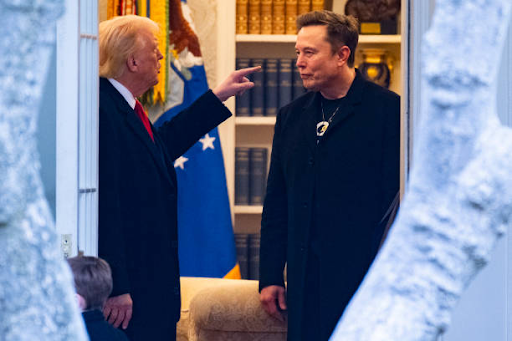
In a political climate where fact and fury often blur, Donald Trump has done it again and this time, he is setting his sights on Elon Musk, the billionaire tech titan who reshaped the internet, space exploration, and electric cars. The former president, never one to shy away from spectacle, hinted he might “look at” deporting Musk —a claim as shocking as it is legally dubious.

What happens when the world’s most powerful man takes aim at the world’s richest man?

The result is a combustible mix of political vendetta, legal fantasy, and personal ego, playing out at the intersection of power, tech, and immigration law.

But is this just Trump being Trump or the situation is caused by a much deeper war between Silicon Valley royalty and MAGA politics?

Let us unpack the story behind the sitch.

The Latest Statement: Trump on Musk

In a recent interview, Trump was asked about Elon Musk’s loyalty to the United States and whether he might consider revoking Musk’s immigration status.

“A lot of people are saying he came in illegally,” Trump said, adding: “I do not know, but if that is the case, we will certainly take a look at it.”

While Trump did not explicitly confirm any official action, his phrasing, especially the notion that Musk might have entered the country “illegally” has added fuel to speculation that political revenge could drive immigration-related scrutiny.

Background: The Trump-Musk Feud

This latest jab is not the first time Donald Trump and Elon Musk have clashed. In 2022, after acquiring Twitter (now X), Musk reinstated Trump’s previously banned account, framing the decision as a free speech issue. He conducted a Twitter poll where 52% of respondents voted to unban Trump, and Musk tweeted: “The people have spoken. Trump will be reinstated.”

This did not mean they were settled, despite this move, Musk still publicly criticized Trump shortly thereafter. Trump responded in typical fashion at a political rally, mocking Musk as “another bullshit artist” and claiming Musk had previously begged him for government subsidies and White House access. Musk also tweeted that it was time for Trump to “hang up his hat and sail into the sunset,” adding that the former president was too divisive to serve another term.

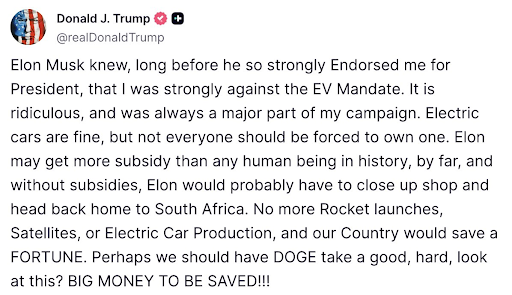
So yes, in summary, their relationship has long been a rollercoaster of mutual opportunism, policy overlap, and personal tension. But the current narrative stemmed from Trump’s recent Truth Social post where he criticized Musk for the financial aid his companies have garnered, especially concerning electric vehicles. The president mentioned that without them, “Elon might likely have to shut down and return to South Africa.”

Screenshot of Donald Trump criticizing the EV mandate and Elon Musk's government subsidies in a social media post on X (formerly Twitter)

His comments have sparked new discussions in the car and EV industries, with many now wondering what future rules might look like.

Trump also took a shot at Tesla CEO Elon Musk. Once seen as having a good relationship, the two now seem to be at odds. Trump accused Musk of depending too much on government money and claimed that without it, Musk would have to shut down Tesla and move back to South Africa.

Trump ended his post by saying: “There will be NO EV MANDATE in the USA,” and added that Americans should be free to choose what kind of vehicles they want to drive; whether electric, gas, diesel, or hybrid.

Is Elon Musk Deportable? The Legal Reality

Immigration Status

Elon Musk was born in South Africa and later obtained Canadian citizenship through his mother. He moved to the U.S. to study at the University of Pennsylvania, entering legally on a student visa. He later obtained an H-1B visa and eventually U.S. citizenship in 2002.

That makes Musk a naturalized U.S. citizen and not an immigrant on a visa, and not deportable under normal circumstances.

Can a Naturalized Citizen Be Deported?

Yes but under very narrow legal grounds, such as:

  • Fraud during the naturalization process (e.g., hiding a criminal record)
  • Membership in certain organizations, like terrorist groups, at the time of naturalization

To date, no credible evidence has ever surfaced suggesting Musk’s naturalization involved fraud or misrepresentation.

Why Is Trump Targeting Musk Now?

Political analysts believe Trump’s attack is both strategic and personal.

Revenge Politics

Trump is known to retaliate against former allies who criticize or distance themselves from him. Musk, who has become a dominant cultural and tech figure, has repeatedly jabbed Trump for his erratic behavior, especially around January 6.

Some speculate that Trump’s statement is designed to intimidate critics and show strength to his base.

Distraction from Legal Woes

Trump is currently:

  • Awaiting sentencing in New York following his 34-count felony conviction in a hush-money case.
  • Fighting three other indictments—including federal charges over the 2020 election and classified documents.
  • Trying to maintain control over the narrative ahead of the 2024 Republican National Convention in July. 

Attacking Musk could shift public attention and energize his supporters.

Business and Political Fallout

For Elon Musk

Musk has not officially responded as of June 30, but earlier this month he mocked Trump on X, suggesting the president was “increasingly unhinged.”

If Trump were to pursue any legal action against Musk in office, it would almost certainly be viewed as an abuse of power and likely challenged in court.

Musk continues to lead several companies heavily reliant on government contracts, including:

  • SpaceX (NASA and Pentagon contracts)
  • Tesla (energy and vehicle subsidies)
  • Neuralink, xAI, and The Boring Company

Any government retaliation could create legal and investor complications.

For the Republican Party

Trump’s tough talk might fire up his loyal supporters, but it could also turn off some Republicans who see it as picking an unnecessary fight with one of America’s most successful business leaders.

In Summary: What Happens Next?

AspectReality Check
Deportation ThreatLegally implausible
Trump’s MotiveLikely personal + political
Impact on MuskMinimal for now, but could escalate
Broader SignificanceRaises concerns about rule of law, use of executive power

With Trump poised to be the GOP nominee and Musk continuing to wield influence over AI, social media, and the space industry, their feud could have ripple effects well beyond headlines.

As of now, there is no formal move to investigate or deport Elon Musk. But in the era of Trump-style politics, the blurring of law and personal vendettas remains a serious concern for critics and constitutional scholars alike.

Binance Launches Global Initiative to Combat Web3 Crime and Strengthen Blockchain Security

0

In response to the rapid rise in crypto-related crimes, Binance, the world’s largest cryptocurrency exchange, has launched a global law enforcement training program to help police and government agencies understand and stop digital crimes in the Web3 world.

The program, often called the “Crypto Cops” initiative by the media, is focused on giving investigators and officers the tools they need to deal with a new type of criminal, one that uses cryptocurrency, Artificial Intelligence (AI), and blockchain to commit fraud, launder money, and steal millions online.

What Is Web3 Crime?

Web3 refers to the next generation of the internet, powered by blockchain technology. It includes:

  • Cryptocurrencies like Bitcoin and Ethereum
  • Decentralized finance (DeFi)
  • NFT marketplaces
  • Crypto wallets and exchanges

While Web3 opens new opportunities, it also creates space for new crimes, such as:

  • Crypto scams (fake investments, phishing)
  • Ransomware attacks
  • “Pig butchering” romance scams
  • Money laundering through anonymous crypto wallets
  • AI deepfakes used to impersonate trusted people

In 2024 alone, crypto-related crimes were estimated to have cost users more than $3 billion, according to multiple security reports.

What Binance Is Doing About It

Binance is not just sitting back. Through its investigations team, the company is working closely with governments, police departments, and financial crime units across the world.

Now, it has launched a formal global training program, offering free, hands-on education to law enforcement about how blockchain works and how criminals try to hide behind it.

The Training Covers:

  • How blockchain and crypto transactions work
  • How to trace stolen or suspicious crypto funds
  • How criminals use multiple wallets (“cross-chain activity”) to confuse investigators
  • Real case studies showing how crypto scams unfold
  • Forensic tools that can help catch cybercriminals

The training is delivered by Binance’s Cybersecurity and Intelligence team, made up of former law enforcement officers, digital forensics experts, and blockchain analysts.

Where It is Already Happening

Binance has already hosted sessions in several countries:

  • South Korea: Over 600 investigators trained, including police and prosecutors.
  • Thailand: Hosted Asia-Pacific Law Enforcement Day, involving officers from seven countries.
  • Moldova: Partnered with the EU’s CEPOL to teach modern cyber-investigation skills.

These sessions are helping to bridge the gap between traditional policing and modern cybercrime.

Why This Matters

Crypto crimes are harder to track than traditional bank thefts. Money can be moved across the world in seconds, often without names or borders.

But with the right training, law enforcement can:

  • Understand crypto activity
  • Use advanced tools to trace wallets
  • Freeze or recover stolen funds
  • Work across countries to catch global scammers

Binance says that the goal is not to control law enforcement, but to support them with education, tools, and cooperation.

The Challenges

  • Many police officers still do not understand crypto well.
  • Cybercriminals are getting smarter and faster, sometimes using AI-generated voices, deepfakes, or synthetic IDs.
  • Laws in many countries are still catching up to this fast-moving technology.

That is why Binance is pushing hard to help governments catch up before criminals get too far ahead.

What is Next?

Binance plans to expand the program globally with:

  • More in-person and online workshops for police and financial investigators
  • Toolkits and software demos for crypto forensics
  • Joint investigations with governments where necessary
  • Support for faster regulation and public awareness

They are also inviting other crypto companies to join forces so that the entire Web3 industry becomes more secure and trusted.

Conclusion

The internet is changing, and so are the ways criminals operate. Binance’s Crypto Cops initiative is a step in the right direction; giving the police and prosecutors of today the training they need to fight the cybercrime of tomorrow.

In the end, the message is clear: You can use crypto for good but you can no longer use it to hide.

AI-Powered Fertility Treatment Helps Couple Conceive After 18 Years

A man who had been told he was infertile for 18 years is now expecting a baby with his wife — all thanks to a groundbreaking artificial intelligence (AI) tool developed by fertility experts at Columbia University, USA.

The couple, who had endured 15 failed rounds of IVF over nearly two decades, had almost given up. But a new AI-powered system called STAR (Sperm Tracking and Recovery) changed everything and may now be offering new hope to thousands of couples struggling with male infertility.

What Was the Problem?

The man suffered from a condition called azoospermia. This means his semen appeared to contain no sperm at all, making natural conception and even IVF nearly impossible.

Normally, when sperm are this rare, lab technicians manually search a semen sample under a microscope for hours — even days — to try and find a single usable sperm. But in this case, even after 48 hours, human eyes found nothing.

How Did AI Make a Difference?

Researchers used a new AI tool called STAR, which is like a super-advanced microscope combined with smart software. Here is how it works:

  • The sperm sample is placed on a tiny chip.
  • A high-speed camera captures millions of tiny images of the sample.
  • The AI scans all of it in under an hour, looking for live sperm that may have been missed by humans.

In this case, the AI found 44 healthy, moving sperm that had been completely invisible during previous tests.

Just one or two healthy sperm is enough for a procedure called ICSI (Intracytoplasmic Sperm Injection), where a single sperm is injected directly into an egg.

Shortly after, the couple was thrilled to learn that the IVF treatment was finally successful — and the wife is now pregnant.

Why This Is a Big Deal

This is the first known pregnancy in the world using sperm found and selected entirely through artificial intelligence.

Here is why experts are calling it a breakthrough:

  • Faster and more accurate: What used to take days now takes less than an hour.
  • Less invasive: The man did not need painful surgery to extract sperm from his testicles.
  • New hope for many: Men who were once told they had “no chance” of fathering a child may now have real options.

Dr. Zev Williams, the fertility doctor who led the team, said:

“We were amazed. The same sample that looked empty to the human eye had live sperm. That is life-changing.”

What Do Other Experts Say?

While many doctors are excited, some urge caution. They say the results are promising, but the technology needs more testing across other clinics and patients.

Dr. Robert Brannigan, a well-known reproductive specialist in Chicago, said:

“This is a fantastic tool, not to replace lab experts, but to help them work better and faster.”

There are also discussions around ethics and access how widely this will be available, and how much it will cost. Still, most agree this could be a major step forward in fertility care.

What Could This Mean for the Future?

  • AI tools like STAR may soon be used to help millions of couples dealing with unexplained male infertility.
  • It could reduce the physical and emotional strain of failed IVF cycles.

In the future, similar AI systems could even help analyze egg quality, embryos, or hormone levels—making fertility treatment smarter and more successful overall.

The Human Side of the Story

For the couple, this was not just a scientific win, it was the end of nearly two decades of heartbreak and hope.

After 18 years of being told “no,” their journey has finally turned into a “yes.”

They are expecting their first child, all because of a technology that saw what humans could not.

Final Thoughts

This story is a powerful reminder of what happens when technology meets compassion. AI did not just improve lab work, it helped create life.

As the STAR system expands to more clinics around the world, it may offer new beginnings to many couples who thought they were out of options.

And for the medical world, it is a glimpse into the future of personalized, tech-enhanced fertility care.

WhatsApp Launches AI-Powered Message Summaries in 2025: Here’s What Users Should Know

Meta-owned WhatsApp has begun rolling out a new feature designed to make catching up on chats much easier: AI-generated message summaries. Known as “Private Message Summaries,” the feature uses artificial intelligence (AI) to generate short overviews of unread messages, helping users stay up to date without scrolling through long threads, especially in busy group chats.

The feature is currently available to a limited number of users in the United States, with broader international rollout expected later this year (2025). According to Meta’s announcement, the summaries are optional, private, and powered by Meta AI, a proprietary large language model (LLM).

What Are Private Message Summaries?

This innovative tool creates succinct bullet points that summarize the content of unread messages. Rather than going through numerous (or even countless) texts, users can click a banner at the top of the chat to receive an immediate summary, emphasizing the main points, mentioned names, and overall context.

Imagine you missed about 1400 messages in a family group or community conversation. Instead of going through each message, WhatsApp’s AI will condense the conversation into a brief summary, like:

  • “Mom disclosed information regarding the event on Saturday.”
  • “Ada proposed changing the schedule.”
  • Three individuals reached an agreement. “One refused.”

What About Privacy?

WhatsApp has emphasized that the summaries are powered by Private AI Processing. This means:

  • The content is summarized directly on your device.
  • Neither WhatsApp nor Meta can read your messages or see the summaries.
  • End-to-end encryption remains intact.

In short, Meta claims the AI helps you catch up faster, without compromising your chat’s privacy.

Who Can Use It?

  • The feature is currently limited to U.S.-based users using English.
  • It is initially being evaluated in both individual and group conversations.
  • Users need to have the most recent version of WhatsApp to utilize it and will notice a “Try AI Summary” notification on eligible chats.

A broader launch is anticipated by late 2025, with additional language and country support planned.

Why This Matters for Busy Users

Modern users are often overwhelmed by notifications, especially in large WhatsApp groups for family, church, school, or work. Missed messages can pile up quickly, making it hard to know what is important and what is not.

This feature solves that problem by:

  • Saving time
  • Reducing chat fatigue
  • Helping users focus on what matters most

Making WhatsApp more functional for professionals and remote workers

Early Reactions: Excitement, with a Dose of Caution

Many users frequently feel overwhelmed by alerts, particularly in extensive WhatsApp groups for family, church, school, or work. Overlooked messages can accumulate rapidly, making it difficult to discern what matters and what does not.

This functionality addresses that issue by:

  • Conserving time
  • Alleviating conversation exhaustion
  • Assisting users in prioritizing what is most important.
  • Enhancing WhatsApp to better serve professionals and remote employees

What to Expect Next

This is just the beginning. Meta has hinted that AI in WhatsApp may soon assist with:

  • Smart replies and auto-drafting messages
  • Real-time language translation
  • Summarizing voice notes
  • AI-generated images inside chats

These features are part of Meta’s broader push to integrate AI across all its platforms, including Facebook, Instagram, and Messenger.

Conclusion

The launch of AI-driven message summaries represents a major advancement in enhancing WhatsApp’s intelligence, efficiency, and user-friendliness. Although worries about privacy and precision persist, the tool’s optional aspect and its efficiency advantages render it a potentially strong enhancement.

For individuals frequently managing various group chats, work notifications, and social interactions, this feature may be truly transformative, providing clarity, efficiency, and ease right at your fingertips. 

Storms and Heatwaves Hit Southern Europe as Jeff Bezos Hosts Star-Studded Wedding in Venice

This week, Southern Europe is experiencing extreme heat and sudden storms. Countries like Italy, Spain, Portugal, and Greece have seen temperatures climb above 40°C (104°F), while France has been hit by severe thunderstorms and flash floods.

Amid this extreme weather, Venice is in the spotlight as Jeff Bezos, the billionaire founder of Amazon, hosts his lavish wedding to Lauren Sánchez on a private island just outside the city.

What is Happening?

  • Several major Italian cities, including Venice, Rome, and Florence, are under red alert due to dangerous heat.
  • People are being advised to stay indoors during peak hours, and hospitals are on high alert for heatstroke cases.

In northern France, intense thunderstorms have damaged homes, flooded streets, and disrupted transport.

Why Venice? And Why the Backlash?

Bezos’ wedding has drawn huge attention, not just because of the celebrity guest list and luxury, but also because of the timing and location.

Here is why some people are upset:

  • Private jets and mega yachts: Around 90 private aircrafts and several superyachts are reportedly being used for the wedding. Activists say this creates a massive carbon footprint, which is irresponsible during a climate crisis.
  • Environmental hypocrisy: The event is happening during one of Europe’s worst heatwaves, and Venice itself is at high risk due to rising sea levels. Critics say hosting a flashy, high-emission event in such a fragile city shows a lack of awareness or care for the environment.
  • Blocked public spaces: Locals say parts of Venice have been closed off for security and logistics, making life harder for residents and tourists. It feels like the city is being taken over for a private party.
  • Wealth inequality and overtourism: Venice is already struggling with too many visitors, high rent, and climate damage. For many, a €40 million wedding is a tone-deaf display of wealth in a city that cannot handle much more stress.

These concerns led to protests with the slogan “No Space for Bezos”, where locals and climate activists called for better protection of public spaces and stronger action on climate change.

How This Affects People

  • Residents and Tourists
    • Many feel pushed aside or locked out of parts of their city due to the wedding.
    • The intense heat is also putting public safety at risk, especially in crowded areas.
  • Emergency Services
    • Hospitals are seeing heat-related illnesses rise.
    • In France, storm damage has overwhelmed first responders.
  • Local Businesses
    • While some businesses may benefit from high-profile guests, others say regular tourism has been disrupted.

Rising resentment may hurt Venice’s already fragile image as a livable city.

End Note

Jeff Bezos’ wedding is more than just a celebrity event. It has become a symbol of a bigger issue; how cities like Venice are being overwhelmed by tourism, environmental stress, and growing inequality. As Europe faces more extreme weather, many believe it is time to rethink how cities balance private wealth, public needs, and environmental responsibility.

The wedding might only last a weekend, but the impact and the debate could last much longer. What happens in Venice could set a precedent for how cities respond to luxury tourism in a warming world.

What’s Going On Between the US and Iran in 2025: Conflict, Diplomacy, and Oil Market Risks

Tensions between the United States and Iran have reached a boiling point again, and people around the world are watching closely. In late June 2025, things got very serious when the US bombed Iranian nuclear sites and Iran hit back.

Read along to understand what happened, why it matters, and what could come next.

What Happened?

On the night of June 22, 2025, the United States launched surprise airstrikes on three key nuclear sites in Iran. These sites; one in Natanz, another in Fordow, and lastly Isfahan, are where Iran has been working on parts of its nuclear program.

President Donald Trump claimed the attacks were necessary to stop Iran from getting closer to building a nuclear weapon. He said the targets were “completely destroyed.”

Shortly after the strikes, Iran fired 14 missiles at a major US military base in Qatar. Thankfully, most of them were shot down, and there were no American casualties. Iran also targeted Israel, who joined the U.S. in the initial assault, setting off alarms and causing panic in cities like Tel Aviv, though most attacks were intercepted.

In a televised message to the nation, the Israel prime minister stated, “we reduced Iran’s nuclear program to nothing” and that Israel would conduct additional strikes if Tehran attempted to develop nuclear weapons.

“If someone in Iran tries to restore that programme, we will act with the same determination, the same power, to cut off any such attempt,” said Netanyahu.

“I repeat — Iran will not have a nuclear weapon.”

Is There a Ceasefire?

Yes, sort of. The US has announced a “total ceasefire,” saying it will not strike again for now. But Iran has not fully agreed to this. They say they were not involved in any talks and do not see it as a proper agreement.

Behind the scenes, countries like Qatar have tried to calm things down by helping both sides talk, even if quietly.

Why Does This Matter?

This is not just a fight between two countries, it has global effects:

  • Nuclear risks: Attacking nuclear sites might delay Iran’s nuclear plans, but experts warn it could also make Iran more determined to get nuclear weapons.
  • Oil prices: When tensions rose, oil prices went up. The Middle East is a major oil supplier, and any disruption can affect global fuel prices.
  • World peace: If the conflict spreads, it could pull in other countries and create a much larger war.
  • Cyberattacks: Iran has a history of launching digital attacks. Experts say we should be prepared for cyber warfare, not just rockets.

What Could Happen Next?

Here is what many experts are watching closely:

  1. Will the ceasefire hold?

It is uncertain. The US says things are calm for now, but Iran seems angry and may strike again later, especially through indirect means like proxy groups or hacking.

  1. Could Iran block oil routes?

Yes. Iran might threaten the Strait of Hormuz, a narrow sea route through which about 20% of the world’s oil passes. If blocked, it could cause global shortages and price spikes.

  1. What is the US plan?

Vice President JD Vance said the US does not plan to send troops into Iran. But if Iran hits back again, the US might respond with more airstrikes or cyberattacks.

  1. Could this turn into a bigger war?

This is the major concern. For now, both sides seem to be testing limits without wanting full-blown war. But one wrong move could change that.

Final Thoughts

This situation is serious but it is not a full-scale war (yet). The US hit Iran’s nuclear facilities. Iran hit back with missiles. Now both sides are tense, and the world is watching to see what happens next.

For people, the most noticeable impact might be fuel prices, international travel delays, or internet disruptions if cyberattacks occur. For leaders and diplomats, the focus is on avoiding a wider war, and somehow finding a way to bring both sides back to the table.

7 Million Streaming Accounts Hacked in 2024: Gen Z Nigerians Urged to Take Cybersecurity Seriously

0

In 2024, over 7 million user accounts from some of the world’s most popular streaming platforms including Netflix, Disney+, Amazon Prime Video, HBO Max, and Apple TV+ were compromised in a global wave of cyberattacks. The breaches did not happen because of flaws in the platforms themselves but were the result of user-targeted attacks, primarily through phishing scams and malicious downloads.

In the aftermath of these incidents, cybersecurity experts have raised red flags about Gen Z Nigerians, who are now one of the most digitally active but cyber-vulnerable populations in Africa.

The Anatomy of the Attack: How 7 Million Streaming Accounts Got Compromised

Cybercriminals did not need to break into Netflix’s servers to steal your login. Instead, they went for the softest target: you, the user. Here is how:

  • Phishing Emails: Fake emails claiming your subscription was expiring or that there was a “problem with your payment” lured users to click on malicious links. Once clicked, users unknowingly gave away their login credentials.
  • Fake Streaming Apps & Websites: Users searching for “free streaming” or cheaper access were tricked into downloading malware-ridden apps or visiting cloned websites.
  • Credential Stuffing: Hackers used login details stolen from other data breaches to log in to streaming accounts, exploiting people who reuse the same passwords across multiple services.

Spyware & Trojans: Malware like RiskTool was hidden in pirated software or browser extensions. It ran silently in the background, collecting user data and streaming credentials without detection.

Why Gen Z Nigerians Are at Risk

Gen Z, usually characterized as individuals born from 1996 to 2012, represents Nigeria’s most technologically adept generation. They are the most vulnerable:

  • Intensive Streaming Activity: Gen Z’s literally do everything in excess especially when it comes to entertainment like music, films, anime, and K-dramas. Services such as Netflix and YouTube are intricately integrated into the entertainment routines of Gen Z.
  • Digital Reliance: Gen Z lives on the internet. Whether it is online learning or remote work, dating apps or gaming, you will find them there.
  • Cyber Awareness Deficit: While Gen Z are digitally skilled, numerous Gen Z individuals do not have formal education or understanding of cybersecurity threats. Rapid clicking, utilizing pirated applications, and disregarding software updates are frequent practices.

Along with the increase of unofficial streaming services, altered applications, shared login information, and reliance on public Wi-Fi—Gen Z emerges as a key target for cybercriminals.

Nigeria: A Data Breach Hotspot

According to Surfshark’s 2025 cyber report:

  • Nigeria ranked among the top 10 African nations for total number of data breaches in 2024.
  • Over 23 million Nigerians have been affected by data leaks since 2004.
  • In early 2025 alone, over 119,000 Nigerian user accounts were compromised across various platforms.

While there was an 85% drop in data breaches globally in early 2025, the number remains dangerously high, especially in resource-constrained environments where digital literacy is uneven and cybersecurity infrastructure is lacking.

Why This Is Bigger Than Entertainment

At first glance, losing access to your Netflix or Spotify account may seem like a minor inconvenience. But this issue runs much deeper:

  • Financial Risk: Many compromised accounts are tied to credit cards or banking details. Hackers can make purchases or sell your credentials on the dark web.
  • Identity Theft: A breached email or account may open the door to more serious invasions; like impersonating you online or accessing sensitive personal documents.
  • Emotional and Social Harm: Losing access to personal accounts or being impersonated online can lead to embarrassment, social tension, or reputational damage.

In Nigeria, where digital infrastructure is growing faster than digital safeguards, such breaches may set back trust in digital platforms and hurt confidence in e-commerce, online learning, and tech innovation.

What Should Gen Z Nigerians Do? Practical Steps to Protect Yourself

  1. Stop Reusing Passwords: Use different passwords for different apps and platforms. Use a password manager if needed.
  2. Enable 2FA (Two-Factor Authentication): This adds an extra layer of security that makes it harder for hackers to get in.
  3. Avoid Pirated Apps: Do not download modified APKs or unofficial versions of streaming apps. They often contain hidden malware.
  4. Verify Emails and Links: If Netflix or Disney+ sends an email, check the sender’s address. Do not click links in suspicious messages.
  5. Use Antivirus and Anti-malware Software: Keep your device protected, especially if you download a lot of content or use public Wi-Fi.

Log Out of Shared Devices: If you use a friend’s phone or a cybercafé, always log out completely when done.

The Bigger Picture: Building a Culture of Cyber Awareness

This breach is not just about Netflix, it is a warning sign. As Nigeria becomes more digitally connected, digital safety must be taught, practiced, and prioritized.

Parents, schools, and government agencies need to work together to:

  • Integrate cybersecurity into school curricula.
  • Launch awareness campaigns on social media platforms popular with youth (TikTok, Instagram, X).

Support affordable cyber insurance and tech tools for young Nigerians.

Conclusion

Streaming accounts being hacked may seem like a personal inconvenience, but it represents a systemic vulnerability. Gen Z Nigerians are creative, entrepreneurial, and deeply connected, however, they must take cybersecurity seriously.

Entertainment cannot come at the cost of identity, safety, or financial loss. It is time to treat digital protection not as an option, but as a necessity.

If you are a Gen Z Nigerian reading this: Change your password today. And spread the word.

SpaceX’s Starship Explodes During Ground Test in Texas: What Happened?

0

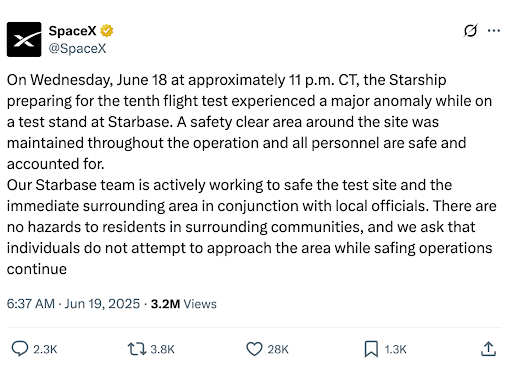
Tremors shook the ground, a bright flash lit up the sky, and a thunderous boom followed; that was the experience for many Texas residents on Wednesday night, June 18, around 11 p.m. The cause? A SpaceX Starship rocket exploded during a routine ground test at Starbase, the company’s launch site near Boca Chica. What was meant to be a standard safety check quickly turned into a fiery spectacle visible for miles.

What Happened?

The explosion occurred during what is called a static fire test: a standard procedure where engines are ignited briefly while the rocket remains on the ground. This test is required to observe how the rocket’s engines perform under launch conditions, without actually lifting off.

According to SpaceX, the test was being conducted on “Ship 36”, one of the newest Starship prototypes, when the vehicle experienced a “major anomaly” that resulted in a sudden and violent explosion.

Witnesses described a loud explosion, succeeded by a massive orange fireball illuminating the night sky. Several residents in the vicinity reported that they felt their houses tremble from the impact of the explosion. There were no injuries reported, due to safety zones established to maintain a safe distance for staff during these tests

Why It Exploded

While SpaceX has not released a full report, the detection suggests that the failure may have occurred due to excessive pressure or a malfunction during the fueling process. Such failures are not uncommon in experimental rocketry, especially with an aircraft as complex as Starship.

The prototype was being prepared for its tenth planned flight test, part of a rapid development cycle that SpaceX has embraced to fine-tune the design.

Why Starship Is So Important

Starship is not just any rocket. It is a fully reusable spacecraft that stands over 120 meters tall, making it the largest rocket ever built. It is designed to:

  • Carry astronauts to the Moon under NASA’s Artemis program.
  • Transport humans to Mars, possibly within the next decade.
  • Deploy Starlink satellites in bulk.
  • Replace the Falcon 9 as SpaceX’s main launcher for future missions.

Each prototype launch, test, and static fire brings SpaceX one step closer to achieving these goals.

What This Means for the Program

This explosion is the fourth major incident involving a Starship test this year alone:

  • In January, a test flight ended in loss of vehicle control.
  • In March, Starship suffered engine failures during ascent.
  • In May, another prototype lost communication mid-flight.

The latest explosion could delay the next scheduled launch, but it is unlikely to slow SpaceX down for long. Elon Musk and his team have a “fail fast, learn faster” approach, accepting failures as part of the rapid innovation process.

Despite the setback, SpaceX already has a next prototype—Ship 37—nearly ready, and testing is expected to resume in the coming weeks.

The Bigger Picture

SpaceX has Federal Aviation Administration (FAA) authorization for as many as 25 launches and 50 landings each year at Starbase, showing trust in the initiative even with periodic explosions. Every test offers engineers crucial information, aiding in the improvement of hardware and resolving software problems prior to human occupancy.

Musk has been open regarding the risky path to Starship’s development. In an earlier declaration, he mentioned:

“If you’re not blowing things up, you’re not trying hard enough.”

In that spirit, the explosion, while dramatic, is seen internally as a stepping stone, not a failure.

Final Takeaway

SpaceX’s Starship explosion in Texas is a reminder of just how complex space travel remains. No one was injured, and the company remains undeterred in its mission. The road to Mars, and even back to the Moon is paved with trial, error, and fireballs. But with each test, SpaceX gets closer to redefining the future of spaceflight.

Next steps: The company will assess the cause of the explosion, roll out Ship 37, and prepare for the next test. If all goes well, expect another launch attempt before summer ends.

Smart Home Dangers You Need to Know in 2025

Why your “smart” devices might not be as safe as they seem

Smart homes are becoming more popular every year. From voice assistants like Alexa and Google, to smart lights, security cameras, and even fridges that talk to you, technology is making life easier and more comfortable.

But while smart homes are cool and convenient, they can also come with serious risks. Some of these problems are hiding in plain sight and they can affect your privacy, safety, and personal data.

Your Smart Devices Can Be Hacked

Many smart devices connect to the internet all the time. That means hackers can break in, just like they would break into a computer or phone.

There have been real cases where people:

  • Got their baby monitors hacked, and strangers started talking through them
  • Had their smart door locks opened remotely by cybercriminals
  • Had their cameras watched by people they did not know

These things happen when devices are not well protected or when people forget to change default passwords.

Your Devices Are Always Watching (Sort Of)

Most smart devices are made to listen or respond to your voice. But many are always listening in the background for words like “Hey Alexa” or “OK Google.”

Even though they do not record everything you say, they can pick up parts of conversations and this data often gets sent to companies for processing. That means:

  • Advertisers might use it to sell you products
  • Companies may store it without your full knowledge

In some cases, your data can be shared with the government or third parties

AI Devices Learn About You

Some smart home tools use artificial intelligence (AI). They learn your habits like what time you come home, what music you play, or when you usually go to bed.

While that can be helpful, it also means these devices know:

  • Your daily routine
  • When you are home or not
  • What you buy, listen to, or search for

If someone gets access to that information without your permission, it can lead to privacy problems or even dangerous situations.

Are Your Devices Really Safe?

The truth is, many smart home gadgets are made cheaply. They do not always come with strong security. Unlike your phone or laptop, your smart camera or doorbell may not protect your personal info very well.

Also, many people forget to:

  • Change the passwords
  • Update the devices
  • Use safe internet connections

This makes it easier for hackers to sneak in through your “digital door.”

How to Stay Safe in a Smart Home

You do not have to stop using smart devices but it is smart to be careful. Here are simple tips to protect yourself:

  1. Change the default password on every device.
  2. Update your devices regularly to fix security issues.
  3. Secure your Wi-Fi with a strong password.
  4. Check your privacy settings and turn off features you don’t use.
  5. Use a guest Wi-Fi network just for your smart gadgets.
  6. Think twice before buying a smart version of every appliance; you may not need it.

Smart homes can make your life easier, more fun, and even safer. But they also come with hidden problems, especially when it comes to privacy and security.

The best way to enjoy a smart home is to use your devices wisely, stay alert, and take small steps to protect your information.

In the end, being “smart” is not just about your home, it is more about how you use the technology inside it.

Site logo

* Copyright © 2024 Insider Inc. All rights reserved.


Registration on or use of this site constitutes acceptance of our


Terms of services and Privacy Policy.