Home Blog Page 35

Artificial Intelligence Radiology

Radiology stands as a cornerstone in contemporary healthcare, furnishing indispensable insights into patient conditions by deciphering an array of medical images, including X-rays, CT scans, MRIs, and ultrasounds. Due to the intricate nature of radiological processes, experts in the field have embraced Artificial Intelligence (AI) within their systems, hoping to achieve ease, efficiency and increased productivity. Nevertheless, a pertinent question looms: can substantial medical decisions be reliably delegated to machines? This article endeavors to unravel the answer to this inquiry.

Adoption of AI in Radiology
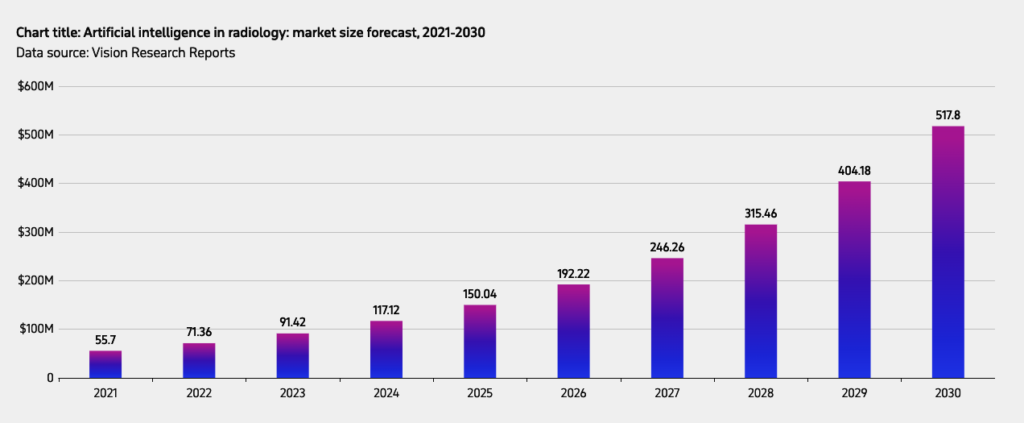
In a recent study highlighted by itransition, there is a shortage of radiologists globally, with AI showing promise in addressing this gap and improving accuracy in diagnosing conditions like hip fractures. AI’s potential to enhance healthcare through its accuracy and efficiency is evident amidst the growing demand for radiology services.

Moreover, as depicted in the chart above, AI adoption in the radiology sector is projected to steadily rise until 2030, indicating its significant impact in the field.

Applications of AI in Radiology

Artificial Intelligence (AI) teaches computers to think and learn like humans do. In radiology, AI algorithms are like smart detectives that look at medical images and find any unusual things that might show a disease. They are trained to spot even tiny changes in images, helping doctors catch problems early and make more accurate diagnoses. AI achieves this through the use of Computer-Aided Diagnosis (CAD) tools. You can think of CAD systems as helpful assistants to doctors. They point out the critical areas in medical images that need attention. This helps doctors focus on the most critical cases, reduces mistakes, and makes diagnoses more accurate.

AI is also useful in some extreme cases in radiology like classifying brain tumors, detecting Alzheimer’s disease, and spotting vertebral structures, amidst many others. These cases require utmost seriousness, sensitivity, and accuracy in the diagnostics and treatments, which AI facilitates through advanced deep learning and machine learning algorithms.

In radiology, AI can also help with paperwork! It can read medical images and notes to create reports automatically. This saves time for doctors and makes sure that reports are always clear and correct.

Another application of AI in radiology is predictive maintenance. AI is renowned for its ability to sift through tonnes of historical and present day data to predict occurrences. It is capable of doing that in radiology as well. It is like looking at a big puzzle in the form of medical information to see trends and get insights on what will most likely happen. This helps doctors plan ahead and give patients the best care possible.

Benefits of AI in Radiology

There are several advantages that AI offers, as evidenced by its applications in radiology.

  1. AI helps doctors find health problems more accurately in X-rays and scans.
  2. Machines are generally more efficient than humans. Hence, with AI, doctors can finish their work in a timely manner.
  3. AI can spot diseases early, which means doctors can treat them sooner.
  4. With AI, doctors can get their reports faster, so patients can start treatment sooner.
  5. AI helps doctors give each patient the right treatment for them.
  6. AI helps doctors make fewer mistakes when looking at X-rays and scans.
  7. Using AI can save money for hospitals and patients because it makes processes faster and more efficient.
  8. AI itself is like a trove of knowledge. A platform that is able to assimilate billions of data fragments cannot be underestimated. Hence, doctors can consult AI for advice on certain processes. It is more like having a genius friend to help at all times.
  9. AI helps make sure that doctors everywhere follow the same rules.
  10. AI keeps getting better and learning new things, so it can help doctors even more in the future.

Challenges and Limitations

In discussing the challenges and limitations of AI in Radiology, it is essential to recognize that while AI brings significant benefits, it also faces hurdles that need addressing. Moreover, no system is flawless, they all undergo continuous refinement in pursuit of perfection.

One major challenge is ensuring that AI algorithms are accurate and reliable. While AI can help detect abnormalities in medical images, it is crucial to verify its findings with human expertise. AI is not infallible; there are instances where it may misinterpret images or overlook subtle indicators of disease, potentially resulting in misdiagnosis. Therefore, it is important not to overly depend on AI alone.

Another concern is the lack of diversity in the data used to train AI algorithms. If the data used to train AI systems predominantly represent one demographic group, it may lead to biases in the algorithms’ performance. For instance, AI trained on images from a specific population may not perform as well when applied to images from a different demographic.

Privacy and security are also significant considerations in the use of AI in radiology. Medical images contain sensitive patient information, and in the event that appropriate security measures aren’t implemented,  there is a risk of data breaches or unauthorized access.

Ultimately, integrating ethical practices when using AI is of paramount importance as it can help mitigate challenges and address ethical concerns effectively.

What does the future hold?

Advances in AI are expected to revolutionize diagnostic capacities, and the field of radiology stands to benefit greatly from this. One is the improvement in productivity and efficiency in radiology by streamlining operations. Accurate diagnosis will also be improved by a more seamless collaboration between radiologists and AI. 

As AI becomes more widespread in Radiology, ethical issues and legal frameworks will change to meet its needs. Due to AI’s capacity to evaluate large amounts of imaging data, patient outcomes will be further enhanced by early disease diagnosis. Ultimately, global patient care will be enhanced and healthcare delivery will be transformed overall by AI in Radiology.

Key Takeaways

  • AI is revolutionizing Radiology by enhancing the interpretation of medical images.
  • AI algorithms analyse images, detect abnormalities, and assist radiologists in making accurate diagnoses.
  • CAD systems act as helpful assistants to radiologists, highlighting critical areas of concern.
  • AI facilitates automated reporting, saving time and ensuring consistency in radiology reports.
  • Predictive analytics powered by AI enable proactive patient care and early disease detection.
  • Despite the benefits, challenges exist, such as ensuring the accuracy and reliability of AI algorithms.
  • Ethical considerations are crucial when integrating AI into radiology practices.
  • AI adoption in radiology is expected to increase significantly, driving improvements in healthcare.
  • AI is particularly useful in complex cases like brain tumor classification and Alzheimer’s disease detection.


Artificial Intelligence Books

Picking a quote from the  library of Rachel Anders – “The journey of a lifetime starts with the turning of a page.” This is a profound truth. Each of us, with our unique existence and experiences, is akin to an unfinished story, waiting to unfold and be written. In the same way we have books on all topics and niches, there are also books on Artificial Intelligence (AI). As the world continues to grasp the revolutionary potential of AI across various spheres, understanding its foundational underpinnings and applications has become essential. What other way than through books is the best way to do that?

Welcome to your AI reading guide, where we will explore the complex field of AI and offer you a selection of recommended readings as well as supplementary materials to help you through the deluge of available AI literature. 

Importance of AI literacy

Nowadays, it is rare to encounter someone unfamiliar with the term AI. However, being aware of AI and understanding its workings are distinct concepts, emphasizing the need to learn about AI. AI knowledge enables people to calmly and competently traverse the intricate realm of AI platforms. With this knowledge, people are better able to assess AI-driven information and make well-informed judgements about the technology they use. 

Understanding how AI functions also helps people think critically and ethically, which enables them to solve AI system-related problems and even real world problems. 

Additionally, individuals who possess knowledge of AI have an advantage over those who lack it in the job landscape. Ultimately, fostering a more diverse and equal society and guaranteeing that everyone can take an active role in the AI-powered future depend on AI literacy.

List of AI Books

There is a trove of knowledge in the AI domain that is silently waiting to be unveiled. Various academics and experts alike have conveyed their knowledge and understanding of this revolutionary concept into written forms, providing an opportunity for brilliant and curious minds to comprehend the intricacies of AI. Are you a beginner yearning to learn more about AI? Or an experienced individual looking to expand your horizons? This page is for you. Keep scrolling and dive into your preferred book.

Introductory Guides

  1. “Artificial Intelligence: A Guide for Thinking Humans” by Melanie Mitchell

Read Here-https://www.goodreads.com/en/book/show/43565360 

Summary

An extensive introduction to AI is given in this book. The book explores the history of AI, encompassing its emergence, perception, and adoption, as well as the benefits and challenges it brings. With relatable examples that anybody can comprehend, the author highlights how crucial it is for people navigating the field of AI to be aware of both the potential benefits and drawbacks of the technology. 

  1. “Artificial Intelligence For Dummies (2nd Edition)” by Luca Massaron and John Mueller

Read Here- https://www.dummies.com/article/technology/information-technology/ai/general-ai/ai-dummies-cheat-sheet-253190/ 

Summary

This book is literally the ABC of AI. In a simple and clear format, the book provides an exhaustive guide to the AI landscape.

  1. “Life 3.0: Being Human in the Age of Artificial Intelligence” by Max Tegmark

Read Here-https://www.goodreads.com/en/book/show/34272565 

Summary

“Life 3.0” is an insightful read that delves into the myriad concerns confronting humanity in the era of AI. The issue of job displacement perceived by people due to AI brilliance has been a topic of major controversy. The book also shed light on the  adverse effect posed by AI. This book touches on all these aspects and more. With the help of this book, you get to arm yourself with the knowledge and information you need to keep up in this modern era.

Technical Deep Dives

  1.    “Deep Learning” by Ian Goodfellow, Yoshua Bengio, and Aaron Courville

 Read Here- ​​https://www.amazon.com/Deep-Learning-Adaptive-Computation-Machine/dp/0262035618 

Summary

Without a doubt, “Deep Learning” is the best book for individuals interested in comprehending how computers learn from volumes of “data” and the intricacies involved. It provides a thorough investigation appropriate for scholars and graduate students alike. The book covers various aspects of deep learning, particularly the mathematical underpinnings and emerging algorithms, as well as invaluable topics essential for advancing research in the field. 

  1.    “Artificial Intelligence: Foundations of Computational Agents” by David L. Poole and Alan K. Mackworth

Read Here- https://www.amazon.com/Artificial-Intelligence-Foundations-Computational-Agents/dp/1009258192 

Summary

The fundamental ideas, theories, and methods needed to comprehend the workings of intelligent computational beings are covered in this book. It examines topics such as; deductive reasoning, multi-agent systems, data representation, problem-solving,  and the use of machine learning. It is a popular choice for scholars, which is a testimony to its depth.

  1.    “Prediction Machines: The Simple Economics of Artificial Intelligence” by Ajay Agrawal, Joshua Gans, and Avi Goldfarb

Read Here-  https://agrawal.ca/prediction-machines-book 

Summary

This particular book has been getting a lot of reviews for its depth and significant context on AI, decision making, the economic principles/implications of AI, and lots more. Notably, the book argues, with evidence, that AI fundamentally changes the cost of prediction, which in turn impacts various aspects of business and society. Are you curious to learn more? You should grab a copy.

  1.    “The AI Advantage: How to Put the Artificial Intelligence Revolution to Work” by Thomas H. Davenport

Read Here- https://www.amazon.com/Advantage-Artificial-Intelligence-Revolution-Management/dp/0262039176 

Summary

In this book, Davenport provides insights into how various organisations can leverage AI tools to gain a competitive edge, improve decision-making processes, and drive innovation. The book covers a variety of AI-powered tools and devices, including natural language processing, machine learning, and robotic process automation, and cites some real-world applications through relevant instances and scenarios. It is suitable for industry leaders and stakeholders.

AI Implications and Challenges

  1. “The Big Nine: How the Tech Titans and Their Thinking Machines Could Warp Humanity” by Amy Webb

Read Here- https://www.goodreads.com/book/show/41717507-the-big-nine 

Summary

Through meticulous research and insightful commentary, Webb explores the potential risks and consequences of AI development, including issues related to privacy, bias, surveillance, and job displacement. Relying on interviews with industry experts and thought leaders, the book provides a stimulating examination of the ethical, social, and diplomatic consequences of AI technologies.

  1. “Weapons of Math Destruction: How Big Data Increases Inequality and Threatens Democracy” by Cathy O’Neil

Read Here- https://www.amazon.com/Weapons-Math-Destruction-Increases-Inequality/dp/0553418815 

Summary

Cathy O’Neil explores how mathematical models, often referred to as “weapons of maths destruction,” can reinforce existing biases and perpetuate discrimination in areas such as education, employment, and criminal justice. Her book illuminates the perils of automated decision-making and the pressing need for ensuring ethical guidelines when using data. The book focuses on safe methods to navigate these technologies, which is precisely what humanity needs at the moment. It is a very insightful book.

  1. “Rebooting AI: Building Artificial Intelligence We Can Trust” by Gary Marcus and Ernest Davis

Read Here-https://www.goodreads.com/en/book/show/43999120 

Summary

Gary Marcus and Ernest Davis thoroughly examine the present state of AI and propose a path forward for creating AI systems that tend to be more reliable and ethical. The book argues that many existing artificial intelligent technologies suffer from fundamental limitations and biases, which can undermine their effectiveness and ethical integrity. 

The authors also stress the significance of ethics in AI development, advocating for increased responsibility, openness, and regulatory monitoring.

Artificial Intelligence (AI) in the Bible

The exploration of Artificial Intelligence (AI) in religious settings, particularly in the Bible, presents a fascinating avenue for grand contemplation and inquiry. Some individuals have begun to regard AI not merely as a tool for assistance, but as a significant source of reliance, surpassing its intended purpose. Essentially, it assumes an idolatry role in the hearts of some people, which is not meant to be. However, despite the seemingly “technological-idolatry” and misuse surrounding the modern nature of AI, the timeless wisdom found in religious texts often offers surprising perspectives on contemporary technological progress. By examining these intersections between divine wisdom and modern technology, We can better comprehend their moral, ethical, and theoretical ramifications in our lives and society. Join us as we navigate this intriguing realm, where spirituality meets technology in the pages of the Bible.

 Artificial Intelligence (AI) References in the Bible and their Interpretations

As we all know, the Bible is all-encompassing. Throughout its passages, there are various notions and contexts that can be related to some aspects of AI. However, interpretations vary as they depend on individual convictions and beliefs. Hence, the topic should be approached with great caution, ensuring it is not mistaken as a replacement for the divine

Some of these passages are interpreted below.

Wisdom and Understanding

Proverbs 4:6-7 states: “Do not forsake wisdom, and she will protect you; love her, and she will watch over you. The beginning of wisdom is this: Get wisdom. Though it costs all you have, get understanding.”

In this Bible passage, wisdom is personified as a feminine figure, reflecting deep insight and understanding. This passage could be related to the importance of prioritizing wisdom and understanding through the development and deployment of AI technologies. Artificial Intelligence (AI), by its default characteristic, possesses the capacity to bring humans more knowledge, through its ability to filter through and process enormous amounts of data. This pursuit of knowledge conforms with the will of God, as AI aids humanity in uncovering deeper insights and truths inherent in the world.

Just as the passage emphasizes the value of wisdom as a protective force and encourages the pursuit of understanding, it can also be interpreted as a reminder for AI developers and users to prioritize ethical considerations, responsible designs, and a thorough comprehension of the complications of AI processes.

Ethical Considerations

Romans 12:21 states, -“Do not be overcome by evil, but overcome evil with good.”

One could interpret Romans 12:21 in relation to AI by considering the ethical implications and responsibilities associated with its usage. As regards AI, this verse can be seen as a reminder to use the technology for good. 

Additionally, rather than overlooking AI as it is being used for corrupt purposes, entities and individuals engaged in its development should strive to harness it for constructive purposes, capitalizing on its capacity to tackle societal issues, uphold equity and impartiality, and augment the welfare of humankind. Thus, by applying the principles of righteousness and ethical conduct in the design and application of AI systems, one can heed the cautionary words stated in Romans 12:21 to tackle evil with good in the domain of AI.

Additionally, in Micah 6:8, “He has shown you, O mortal, what is good. And what does the Lord require of you? To act justly, to love mercy, and to walk humbly with your God.” It is advised that people behave morally, kindly, and modestly. Upon examining this verse in the context of AI, it serves as a reminder of the moral obligations associated with the creation and implementation of AI technology.

To act justly in the context of AI could involve striving for fairness, transparency, and accountability in the systems we build, guarding against biases and unfair outcomes. Showing kindness can be interpreted as using AI to foster empathy, and inclusivity, in areas like healthcare and social services.

In essence, Micah 6:8 and Romans 12:21 offer gentle guidance to infuse ethics, compassion, and humility into the advancement and application of artificial intelligence, reminding us to prioritise human welfare and ethical considerations as we navigate the complexities of technology.

Spiritual Reflection

Psalm 135:15-18 states: “The idols of the nations are silver and gold, made by human hands. They have mouths, but cannot speak, eyes, but cannot see. They have ears, but cannot hear, nor is there breath in their mouths. Those who make them will be like them, and so will all who trust in them.”

This passage is very simple and straight-forward. The Lord is a jealous being. The passage highlights the mediocrity and inferiority of human creations in comparison to the Lord’s. While AI technologies may possess the capabilities to perform certain tasks, they lack the essence of life and consciousness. Like the idols mentioned in the psalm, AI systems can be powerful tools but ultimately cannot replace the divine or possess true understanding or awareness. Therefore, the passage serves as a reminder of the distinction between human creations and the divine.

Similarly, Exodus 20:3 delivers a clear commandment: “Thou shalt have no other gods before me.” This foundational principle reminds us of the paramount importance of maintaining God as the central focus of our worship and devotion. In the context of AI, this verse serves as a warning against elevating technological innovations to the status of idols.

While AI offers remarkable capabilities and has the potential to revolutionize various aspects of human life, it is imperative to maintain a healthy perspective and recognize its limitations. Placing excessive trust or reliance on AI, to the extent of replacing God as the ultimate source of wisdom and guidance, would constitute a form of idolatry condemned in Scripture.

Prophecy and Predictions

Various prophets in the Bible, such as Daniel and Isaiah, received visions and prophecies about future events. For instance, in Daniel 2:19–23 to be particular, Daniel, with divine help, interprets King Nebuchadnezzar’s dream, stating, “During the night, the mystery was revealed to Daniel in a vision. Then Daniel praised the God of heaven and said: ‘Praise be to the name of God for ever and ever; wisdom and power are his. He changes times and seasons; he deposes kings and raises others. He gives wisdom to the wise and knowledge to the discerning. He reveals deep and hidden things; he knows what lies in darkness, and light dwells with him. I thank and praise you, God of my ancestors: You have given me wisdom and power, you have made known to me what we asked of you, you have made known to us the dream of the king.” 

Similarly, Isaiah 44:7 speaks of God as the ultimate source of knowledge and prophecy, stating, “Who then is like me? Let him proclaim it. Let him declare and lay out before me what has happened since I established my ancient people, and what is yet to come—yes, let him foretell what will come.”

These visionary ideas and the predictive capabilities of AI technologies can be compared. AI algorithms analyze vast amounts of data to make predictions about future trends, patterns, and outcomes. However, unlike the divine influence that biblical prophets received, AI predictions are grounded within human inventions, like statistical analysis and machine learning algorithms rather than divine intervention.

By referencing these biblical passages, we acknowledge the human quest for understanding and foresight, as exemplified by the prophets, while also highlighting the limitations of AI compared to divine revelation. They emphasize the significance of exercising judgement and critical thinking when understanding predictions produced by AI, acknowledging them as tools created by humans rather than sources of immutable truth.

Artificial Liquid Intelligence (ALI)

The cryptocurrency market is gradually being impacted by Artificial Intelligence (AI), which is influencing the nature of trading and investment options. A good example is the Artificial Liquid Intelligence (ALI), a cryptocurrency utility token that harnesses the principles of fluid dynamics and biomimicry to create intelligent systems capable of fluid-like behavior and adaptability. With ALI, the gap between cryptocurrency, AI, and Non-Fungible Tokens (NFTs) will be breached.

Properties and Characteristics of Artificial Liquid Intelligence (ALI)

Today, the ALI trading price sits at $0.02513. However, this value is expected to rise due to its attractive properties and characteristics. 

  • ALI tokens have a limited supply, which, depending on demand, may cause rarity and eventually raise their worth.
  • In the larger blockchain ecosystem, ALI tokens can interact with different platforms or Decentralized Apps (DApps), enabling users to take part in a range of activities.
  • ALI tokens are often built on decentralized blockchain networks, ensuring transparency, immutability, and censorship resistance.
  • On different cryptocurrency trading platforms, ALI tokens can be exchanged, offering liquidity and allowing users to purchase, sell, or swap them for other digital currencies.
  • Cryptographic methods are used to safeguard ALI tokens, which are subsequently stored in digital wallets to prevent unauthorised access and guarantee safe transactions.

Use Cases

Artificial Liquid Intelligence (ALI) has various use cases, and they include: 

  • Empowering the creation, administration, and progression of intelligent Non Fungible Tokens (iNFTs) by infusing them with flexible and adjustable features, including learning, decision-making, and self-enhancement capabilities.
  • By integrating ALI, iNFTs attain a higher level of intelligence, enhancing their functionality, adaptability, and value proposition within the ecosystem.
  • As the governing token for the iNFT ecosystem, ALI gives its holders the capacity to make decisions that determine the course and advancement of the platform.
  • In Decentralized Finance (DeFi) systems, ALI tokens can be pledged as guarantee for loans or other financial instruments.
  • Holding ALI tokens may grant users access to premium features, services, or content within decentralized applications (DApps) or platforms.

Tokenomics

The word “tokenomics” describes the financial viability of digital tokens, including elements like how they are distributed, circulated, and used in a particular ecosystem. The operation and value proposition of artificial liquid intelligence (ALI) tokenomics are supported by a number of essential elements.

One is the utility of ALI tokens. These tokens have several functions, including acting as an ecosystem governance tool and facilitating the establishment and administration of iNFTs. They represent a governance system that goes beyond simple transactions and gives token holders the ability to influence important choices about the growth and direction of the platform.

In addition, the ALI token economic model sets important factors including the quantity of tokens available, the rate of inflation, and the procedures for burning or staking tokens. These factors affect the token’s long-term viability, value stability, and scarcity. Tokenomics also includes rewards for staking and liquidity mining, which are intended to promote involvement and growth within the ecosystem.

Moreover, the combination of ALI tokenomics with DeFi protocols opens up new opportunities for yield farming, liquidity provision, and other creative financial techniques. Through this integration, the token’s usefulness is increased outside of the iNFT ecosystem and its liquidity is improved.

All things considered, the conversation around ALI tokenomics explores its complex nature and emphasizes its significance as a cornerstone of the ALI ecosystem. Through incentive alignment, engagement, and community-driven governance, ALI tokenomics seeks to steer the ecosystem towards innovation and sustainable growth.

What to expect from ALI in the future

With its capabilities, ALI has the potential to reshape a number of sectors in the near future. We can expect further developments in AI as its use increases, especially in the area of NFTs. More intelligence and adaptability are anticipated as a result of ALI’s integration into the NFT ecosystem, opening the door for more complex and interactive digital assets.

Moreover, it is anticipated that ALI will be crucial to the governance of the iNFT ecosystem by providing players with a decentralised framework for reaching agreements. In decentralised platforms, this democratisation of governance procedures will promote increased inclusivity and openness.

Furthermore, ALI’s usefulness is probably going to go beyond the iNFT ecosystem, acting as a flexible payment and incentive mechanism for a range of applications. Its incorporation into reward programs and payment systems will also simplify transactions and encourage engagement in online communities.

All things considered, ALI’s future looks bright for innovations in digital asset management, AI, and decentralized governance. ALI is positioned to take the lead in creating a more intelligent, decentralized, and inclusive digital future as technology develops.

Quotes about Artificial Intelligence (AI)

Welcome to our curated compilation of reflective quotes about Artificial Intelligence (AI). From varying opinions on its potential to warnings about its ethical misgivings, these quotes offer insights into the matters arising from AI and its implications for society and mankind as a whole. 

  1. “Robots are not going to replace humans, they are going to make their jobs much more humane. Difficult, demeaning, demanding, dangerous, dull – these are the jobs robots will be taking.” – Sabine Hauert
  1. “AI is neither good nor evil. It’s a tool. It’s a technology for us to use.” – Oren Etzioni
  1. “Artificial intelligence will reach human levels by around 2029. Follow that out further to, say, 2045, we will have multiplied the intelligence, the human biological machine intelligence of our civilization a billion-fold.” – Ray Kurzweil
  1. “The tools and technologies we’ve developed are really the first few drops of water in the vast ocean of what AI can do.” – Fei-Fei Li
  1. “A lot of movies about artificial intelligence envision that AI’s will be very intelligent but missing some key emotional qualities of humans and therefore turn out to be very dangerous.” – Ray Kurzweil
  1. “The development of full artificial intelligence could spell the end of the human race.” – Stephen Hawking
  1. “Artificial intelligence is the new electricity.” – Andrew Ng
  1. “The question of whether a computer can think is no more interesting than the question of whether a submarine can swim.” – Edsger W. Dijkstra
  1. “Artificial intelligence is not a product of gods; we are the gods who will shape it.” – Amit Ray
  1. “The day healthcare can fully embrace AI is the day we have a revolution in terms of cutting costs and improving care.” – Fei-Fei Li
  1. What we’re talking about here is artificial consciousness—consciousness in a machine. Can that be achieved?” – Ian Malcolm, Jurassic Park
  1. “We should fear the day when machines start to think like humans. It’s the day they become better than us at everything.” – Elon Musk
  1. “It is not the strongest of the species that survives, nor the most intelligent, but the one most responsive to change.” – Charles Darwin
  1. “If a machine is expected to be infallible, it cannot also be intelligent.” – Alan Turing
  1. “The real problem is not whether machines think, but whether men do.” – B.F. Skinner
  1. “The real danger is not that computers will begin to think like men, but that men will begin to think like computers.” – Sydney J. Harris
  1. “The computer was born to solve problems that did not exist before.” – Bill Gates
  1. “The art of programming is the skill of controlling complexity.” – Marijn Haverbeke
  1. “The machine does not isolate man from the great problems of nature but plunges him more deeply into them.” – Antoine de Saint-Exupéry
  1. “The advance of technology is based on making it fit in so that you don’t really even notice it, so it’s part of everyday life.” – Bill Gates
  1. “Artificial intelligence would be the ultimate version of Google. The ultimate search engine that would understand everything on the web. It would understand exactly what you wanted, and it would give you the right thing. We’re nowhere near doing that now. However, we can get incrementally closer to that, and that is basically what we work on.” – Larry Page
  1. “The development of full artificial intelligence could spell the end of the human race … .It would take off on its own, and re-design itself at an ever increasing rate. Humans, who are limited by slow biological evolution, couldn’t compete, and would be superseded.” — Stephen Hawking
  1. “I’m increasingly inclined to think that there should be some regulatory oversight, maybe at the national and international level, just to make sure that we don’t do something very foolish. I mean with artificial intelligence, we’re summoning the demon.” —Elon Musk
  1. “Nobody phrases it this way, but I think that artificial intelligence is almost a humanities discipline. It’s really an attempt to understand human intelligence and human cognition.” —Sebastian Thrun
  1. “Machine intelligence is the last invention that humanity will ever need to make.” – Nick Bostrom

Applied Artificial Intelligence

Applied Artificial Intelligence (AI), in a simple definition, is the transition of AI from a visionary concept to an observable one, a reality with practicality across various domains. As the capabilities of AI continue to evolve, various industries are increasingly tapping into its power to spur growth, optimize processes, improve efficiency, deliver value, and manage tricky situations. This web content explores the diverse landscape of applied AI, shedding light on its applications, benefits, challenges, and future outlook.

Applications of Applied Artificial Intelligence

Through applied AI, AI is being implemented by several sectors to address everyday issues and enhance workflows. Here are some key applications of applied AI:

1. Healthcare

In healthcare, through the use of data analysis, medical image recognition, predictive analysis, and similar processes, AI helps in carrying out medical diagnosis, personalized treatment plans, drug discovery, and patient monitoring.  AI-powered algorithms can also detect trends in patient records, which can provide insights for medical personnel to make more accurate diagnoses and treatment decisions.

2. Finance

Literally all kinds of financial establishments incorporate AI into their systems. In finance, AI is mostly used for fraud detection, risk assessment, trading, and customer service. The ability of AI to analyse financial data can be said to be unmatched. Through this analysis, the finance team is able to spot suspicious transactions, forecast market trends, and automate routine tasks such as customer inquiries and account management.

3. Engineering 

In Engineering, AI is used for various purposes;

  1. AI enhances energy management, reduces carbon footprints, and promotes sustainability through renewable energy integration.
  2. AI is used for route optimisation and logistics planning in transport management.
  3. It also enables the development of autonomous systems, like robots. These robots help make work easier and faster, and they reduce the workload on human workers.
  4. AI algorithms can also analyze structural models and perform complex simulations to evaluate the behavior and performance of buildings, bridges, and infrastructure projects.

Visit here to read more on the Engineering Applications of AI

4. Education

In all forms of education, be it formal or informal, AI has been making waves. In the academic context, AI is used for personalized learning as it can adapt learning materials to individual student needs, and automate administrative tasks like student assessment. Moreover, students use AI in their homes for their research endeavors and even minor tasks. The level of AI adoption in the education sector can be only said to be astounding.

5. Agriculture

The integration of AI into agriculture has also benefited the sector in the worldwide handling, and delivery of produce. Farmers can now overcome long-standing obstacles, boost output, and help create a more resilient and sustainable food system by utilizing AI-driven solutions. 

These are only a handful of the diverse applications of AI. As AI technology continues to evolve, its potential to elevate businesses and life as a whole will also continue to increase.

Benefits of Applied Artificial Intelligence (AI)

Artificial Intelligence (AI) has emerged as an explosive force in the information age of today, and its actual implementation (applied AI) across numerous disciplines, if not all, appears to be quite beneficial. 

These benefits include:

  1. Enhanced efficiency and productivity: As we all know, AI systems are capable of analyzing massive volumes of data in real-time. This, in-turn gives businesses insightful information that they can use to make smart calls while maximizing their operations.
  1. Another noteworthy benefit of applied AI is its ability to execute commands with impeccable precision and accuracy. It does this by reducing human error and ensuring consistency in operations, thereby enhancing the quality of outcomes and improving overall performance.
  1. Applied AI enhances the customer experience by enabling personalized interactions using chatbots and virtual assistants, 24/7 support, and seamless communication channels, fostering loyalty and satisfaction.
  1. AI-systems are growth-oriented and versatile, allowing businesses to easily react to the changing demands of their customers as well as the  market conditions. Whether scaling up operations or diversifying offerings, applied AI provides businesses with the flexibility to respond quickly to evolving demands and opportunities.
  1. AI plays a critical role in risk mitigation by detecting fraud, ensuring regulatory compliance, and managing crises effectively. AI systems achieve this by analyzing data patterns and identifying potential risks, enabling organizations to proactively address challenges and minimize adverse impacts.

Challenges of Applied Artificial Intelligence

While applied AI brings about increased life prospects, amongst many other benefits, there are also a number of challenges that must be resolved for these technologies to be successfully implemented. 

Challenge number one is the availability of authentic data. AI algorithms rely heavily on data to make accurate predictions and decisions. Nonetheless, it can be difficult at times to guarantee the availability and quality of this data, especially in disciplines where the data is unreliable.

The second challenge is the ethical considerations surrounding the use of AI. Applied AI in the wrong hands can be fatal. Even in the right hands, there are also concerns related to privacy, transparency, bias, and accountability. These considerations often pose compliance challenges for organizations.

There is also a challenge of integration. Some organizations face difficulties in integrating AI technologies with their current workflows and systems. Legacy systems may lack the necessary infrastructure or compatibility to support AI applications, requiring organizations to invest in system upgrades or custom integrations.

Last, but not least, there is a dearth of capable professionals in the AI domain. This challenge is more pronounced in smaller companies, as they do not have the capability to compete with bigger corporations to draw in and hire skilled AI talents.

Addressing these challenges requires a concerted effort from the broader AI community to develop best practices for the responsible deployment of AI technology. By addressing these challenges, organizations can unlock the full potential of applied AI while mitigating risks and ensuring positive outcomes for society.

Future Expectations of Applied Artificial Intelligence

The future outlook of applied AI is both promising and complex. How so?

Applied AI can be said to be promising, as observed from the discussions so far. An illustration is seen in deep learning, a concept that employs a computational model that mimics the composition and operation of human brain networks to replicate brain functions. Deep learning is making waves and spurring innovations in the field, and it is expected to continue to do so moving forward. 

Furthermore, AI applications across diverse industries will also continue to get better, and this in turn will ultimately spur innovation, address global issues, and improve human welfare. All things considered, applied AI has a bright future ahead of it. However, achieving this promise might prove difficult since it will require cooperation, vision, and a dedication to moral and responsible AI development by the broader AI community.

This achievement may not happen easily, but it will eventually be realized. In this way, we will have the ability to greatly advance our societies and pave the path for a more tech savvy, just, and sustainable tomorrow for all.

Artificial Intelligence (AI) in Insurance

If Artificial Intelligence (AI) were personified, it would undoubtedly emerge as a victor in the game of life. Hardly will you find a working sector that has not integrated AI. The insurance sector is no different. The question now has evolved far from whether AI is capable of bringing about a change to whether or not certain businesses can exploit AI and use it to its fullest. AI aids insurers in improving decision-making, expediting the claims process, and maintaining low premiums. It is like having an overseer watch over claims procedures and make sure policyholders are sufficiently shielded from life’s unforeseen events. Such is the transformative power of AI within the insurance landscape.

Applications of AI in Insurance

Gone are the days of laborious documentation and protracted waits at insurance firms. With the introduction of AI, insurance has become smarter, faster, and more efficient than ever before.

AI has several applications in insurance that help automate claim processing, whereby AI algorithms analyze and process large amounts of data, such as policy details and claim documents, to speed up the claim settlement process, which, in summary, helps reduce manual effort and speeds up overall claim handling time.

Some AI applications also help to detect fraud by analyzing patterns and anomalies in data to identify potential fraudulent activities, which is done by flagging suspicious claims and transactions. This action helps insurance companies prevent losses and maintain professional integrity.

In addition, applications of AI insurance help personalise customer experiences, and assist in risk assessment, management, and underwriting. No more generic responses or endless hold times. There are AI-driven virtual assistants trained to understand your needs and provide personalised assistance whenever you need it. Whether you have a question about your policy or need help with a claim, these AI assistants will provide timely help.

Overall, the application of AI in insurance is needed to transform the industry by automating processes,  improving operational efficiency, enhancing risk management capabilities and improving and personalising overall customer services.

Advantages of AI in Insurance

By incorporating AI as a trusted ally, insurers can adeptly navigate the shifting tides of market dynamics and tailor their offerings to better suit the needs of their policyholders. The integration of AI into insurance processes brings forth a myriad of benefits, including:

Automation of Tasks

AI automates repetitive tasks like data entry, processing of documents, and policy administration, freeing up human employees to focus on more complex and value-added activities.

Customer assistance

With AI, assistance is always just a click away. AI-powered chatbots can assist you with any queries you may have and walk you through the  processes, whether you’re going through insurance policies late at night or submitting a claim on a leisurely weekend.

Fraud Detection

AI also enhances fraud detection and sifts through mountains of data to assess risk factors and determine insurance premiums. This means fairer pricing for policyholders and more accurate risk assessment for insurers.

Risk prediction and mitigation

By analyzing tonnes of data, AI can predict potential risks and help insurance companies prepare for the worst. From predicting weather-related conditions to foreseeing health trends, AI gives insurers a heads-up so they can plan ahead. With this information, insurance companies can further use AI to come up with mitigation strategies to counter whatever problem is likely to occur.

Insurance Coverage

Say goodbye to the usual solo insurance policy! AI calculates and evaluates data to generate customized policies that are ideal for your needs. Whether you are insuring your car, home, or even your pet rock, AI ensures you get the coverage you need without paying for extras you don’t.

Challenges and Limitations

While AI presents significant opportunities for transforming the insurance industry, it also confronts numerous challenges and limitations that demand careful consideration:

Data Quality and Privacy Concerns

For AI systems to make informed choices, data is a major component. But data might differ greatly in terms of quality and dependability, which can provide biased results or incorrect forecasts. Concerns over data security and privacy are also raised by the uncensored use of personal data, particularly in light of strict laws like the GDPR. GDPR stands for General Data Protection Regulation. It is a comprehensive data protection law implemented with the aim of ensuring the safety and control of people’s personal data. Non compliance with these regulations attracts serious fines from the businesses involved.

Interpretability and Transparency

One major obstacle in the field of AI is that AI models are sometimes opaque or incomprehensible. AI models frequently operate with complexity, meaning the inner workings can be complicated and not immediately accessible, in contrast to traditional approaches where decisions are easily known. As a result, insurers sometimes find it difficult to understand the underlying reasoning behind these AI systems’ derivations.

This issue is more pronounced in crucial areas like pricing and claim handling. Insurance companies will find it difficult to defend their choices to clients and government regulators if they don’t have a clear understanding of how AI algorithms come to their findings. 

Moreover, this lack of transparency can lead to distrust among stakeholders and raise concerns about the fairness and accountability of AI processes in insurance.

Regulatory Compliance

Incorporating AI initiatives while maintaining compliance with existing policies in insurance firms sometimes introduces challenges, especially in heavily regulated regions. This is usually a significant problem because the insurance sector is subject to strict laws that govern many elements of its operations, such as pricing, underwriting, and claims management

Ethical Dilemmas and Overreliance

Insurers grapple with questions about accountability, responsibility, and transparency when it comes to algorithms. While AI can boost accuracy and streamline processes, relying too heavily on automated systems may sideline human judgment and breed complacency. Finding the right balance is key. Insurers must weave together AI capabilities with human oversight to uphold ethical standards and manage risks wisely. This approach ensures fair treatment for policyholders while leveraging the benefits of AI in enhanced operations.

Emerging Trends and Opportunities in AI for Insurance

One of the most exciting prospects is the continued advancement of personalized insurance offerings. As AI algorithms become more sophisticated, insurers will be able to tailor policies to individual needs with unprecedented precision. This level of personalization not only enhances customer satisfaction but also helps insurers optimize risk management and pricing strategies.

Furthermore, AI-powered predictive analytics will enable insurers to anticipate and mitigate risks more effectively. By analyzing vast amounts of data in real-time, AI algorithms can identify emerging trends and potential risks before they escalate. This proactive approach not only minimizes losses but also enhances insurers’ ability to provide proactive risk management solutions to policyholders.

Moreover, the integration of AI into claims processing and fraud detection holds significant promise for the future of insurance. AI-driven automation will streamline claims handling processes, reducing paperwork and processing times while improving accuracy and efficiency. Additionally, AI algorithms will continue to play a crucial role in fraud detection, helping insurers identify and prevent fraudulent activities with greater accuracy and speed.

Looking beyond operational efficiency, AI presents opportunities for insurers to deliver value-added services and experiences to customers. For example, AI-powered virtual assistants can provide personalized advice and support to policyholders, enhancing customer engagement and satisfaction. Similarly, AI-driven chatbots can offer instant assistance and guidance to customers, improving overall service quality and responsiveness.

Site logo

* Copyright © 2024 Insider Inc. All rights reserved.


Registration on or use of this site constitutes acceptance of our


Terms of services and Privacy Policy.