Home Blog Page 34

How to Run a Design Thinking Workshop: Step-by-Step Guide

In response to our fast evolving reality, where change is the only constant, industries are constantly on the lookout for new methods to stay afloat and promote significant change in the rapidly developing world of today. And what better way to stimulate this creative spark than with design thinking workshops?

“Design thinking workshops” are like fun learning sessions where people come together to learn how to think creatively and solve problems in new and innovative ways. Picture a scene where minds come together, where you get to study creative ideas and try out novel experiences under the guidance of knowledgeable mentors.

However, these workshops represent a unique learning experience—a chance to venture beyond the boundaries of regularity and into the region of possibility—rather than merely a set of activities. These workshops are of significant importance to everyone, regardless of their level of expertise or inexperience. Prepare to explore your inner creativity, learn new things, and have a great time at these fantastic design thinking workshops!

Objectives of Design Thinking Workshops

Design thinking workshops are created to merge perspectives and bring out the creativity in people, which in turn makes problem solving easier. They are similar to brainstorming sessions and group discussions, except you have the freedom to use your creative mind to generate unusual concepts and get off the beaten track! We might as well cite a quote from Albert Einstein’s book- “Creativity is intelligence having fun.” This is to say that there is no limit to what you can picture with your mind. Afterwards, the design thinking workshop will aid you in knowing which ones to keep.

Additionally, have you ever pictured yourself in someone else’s shoes? What does it feel like? During design thinking workshops, you have the opportunity to discover! Comprehending the requirements of the people who will use your innovations can assist in creating solutions that are genuinely beneficial for them. Design thinking workshops help you break down these comprehended problems into smaller, manageable parts so you can tackle them step by step. More ideas are always preferable when it comes to problem solving! Workshops on design thinking will teach you how to generate a wide range of ideas and select the most promising ones to pursue further. After you have selected a preferred one from these ideas, it is now time to make them a reality! You will eventually learn how to visualise these ideas and test them out to see if they really work.

The ultimate objective of the design thinking workshop is to gradually make individuals problem solvers. By thinking outside the box, empathising with others, identifying the root of the problem, brainstorming numerous solutions, and experimenting with them, you will make great strides in becoming an expert at solving problems!

Workshop Agenda

Workshops on design thinking are interactive sessions intended to promote creativity, teamwork, and originality. The workshops typically follow a structure that guides participants through every step of the design thinking process, from problem identification to solution prototype and testing. Usually, the workshop starts with a social get-to-know-you exercise to set the mood and promote involvement. Subsequently, the participants receive an overview of the principles of design thinking and its importance, emphasising its potential applications in effectively addressing difficult problems and meeting user needs. 

Moving on to the exploration phase, participants engage in activities like empathy mapping in order to gain a deeper understanding of user perspectives and specific areas of concern. During this phase, the problem statement is also established using data gathered from empathy-related activities. This phase then leads to the ideation phase, where people come up with creative concepts and answers to address the given problem. This group brainstorming exercise stimulates a range of thought processes and innovative ideas.

Following the ideation phase, participants go on to the prototyping phase, where they build basic versions of the concepts they have selected. Through prototyping, the participants get to visualise and hone their ideas, leading to better solutions. This leads to the testing phase, where participants conduct user testing to get input on their prototypes and make adjustments based on user insights. This iterative testing process ensures that the final solution meets user needs in an efficient manner.

Throughout the workshop, facilitators provide guidance and support, encouraging participants to think critically, engage in productive teamwork, and embrace experimentation. Upon concluding the workshop, attendees contemplate their experiences, exchange crucial revelations, and deliberate on the subsequent measures for integrating design thinking ideas into their work.

Workshop Processes

  1. The workshop starts by presenting design thinking principles and goals. Facilitators might also offer a summary of the schedule and objectives for the session. 
  2. An introductory activity is frequently included to assist participants in feeling at ease and involved. This could include activities promoting teamwork or games created to foster imagination and cooperation.
  3. Participants are then required to come up with the problem they will focus on in the workshop. This stage consists of discovering user requirements, problems, and important observations that will inform the design process.
  4. During the ideation process’ brainstorming phase, participants produce creative solutions for the given problem. This phase encourages original thought and produces a wide range of ideas through exercises like mind mapping, brainstorming, and sketching.
  5. For their envisioned ideas, participants create prototypes to allow them visualise proprly. Through effective user testing, prototyping allows participants to visualise their ideas and get feedback.
  6. Participants test their prototypes on users in order to get feedback. The prototypes are improved with the help of this input, enabling the final product to successfully fulfil user needs.
  7. During the workshop, participants share important ideas they learned during the design process and reflect on their experiences. Through self-reflection, participants are able to identify new information and consider how they may apply design thinking concepts to their work.
  8. At the conclusion of the workshop, facilitators might discuss next steps for participants, such as implementing solutions, continuing the design process, or applying design thinking techniques to future projects.

Who should attend a design thinking workshop?

While the specific audience may vary depending on the context of the workshop, design thinking workshops are generally inclusive and beneficial for individuals and everyone.  

Business executives, stakeholders, and leaders can gain significant perspectives on consumer requirements and market trends from design thinking workshops. Building on these perspectives, they can find ways to foster an interactive atmosphere within their organisations and make informed decisions based on user-centred concepts.

Product managers and developers  also get the opportunity to brainstorm and create new product ideas, collect user input, and improve current products through iteration in design thinking workshops. These workshops assist them in comprehending user requirements and desires, resulting in the creation of products that are more user-friendly and innovative.

In schools and learning platforms, educators and trainers can equally integrate design thinking principles into their teaching methodologies. This will help students become more creative, critical thinkers, and problem solvers.

Designers and creatives are like the Elon Musk of Artificial Intelligence (AI) in design thinking. They use their abilities to visualise concepts and produce prototypes to play a crucial part in the design thinking process. They can engage with cross-functional teams, investigate novel design ideas, and hone their problem-solving techniques through design thinking workshops.

Design thinking workshops also can assist business owners in identifying market opportunities, evaluating proposed ventures, and developing innovative ways to satisfy clients. These workshops assist them in improving their value propositions, business strategies, and goods and services that appeal to their intended market.

All things considered, anyone interested in fostering creativity, resolving challenging issues, and producing satisfying user experiences can benefit from design thinking workshops. 

Benefits of Design Thinking Workshop

  1. Boosts creativity
  2. It builds a collaborative environment
  3. Enhances probelm solving abilities
  4. User-Centric Solutions
  5. Skills and strategies developed can be applied in real world contexts
  6. Promotes empathy
  7. It fosters an innovative culture
  8. Promote communication
  9. Prototyping development
  10. Fun and engaging
Design Thinking Process in Action: How Apple, Uber Eats, and Netflix Innovate for Success

Design thinking process in action

The design thinking process is a method for coming up with innovative solutions to problems while keeping users’ and consumers’ wants and preferences in mind. To understand more about how this process works, visit here.

Apple’s Product Development

Apple is renowned for its user-friendly, durable,  and stylish products. Behind these finished products is a significant amount of consideration into how individuals such as yourself will utilise each iPhone or MacBook. Let us explore how Apple uses design thinking process to create excellent products.


Empathise: First, Apple communicates with its product users in order to comprehend their preferences and needs regarding their devices. They observe their methods for utilising technology and get suggestions on areas they wish their devices could improve on.

Define: Next, Apple identifies the key elements they wish to address or enhance. Perhaps they observed that individuals find it difficult to navigate some functions, prompting them to prioritise enhancing the navigation experience on iPhones through updates

Ideate: Subsequently, Apple’s designers generate various unconventional solutions to address the identified issues. They could outline various designs or generate ideas for easy navigation on their devices.


Prototype: After generating numerous ideas, Apple begins creating prototypes, which are essentially unfinished models of their devices. They could create a 3D printed prototype or develop a basic version of the software as a test.

Test: Next, Apple requests individuals like yourself to test their prototypes and provide feedback. They observe your usage of their devices and pay attention to your preferences and dislikes. They utilise this feedback in order to implement changes and enhance their designs.

Results: Through this design thinking approach, Apple has created popular gadgets that people enjoy and even yearn to use. From the iPhone series to the Apple Watch, every item is crafted meticulously with care and attention to detail, ensuring they are user-friendly and enjoyable for you to use.

Apple demonstrates how design thinking process can enhance technology for all individuals. By comprehending individuals’ needs, generating innovative concepts, experimenting with them, and enhancing them, Apple has developed devices that are both stylish and user-friendly for all.

Uber Eats

Uber Eats demonstrates design thinking process by effectively grasping and adjusting to the distinct features of various markets globally.

Empathise: Uber Eats acknowledges that each city presents its own distinct obstacles, tastes, and cultural subtleties in the realm of food delivery. They show empathy towards their customers by fully engaging in the local setting in order to gain a deep understanding of the lives of individuals residing, working, and dining in every city.

Define: Using their empathetic understanding, Uber Eats formulates the question: How can we adapt our food delivery service to accommodate the varying needs and preferences of customers in different cities globally? This precise definition helps steer their work towards creating impactful solutions that are relevant in every market.

Ideate: Uber Eats participates in brainstorming sessions and creative discussions to come up with ideas on how to tailor their service to various markets. They investigate new methods to tackle issues like different types of food, transportation systems for delivering orders, and cultural tastes in order to offer a smooth and customised experience for customers around the world.

Prototype: Having various concepts in mind, Uber Eats starts creating prototypes for different features and functions to improve their app and services. They create sample models that demonstrate the distinct traits of each market, experimenting with them in actual situations to collect comments and enhance their blueprints.

Test: Uber Eats tests its prototypes in various cities around the world to see how customers use the app and service in different settings. They ask for input from users and stakeholders in the area, making changes to their designs to make sure they match the specific needs and preferences of each market.

Results: Uber Eats has created a food delivery service that is flexible, customer-focused, and customised to the varying needs of different cities globally through the adoption of design thinking process principles. Their method enables them to remain current and competitive in various markets, offering a seamless and tailored experience for customers no matter their location. By consistently evolving and coming up with new ideas, Uber Eats shows how design thinking process can lead to success on a worldwide scale.

Netflix

An excellent display of design thinking process is evident in Netflix in how they handle content recommendation and personalisation.

Empathise: Netflix has a deep understanding of the varied preferences and watching behaviours of its worldwide viewers. They show compassion towards their audience by delving into user data and feedback, aiming to comprehend the distinct tastes and preferences of every viewer.

Define: Drawing on their empathetic understanding, Netflix identifies the issue as: How can we develop a customised content suggestion platform that effectively anticipates and recommends programmes and films that truly connect with individual subscribers? This precise definition directs their work towards creating solutions that improve the user experience and boost engagement.

Ideate: Netflix participates in idea generation by conducting brainstorming sessions and analysing data to enhance their recommendation algorithm. They are trying out new methods for curating and personalising content by utilising machine learning algorithms, incorporating user feedback loops, and using predictive analytics to improve their suggestions.

Prototype: Netflix starts testing out various versions of their recommendation system with a variety of concepts. They create algorithms that examine user actions, likes, and watching habits to create custom suggestions based on each viewer’s preferences and tastes.

Test: Netflix conducts thorough testing on their recommendation prototypes, assessing subscriber reactions to the personalised suggestions given. They track user engagement data, like click-through rates and viewing durations, and collect feedback via surveys and user interviews to enhance their algorithms and boost the precision of their suggestions.

Results: Netflix has created an advanced content recommendation system by adopting design thinking process principles, offering personalised suggestions based on each user’s preferences. Their method improves user satisfaction, boosts user interaction, and fosters customer approval, all of which contribute to Netflix’s achievement as a top streaming service in the entertainment field. By constantly revising and creating new ideas, Netflix shows how design thinking can lead to success in providing content and customisation.

Impact of design thinking process in other sectors

Similar to Apple, Uber Eats, and Netflix, various sectors have embraced the design thinking process, and the results have been astounding. 

Design thinking has transformed patient care and medical services in the field of healthcare. Empathic approaches have been utilised by healthcare professionals to comprehend the demands of patients, resulting in the creation of patient-centered solutions like better hospital designs, easily navigable medical equipment, and creative healthcare service models.

The transportation, storage, and delivery of goods in the logistics sector follow the same pattern. The design thinking process helps the logistics sector by enhancing supply chain operations, optimising warehouse layouts, and developing user-friendly tracking systems for real-time shipment monitoring. These new developments have made operations more efficient and increased customer happiness.

Agriculture is not to be overlooked either. Design thinking has been crucial in dealing with complicated issues in agriculture like food security, sustainability, and agricultural productivity. Agricultural organisations have created innovative solutions—from precision farming technologies to sustainable farming practices—by understanding and connecting with farmers and stakeholders. These solutions have led to higher crop production, preserved natural resources, and given farmers the ability to make educated choices.

In general, implementing design thinking in different industries has resulted in significant changes, promoting creativity, enhancing user satisfaction, and tackling urgent issues. Organisations can leverage design thinking’s power for positive impact and sustainable growth by adopting empathy, creativity, and iteration.

Key Takeaways

  1. Engaging with end users’ settings to gain insights and create user-centered solutions is crucial in the design thinking process.
  2. Through the iterative cycle of idea development, testing, prototyping, and refining, design thinking enables firms to test ideas, make observations, and systematically refine designs.
  3. Failure is seen in design thinking process as an essential step in the innovation process. Rather than being afraid of failing, businesses should see it as a chance to grow, change, and enhance their offerings.
  4. Precisely defining the problem statement in design thinking process is crucial for effective solutions, ensuring they address root causes and meet user needs.
  5. Design thinking process encourages rapid prototyping and early testing of ideas, enabling businesses to swiftly ascertain effectiveness and gather customer input, thus saving time and resources.

Web 3.0 and the Metaverse: How Decentralization is Shaping the Future of Digital Experiences

0
web 3.0 metaverse

Just like an instinct, humans generally tend to test the boundaries of what is possible for an emerging concept—Web 3.0 in this context. Many developers have tried to comprehend the linkage between Web 3.0 and the metaverse, but what has actually been revealed? Read on to find out.

The boundaries between the actual and virtual worlds are blurred by the metaverse, creating a seamless and comfortable online environment. Comparing Web 3.0 to earlier iterations, the user experience is more dynamic and engaging.

The way we co-exist with the digital world has fundamentally changed as a result of this new digital threshold. We should investigate how Web 3.0 might affect the metaverse and how it might change our online experiences now that we are at the beginning of this digital revolution.

Web 3.0 and the Metaverse: The Connection

The metaverse offers an innovative idea that goes beyond typical digital encounters, with Web 3.0 at its centre, representing the future of the internet. These technologies reject centralised control, allowing users to reclaim power and take ownership and control of their digital identities and assets.

The metaverse flourishes based on these principles, establishing a virtual environment where the digital and physical seamlessly merge. The technology of Web 3.0 allows the metaverse to exist, demonstrating how it can create immersive digital experiences with decentralisation. In unison, they signal the arrival of a fresh era in which the internet transforms into more than just a source of information, becoming a dynamic, captivating realm with endless possibilities.

Applications and Use Cases

The metaverse and Web 3.0 are intertwined through the semantic web. Digest the ensuing discussion to understand how.

In gaming tournaments, the metaverse utilises Web 3.0 technologies to provide immersive experiences, allowing players to interact in real-time, explore detailed environments, and own virtual assets secured by blockchain technology. This improves the gaming experience and brings in new financial models, enabling players to gain actual value from their virtual sessions.

Virtual exchange is an innovative application of Web 3.0 technologies. People get to buy, exchange, and improve digital assets in the metaverse, forming unique spaces for socializing, entertainment, and commerce. These digital properties, protected and exchanged via blockchain technology, present fresh chances for investing and creating in the realm of digital design and community development.

Social interaction and networking are revolutionising the metaverse. Through the intervention of Web 3.0, virtual meetings, events, and social gatherings become more engaging and interactive, eliminating geographical barriers and creating a sense of presence that traditional online platforms cannot match. This has profound implications for remote work, education, and socialisation, enabling global connectivity and collaboration.

Education and training are significantly enhanced by the immersive capabilities of the metaverse, with Web 3.0 as a underpinning structure. Virtual classrooms and training simulations offer hands-on learning experiences that are both engaging and effective. 

These examples show that the Web 3.0 Metaverse offers new opportunities for creativity, communication, and business endeavors, while also expanding our existing digital world. The potential is vast, and as this ecosystem expands, it will surely transform our interactions with the external world and with each other.

Road Blocks

  • There are significant challenges in applying legal and regulatory processes to Web 3.0 and the metaverse. Current laws are not fully prepared for issues like digital property rights and data privacy in these new digital spaces. Governments are still figuring out how to regulate this evolving technology, creating uncertainty for businesses and users. Solving these challenges is essential for a safe and fair digital environment as the metaverse grows.
  • The metaverse poses fresh privacy concerns as advanced technology will improve monitoring of our actions and intentions.
  • When it comes to technology, energy is one of the primary focus. Making use of technologies like blockchain, cryptocurrency, and developing lifelike simulated environments demands a significant amount of computational power.
  • Making different systems and platforms work together seamlessly is a major technical challenge in the Web 3.0 metaverse. Currently, many platforms operate separately, making it hard for users to move their digital assets and experiences betwen them. Overcoming this challenge is crucial ftocreating a unified and expansive metaverse.
  • A notable lack of skills is present in the field of metaverse and Web 3.0 technologies. Many organisations are finding it difficult to locate skilled individuals. Although it is anticipated that this issue will get better eventually, it still poses a significant hurdle for organisations to tackle in the near future.

What to look forward to

There is little doubt that the Web 3.0 metaverse have enormous potential in the future. More fully involved virtual experiences that allow users to socialise, work, and engage in virtual worlds that feel remarkably genuine are to be expected. The integration of blockchain technology will further secure digital transactions and ownership, creating new economic opportunities.Furthermore, with the integration of Metaverse and Web 3.0 technologies in educational settings, the gap in skills will decrease, resulting in an increase in innovation and progress.

In general, Web 3.0 and the Metaverse offer a more creative, engaging, and interconnected online space that will revolutionize our experiences within it.

Web 3.0 Companies

0

Similar to the transformative impact of Artificial Intelligence (AI) on various industries, the internet refuses to be left behind as it continues to make headway and cater to the growing needs of people. A recent advancement on the internet has brought about an evolutionary shift in our ways of doing things. Specifically, in trading and networking. The emergence of Web 3.0 heralds a new era in internet technology marked by decentralisation,  security and data protection, and interoperability. 

Stay tuned as we unveil Web 3.0 and explore the advancements that are defining the future of the web.

Web 3.0

To ease all curious minds pondering the essence of Web 3.0; Web 3.0 can be envisioned as the “internet yearned for.” As an upgrade to Web 2.0, Web 3.0 introduces a more innovative, convenient, and safe approach for users to interact online. It reflects the ideal internet experience that users have long desired. Web 3.0 cannot be properly defined without highlighting its characteristics, which are decentralisation, data ownership, and interoperability.

Web 3.0 companies

Web 3.0 companies are simply the vessels through which Web 3.0 services can be greatly exploited. These establishments utilise Web 3.0’s decentralisation, interoperability, and data privacy features to build a more secure, and expansive internet. Comprehending these essential elements is paramount  to learning more about Web 3.0’s transformational potential.

Decentralisation

At the heart of Web 3.0 lies the principle of decentralisation, which involves shifting control and authority over digital assets from a single entity and allotting them across several nodes. Unlike Web 2.0 platforms, which are often controlled by a single entity, Web 3.0 businesses use decentralised systems like DeFi to provide person to person communication without the need for middlemen. By incorporating decentralised systems, Web 3.0 companies promote transparency, resilience, and censorship resistance.

Data Privacy

Another hallmark of Web 3.0 is the emphasis on data  privacy. In many web spaces, user data is often collected, stored, and monetized by centralised platforms without users’ consent.  By using decentralised storage solutions and cryptography, Web 3.0 companies, on the other hand, enable people to take ownership of their details and allow access selectively through centralised identification systems and data trading systems. This shift towards data control not only enhances user privacy, it also fosters trust and accountability in web dealings

Interoperability

Interoperability is another critical characteristic of Web 3.0 companies, as it enables seamless communication and collaboration across different systems and networks, unlike the strict landscape of Web 2.0, where siloed platforms often hinder data exchange and innovation. By implementing open standards, protocols, and Application Programming Interface (APIs) that promote interoperability across various platforms and apps, Web 3.0 companies have managed to achieve cross-platform compatibility, and improve user web experiences.

Popular Web 3.0 Companies

Ethereum

ETH logo

Ethereum is one of the most renowned Web 3.0 companies, with a decentralised platform that enables the creation of smart contracts and decentralised applications (dApps). Additionally, it is among the top blockchain networks for developing decentralised platforms

Binance

Binance

Binance is another popular Web 3.0 company that provides a comprehensive array of trading services for cryptocurrency, through its peer-to-peer trading function. Binance also offers other services, all of which are intended to facilitate smart contracts.

OpenSea

open sea

OpenSea is a well-known decentralised platform where people trade unique digital items called non-fungible tokens (NFTs). It is similar to an online trading store where you may purchase various virtual properties, artworks, and digital treasures. OpenSea is a popular choice for NFT collectors due to its straightforward navigation and compatibility with various blockchain networks.

Polygon Technology

polygon logo

Polygon, formerly known as Matic Network, is often considered a Web 3.0 company due to its focus on improving blockchain scalability and interoperability. 

Polygon aims to increase the scalability of blockchain technology and make dApps popular among consumers and developers by providing low fees along with swift operations.

Coinbase Global

coinbase

Coinbase is another top cryptocurrency platform around the globe that provides a marketplace for trading digital assets. Over time, Coinbase has expanded the various services to include products like decentralised finance (DeFi) products, NFTs, and other blockchain-related resources.  As the cryptocurrency industry progresses, Coinbase’s role and impact are expected to play a significant role in shaping the advancement of Web 3.0 technologies and applications.

Why Web 3.0?

Imagine accessing the internet without being concerned about your personal information being accessed by hackers or other unauthorised parties. Exactly! Web 3.0’s decentralised platforms result in improved security features.

Web 3.0 enables users to own and control their data securely. This implies that consumers now have more choice over how their private information is shared, accessed, and made profitable, owing to the movement towards data ownership and privacy. This also lessens the risk of privacy infractions and data leaks.

Another boon Web 3.0 brings is cost-effectiveness. This is achieved by the automation of processes, which completely rid users of the need for intermediaries, thereby reducing extra costs.

Last but certainly not least, with the introduction of Web 3.0, people globally can now access a broad spectrum of financial services, such as exchange, investments, and trading, using DeFi platforms, doing away with the need for regular financial intermediaries.

Challenges in transitioning to Web 3.0

Transitioning to Web 3.0 comes with several challenges that need careful consideration to overcome. One significant challenge is the complexity of decentralised technologies like blockchain and smart contracts, which require professional expertise to implement effectively. 

Additionally, ensuring smooth communication and data exchange between different blockchain networks remains a challenge due to interoperability issues.

Scalability is another challenge, as existing smart networks are unable to assimilate the large volumes of data required for widespread adoption. Integrating scalability and decentralisation has been a subject of great concern that the professionals are actively tackling.

Regulatory uncertainty is a concern, especially in areas like decentralised Finance (DeFi) and digital identity, where legal frameworks are still evolving. Clarifying regulations and compliance requirements is essential to foster a supportive environment for Web 3.0 projects.

Data privacy and security are also significant concerns, as decentralised systems can still be vulnerable to hacking and privacy breaches. 

Lastly, user education and adoption are key challenges. Many users are unfamiliar with decentralised technologies and hesitant to embrace new concepts. To encourage adoption and ensure widespread recognition of the new web, it is paramount to enlighten users and raise awareness of the advantages of Web 3.0.

Future Outlook

With the advent of Web 3.0, AI, and other emerging technologies, it is safe to say this is just the beginning. In the future, we may anticipate seeing a rise in the use of decentralised systems and all the benefits it brings, as well as interactive apps that completely transform the way people communicate and conduct business online as technology develops and grows.

Artificial Intelligence TV show

The creation and broadcasting of Artificial Intelligence (AI)-themed television (TV) programs has increased significantly in the media industry in recent years. These shows cover an extensive array of AI-related topics, including the ethical conundrums and societal ramifications as well as possible benefits and improvements.  This sudden rise in popularity of TV shows featuring AI themes can be said to reflect the society’s rising interest in and apprehension about this quickly developing technology.

In this post, we will highlight and review some of the popular AI TV shows. Stay tuned.

AI Decoded on BBC

The AI decoded show on BBC discusses the matters arising of AI. Both in the scientific realm and in the local community, the channel has proved to be a major platform to get the latest AI updates. The show sheds light on the pro’s and con’s of AI technologies through in-depth analysis and expert interviews, igniting stimulating debates about the significance of these technologies for society. The show delivers fascinating views and viewpoints that shed light on the intricate and always changing field of AI for all viewers, whether you are a tech geek or a concerned citizen interested in the societal consequences of AI.

Subscribe to the channel here- 

Discovery Channel

Discovery Channel also presents shows on AI. Though they might not have main AI shows like the BBC’s “AI Decoded,” Discovery Channel frequently airs series and documentaries that discuss technology innovations, which generally includes AI. These programs examine a range of AI-related topics, including its applications, societal effects, and future implications.

Subscribe to the channel here- https://youtu.be/H3P87qCdqk4?si=5WabheJ92cnEMwNx 

BBC Click

Begin a thrilling journey into the realm of science and technology alongside Click! Here, you get to learn about the newest developments and trends that are transforming our way of life. From AI and robotics to other cool tech stuff, click explores it all in simple terms that everyone can understand. So, grab your popcorn and get ready for a fun and educational journey with Click!

Subscribe to the show here- BBC News – Click 

Bloomberg Technology

Bloomberg technology is a TV show that highlights the tales of inventive individuals who are setting the course for the future through their innovative concepts and creations. The show spotlights the creators behind groundbreaking progress in technology, science, art, and more through detailed interviews and engaging storytelling. Every episode provides viewers with a peek into the lives and work of these individuals, giving a look into their creative processes, hurdles, and goals. It is a very insightful watch.

Subscribe to the show here- https://www.bloomberg.com/technology  

TechCrunch TV

TechCrunch TV primarily produces online video content rather than traditional TV shows. TechCrunch TV features interviews, panel discussions, product demonstrations, and news updates related to the technology industry, including AI, startups, gadgets, and entrepreneurship.

Subscribe to channel here-https://techcrunch.com/tag/techcrunch-tv/ 

CNN’s Tech for Good

CNN Tech for Good is a segment on CNN that highlights how technology is being utilized to tackle global issues and create a beneficial influence on communities. By sharing engaging narratives and conducting interviews, CNN Tech for Good showcases innovative endeavors, programs, and people utilizing technology to advance social impact, support environmental preservation, and enhance global well-being. It is a very informative watch, do not miss the next episode.

Subscribe to the show here- https://edition.cnn.com/world/tech-for-good 

Artificial Intelligence in sports

As we all know, Artificial Intelligence (AI) is often associated with technology and other serious professions. However, it is not limited to them, its influence extends far beyond these realms, reaching into unexpected areas such as sports. In sports, AI is changing everything—including how athletes prepare for competition and interact with supporters. Thanks to advancements in AI technology, sportsmen and their managers now use data-driven insights to enhance performance, reduce injuries, and present their fans with engaging experiences. Join us as we explore further how AI impacts the sports industry.

Applications of AI in Sports

One of the most significant areas where AI has made its mark in sports is performance analysis. Performance analysis can involve monitoring player movements, evaluating tactics and strategies, assessing physical fitness, and assessing injury risk. Through advanced analytics and sophisticated player tracking systems brought about by AI, coaches and analysts can better analyze player metrics without relying solely on gut instinct. Furthermore, the real time data provided by AI on athlete movement, and performance measurements offer priceless insights for the players themselves, as they can access their strengths and weaknesses and develop various tactical approaches.

Another area where AI has made its mark in the sports industry is injury prevention and wellness. Sporting teams can now recognise possible dangers and take preventive action to keep players in peak condition by utilizing AI predictive analytics. Nonetheless, if an injury eventually occurs, AI rehabilitation programmes now provide personalized treatment plans tailored to each athlete’s needs, ensuring a speedy and effective recovery process.

Lastly, beyond the playing field, AI is changing how fans engage with sports, making the viewing experience more immersive and enjoyable. How so? AI algorithms are able to tailor content and interactions by using existing data on user preferences and behaviors, which helps to  bring fans right into the heart of the action, with captivating augmented reality features, instant highlight reels, and live insights, ensuring every moment is unforgettable.

Real – Life Scenario

Using some of the most popular sports worldwide, let us explore how AI is applied to their gameplay..

Football

As the most popular sport in the world, team competition is fierce. As such, each of these football teams strives to win. Consistent with this, some of the managers and coaches alike are starting to understand how crucial technology is to the game, particularly AI. AI performance analysis tools like viper pods have become invaluable for coaches and teams aiming to gain a competitive edge. Take, for example, esteemed football clubs like Barcelona and Manchester City, which employ AI modified tracking systems to meticulously monitor player movements, passing accuracy, and defensive positioning during both matches and training sessions. This innovative approach has notably enhanced their overall performance on the field.  By exploiting this wealth of data, coaches can observe trends, hone strategies, and make informed choices to improve teamwork and performance.

Basketball

Similar to football, AI is transforming player development and game strategy in the high-energy world of basketball. Various NBA teams now leverage AI analytics platforms to dissect game footage, track player movements, and identify key performance indicators. This AI-informed analytics also provides insights into gameplay metrics such as shooting percentages, and possession outcomes, which allow coaches to tailor training regimens and game plans to maximize performance and exploit opponent weaknesses.

Golf

Even in the individual sport of golf, AI is making waves with its ability to enhance both gameplay and player performance on the course. Players now use AI swing analysis tools to enhance their abilities and increase their accuracy on the golf course. This tool helps them identify weak points and improve their performance by analyzing swing dynamics, speed and ball trajectory.

Challenges

One of the most significant obstacle to incorporating AI in sports is making sure that player data is available and reliable. While modern AI sensors and tracking devices gather enormous volumes of data, it is still crucial to make sure the information is accurate and relevant. Coaches and analysts often struggle with the task of interpreting and analyzing these data effectively to derive actionable insights that can foster athlete development and team performance.

The cost and accessibility of AI systems also pose a significant challenge for smaller clubs or sports organizations with limited financial resources. The initial cost for the installation of AI systems and even maintenance is not small. This hinders the smaller clubs ability to leverage these advanced tools for performance enhancement. 

Another challenge is resistance to change. Some sports coaches and managers may be hesitant to embrace advanced methods over traditional methods due to uncertainties and other concerns about AI systems. It is crucial to conquer doubt and promote the adoption of AI systems in the sports sector in order to help stakeholders grasp the benefits and value proposition.

The moral consequences of AI in sports are also significant, as issues related to player privacy, data protection, and algorithm bias must be carefully addressed through ethical AI practices.

If these obstacles are properly handled, the sports industry can begin to fully embrace innovative methods, promote creativity, and redefine the benchmarks of athletic accomplishment, leading to unparalleled levels of success for the game.

Future Outlook and Opportunities

In the sports industry, the infusion of AI has brought about a shift from the norm, leading to improved performance and informed decision-making. 

Beyond mere improvements in player capabilities, it is about evolving the entire ecosystem. Progress in technology is what we experience daily, and as regards sports, AI is definitely pushing the boundaries of what is possible. The incorporation of AI will definitely give us insight into the future of sports, which will lead to great innovations and excitement within the arena and beyond for the near future that dawns upon us.

The best Artificial Intelligence app for android

The way we engage with technology has changed dramatically as a result of Artificial Intelligence (AI), and the development of applications powered by AI has, in a similar way, enhanced smartphone capabilities. Android users are greeted with an abundance of AI applications that suit a wide range of requirements and interests in this age of digital innovation. AI applications have become essential tools in our online toolbox, delivering tailored preferences, streamlining daily activities, and increasing productivity. 

However, as regards the “best Artificial Intelligence (AI) app for Android,”  there are a number of aspects to take into account. Aspects like the user’s favorite app features, functions, and the app’s type and purpose.

Regardless of your interests, read on as we guide you in locating the best AI app for your android phone.

Characteristics of a good Artificial Intelligence (AI) app

Choosing the best Artificial Intelligence (AI) app can be a complicated process, as what is best for user A might not be what user B needs. In what way? 

An app’s importance is frequently determined by its features, which are subjective to the user. There are various classifications of AI apps,  such as finance apps, virtual assistant apps, health and wellness apps, and many more. The best app in each of these classifications will, however, depend on the user. 

Nonetheless, to be regarded as the best, AI apps must possess some characteristics, namely; ease of access, performance, and a user-friendly interface. These basic characteristics are essential for improving an app’s ranking and ensuring it meets the requirements of the user.

The best Artificial Intelligence (AI) app for Android

The term best is relative. Nothing is absolute as regards technology, particularly as regards AI. There can only be better, and definitely not the best. Preferences vary among users, making it challenging to determine a universally best Android AI app. Instead, users seek what suits their needs and preferences.

In this read, we will explore various classifications of AI apps and highlight examples of top apps within each category. With this, users can determine what works best for them through experimentation and exploration.

AI Virtual Assistant Apps for Android

With the advent of AI, personal assistant apps have entered a new phase that is completely changing how we use our smartphones to obtain information, manage chores, and schedule our schedules. As the name implies, these AI-powered personal assistant apps help people with their everyday tasks by using sophisticated algorithms to comprehend user inquiries, predict their needs, and offer prompt assistance. 

From managing appointments and setting reminders to answering questions and providing recommendations, these apps aim to streamline daily tasks and enhance productivity. Top examples of these apps include; Google Assistant, Amazon Alexa, Jarvis Artificial Intelligence, ChatGPT, and Microsoft Cortana. The best, however, in this class, ultimately depends on the preferences of the user, as they are all great apps.

AI Productivity Apps for Android

Through the incorporation of AI, productivity apps are now better, more intuitive, and capable of assisting users in getting things done with greater efficiency. These productivity apps come with various features and functions, designed to make work easier and faster for users while providing personalized recommendations. Top examples of these apps include Slack, Grammarly, Canva, Timely, Knowmail, and Motion. The choice of the best AI productivity app for Android similarly hinges on the specific type of app and the user’s preferences.

AI Photo Editing Apps for Android

It is no exaggeration to say that photography as a whole has transformed through AI. Gone are the days of editing photos with composite imaging and dark room editing.  Exploiting the power of AI, these apps now come with features to automatically enhance images, remove imperfections, and apply artistic effects with just a few taps. From correcting lighting and color balance to removing unwanted objects and adding creative filters, AI photo editing apps offer a wide range of features to help users achieve professional-looking results with ease. Examples of these apps include Canva, Pixlr, Adobe Photoshop, Photo Editor by BeFunky, AI Photo Editor, and Picsart.

AI Health and Fitness Apps for Android

Android users’ approach to achieving their wellness goals has been completely transformed by AI-powered health and fitness apps. These artificial intelligence-powered applications measure health metrics, give e-consultations, and offer personalized insights. Consequently, they are essential tools for users trying to enhance their overall well-being. Examples include Google Fit, Evolve AI, AI Trainer, Insane Fit, and Freeletics Bodyweight.

AI Education and Learning Apps for Android

Owing to the sector-wide advancements brought about by AI, learning has been made easier and readily available online for individuals of all ages. Android users have the opportunity to explore various AI educational apps for their personal use at will. These apps provide a plethora of choices and resources to support users in their quest for knowledge. AI apps in this category include Duolingo, Coursera, Teded, Udemy, and AI Math.

AI Banking and Finance Apps for Android

In banking and finance, AI-powered apps are changing how we handle our money. These apps use AI to offer personalized financial services, real-time insights, and better security. Take, for example, Lemonade, an insurance app that tailors plans to your needs using AI. Albert is another app that helps manage money by analyzing spending habits and offering savings tips. Clarity Money tracks spending and suggests ways to save. These apps make managing finances easier and more effective.

Robotics and Artificial Intelligence (AI)

If we pay close attention to the world around us, we will notice that technologies once confined to futuristic movies, especially within the sci-fi genre, are gradually being realized. What once seemed unattainable is now within our grasp and they are all made possible by Robotics and Artificial Intelligence (AI). Furthermore, the line between human and machine is progressively blurring with each new breakthrough, from the creation of soft robots to advancements in neural networks.

But, there are a lot of concerns and questions about this new reality. One is how Robotics and AI will influence our economies, cultures, and businesses. What moral conundrums result from machines imitating human intelligence? And in an era where technology surpasses our wildest expectations, what does the future hold?

The Concept of Robotics

To put it simply, Robotics is the branch of science and engineering that studies the creation, maintenance, use, and application of robots. These robots are programmed so well that they can carry out tasks independently with a little directive from humans. They are created in various shapes and sizes and they can even be built to resemble humans.

To construct these machines, robotics incorporates components of engineering, and computer science. Overall, robotics seeks to enhance production, safety, and efficiency in a range of fields as well as daily life.

The Concept of Artificial Intelligence (AI)

AI has a lot of definitions. One way to describe it is the replication of human intelligence in computers. It is also correct to say AI is a system that has been designed to have human-like thought and learning processes, though it is not a universal AI characteristic. It involves developing computer programs and algorithms capable of performing tasks requiring human intelligence, such as speech recognition, voice and language translation, visual perception, and many more. AI technology encompasses several examples such as deep and machine learning, robotics, and computer vision. The goal of the field is to proficiently mimic human cognitive capacities to solve intricate puzzles, increase productivity, and improve decision-making in a variety of contexts.

Differences between robotics and Artificial Intelligence (AI)

AspectRoboticsArtificial Intelligence (AI)
DefinitionRobotics deals with the creation, maintenance, use, and application of robots.AI refers to the replication of human intelligence in computers.
FocusPrimarily focused on the development and application of physical machines (robots).Primarily focused on developing algorithms and software to mimic human-like intelligence.
FunctionalityFunctions in the physical world.Functions in the virtual realm.
ExamplesIndustrial robots, robotic arms, autonomous vehicles, drones.Chatbots, virtual assistants, recommendation systems, autonomous vehicles (AI-driven), Natural Language Processing (NLP) systems.
Interaction with HumansCan interact with humans physically through manipulation and movement.Can interact with humans through speech recognition, and other interfaces.
Application AreasAll sectorsAll sectors

Integration of Robotics and Artificial Intelligence (AI)

In the tech world, Robotics and AI are like “two sides of the same coin”. They are strongly interdependent on each other, shaking up everything from the norm. Just picture robots that do not just follow commands, but also have the ability to think and make choices independently. As a matter of fact, they are already being used in factories, hospitals, and you can even see some on the streets. These intelligent robots improve by learning from errors, adjusting to different scenarios, and performing at a higher speed and quality than previously experienced.

The integration between Robotics and AI can be said to be felt mostly in the real sector. In factories, AI-powered robots are a must have because they do not get tired, making sure everything runs smoothly and efficiently. They are able to quickly identify issues and address them before they become serious. These intelligent devices are also used to monitor patients’ vital signs, aid in surgery, and even aid in rehabilitation in hospitals.

And it is not just limited to factories and hospitals. Humans are now keeping AI-powered robots as companions, which are also helping to simplify our lives at home. They assist with tasks, and also provide companionship. They have the ability to adjust rapidly and easily pick up on our routines, predict our requirements, and react to our instructions.

Ultimately, the integration of Robotics and AI is like bringing science fiction to life. We are officially entering the future era, and with the constant evolution of technology, we can anticipate even greater advancements in the future.

Impact of  Robotics and Artificial Intelligence (AI)

Robotics and Artificial intelligence (AI) are permeating every facet of our lives, which is more dominant in the tech industry. Their impact is felt literally everywhere. Firstly, AI-driven robots are assisting physicians in the medical field with procedures, disease diagnosis, and even patient therapy. They contribute to the accessibility and efficiency of healthcare. Secondly, they help immensely in factories by enhancing their productivity. They can work tirelessly around the clock, handle dangerous tasks, and produce goods with precision and speed.

Even in our movement. AI-powered innovations like drones, delivery robots, and self-driving cars have completely changed our means of transportation.  However, beyond the practical uses, AI is also about the ethical and social consequences. As AI becomes more intertwined in our daily lives, concerns emerge regarding privacy, job displacement, and the essence of humanity. Hence, it is very important how we can adjust to and utilize the potential of these amazing advancements to build a brighter future for everyone, making the question of how these technologies will be used a relevant and thought-provoking question in this era.

Future Possibilities

In the near future, Robotics and AI is expected to explode with boundless innovations. These two technologies offer incredible potential and promise. It is of paramount significance that we use them wisely and for the greater good of society. Whether it is in technology, finance, healthcare, or our everyday lives, by working together and thinking ahead, we can create a future where humans and machines work together smoothly. This future will be smarter, safer, and filled with kindness.

What is Web 3.0?

0

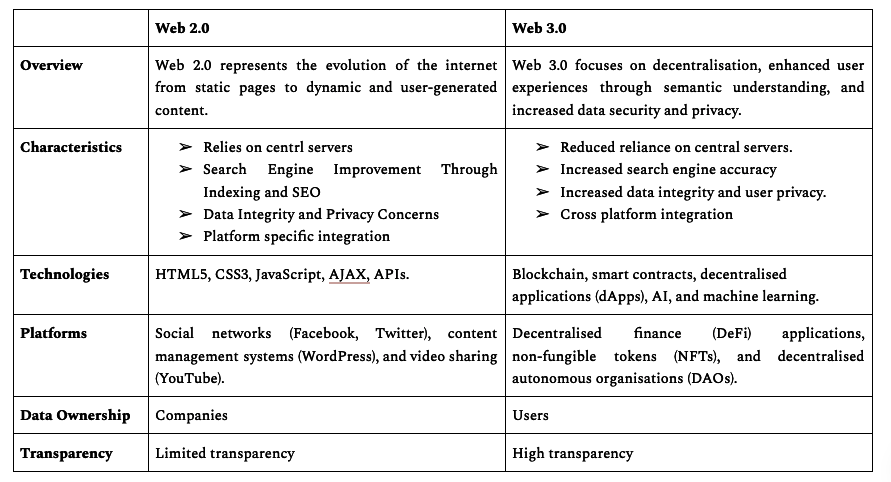
Imagine an internet that provides you with exactly the information you need, even if your search prompt is very vague. Yes, that is Web 3.0. As an upgrade to Web 2.0, Web 3.0 introduces a more innovative, convenient, and safe approach for users to interact online. It reflects the ideal internet experience that users have long desired. Web 3.0 cannot be properly defined without highlighting its features, which include decentralization, Artificial Intelligence (AI) and machine learning, data ownership, and interoperability. 

Features of Web 3.0

Decentralization

At the heart of Web 3.0 lies the principle of decentralization, which involves shifting control and authority over digital assets from a single entity and allotting them across several nodes. Unlike Web 2.0 platforms, which are often controlled by a single entity, Web 3.0 businesses use decentralized systems like Decentralized Finance (DeFi) to provide person to person communication without the need for middlemen. By incorporating decentralized systems, Web 3.0 companies promote transparency, resilience, and censorship resistance.

AI and machine learning

Another essential element driving Web 3.0 is AI and machine learning technologies. These technologies guarantee that data from various platforms can be interconnected and comprehended contextually by machines. This improved understanding and responsiveness allows for advanced search functions, making it easier for users to quickly access more pertinent information online, which in turn opens up possibilities for more comprehensive and interconnected web applications.

Data Privacy

Another hallmark of Web 3.0 is the emphasis on data  privacy. In many web spaces, user data is often collected, stored, and monetized by centralized platforms without users’ consent.  By using decentralized storage solutions and cryptography, Web 3.0 enables people to take ownership of their details and allow access selectively through centralized identification systems and data trading systems. This shift towards data control not only enhances user privacy, but also fosters trust and accountability in web dealings.

Interoperability

Interoperability is another critical characteristic of Web 3.0, as it enables seamless communication and collaboration across different systems and networks, unlike the strict landscape of Web 2.0, where siloed platforms often hinder data exchange and innovation. This improved data connectivity provides advanced search capabilities, helping users locate relevant information more quickly. 

Comparison between Web 2.0 and Web 3.0

Concerns surrounding Web 3.0

  • Several Web 3.0 platforms experience issues with sluggishness and congestion, leading to increased fees and delays. This creates difficulties for these platforms in managing a large number of users simultaneously.
  • Laws and regulations for Web 3.0 are not clear yet, making it hard for developers and users to know what is allowed. This can slow down the growth of these technologies.
  • Web 3.0 applications may pose a challenge for individuals who lack technical proficiency. Dealing with private keys and smart contracts can be difficult to navigate
  • It is tough to follow laws in decentralized systems, especially rules about preventing money laundering and verifying users’ identities.
  • In the wake of recent disappointments from various Web 3.0 initiatives, the focus is shifting towards ensuring the protection of consumers and investors for regulators and the public.

Examples of Web 3.0

  • Platforms like OpenSea and OpenBazaar allow people to buy and sell directly with each other without using middlemen. They use blockchain technology to make sure transactions are secure and clear.
  • Browsers like Google Chrome, can be integrated with various extensions, like MetaMask. Compared to standard web browsers, these applications provide users greater privacy, security, and control over their data.
  • Ethereum and Bitcoin are other examples of web 3.0. They allow peer-to-peer financial exchanges on a global scale and enable decentralized transactions to happen globally without the need for middlemen.

Future Expectations

It is evident that we are just getting started with Web 3.0 and other emerging technologies.

  • In the upcoming days, we can expect a significant increase in the usage of Web 3.0.
  • Additionally, there will no longer be a need for permissions. That is, anyone will be able to access its services without authorization.

Cognitive Artificial Intelligence (AI)

Absolutely, Artificial Intelligence (AI) has showcased its capability to execute numerous tasks guided by humans at the helm. Yet, there is growing curiosity about other forms of AI. Cognitive AI emerges as a major category in this discussion, but how does it differ from the AI we are familiar with? In this article, we will explore cognitive AI, its distinct characteristics and functionality, and its contributions to humankind as a whole.

What is Cognitive AI?

Under the umbrella term AI, Cognitive AI is a branch that seeks to imitate human cognitive functions such as reasoning and decision making. Its goal is to develop AI systems that can comprehend context, learn from data, and communicate with users more naturally. In order to accomplish these goals, Cognitive AI combines methods from domains including machine and deep learning, cognitive computing and many other similar programs.

Components of Cognitive AI

In Cognitive AI, there are several key components that work together to make it all happen. 

Firstly, Cognitive AI is all about learning. Cognitive AI systems are able to learn through pattern recognition and large-scale sample observation. Similar to how we learn from experience, our understanding improves with the abundance of experiences we face. This aids AI’s understanding of its surroundings.

And get this too – Cognitive AI can understand human language! Similar to how we speak to our phones to carry out tasks, Cognitive AI also allows for conversations with you. It can even “see” things like a person does. It is able to identify objects in images and movies, like structures or automobiles. This is called computer vision.

Ever seen those cool robots that can do things on their own? They are powered by Cognitive AI too. These robots employ specialized sensors to determine their movement and the actions. Another amazing feature of Cognitive AI is speech recognition. It is the process by which our gadgets interpret spoken commands and translate them into text or actions. With the advancement of technology, voice-controlled gadgets are already commonplace.

All of these functions, nevertheless, did not emerge out of the blues. They are made possible by Cognitive AI’s simplified procedures, which are primarily the result of deep learning, computer vision, machine learning, Natural Language Processing (NLP), and neural networks. Together, these elements function as a cohesive unit, with each member contributing distinct advantages. These elements work together to provide the basis of Cognitive AI.

Applications of Cognitive AI

With its amazing functions, Cognitive AI is completely changing sectors. In the medical field, it is transforming medical image analysis, tailoring treatment plans, and diagnostics to provide more precise and effective patient care. Comparably, in the financial industry, Cognitive AI is essential to detecting fraud, assessing risks, and customer support, improving both financial security and service quality.

In addition, Cognitive AI is transforming customer service experiences through virtual chatbots, offering immediate assistance and increasing user satisfaction. In academics, it is enhancing learning  experiences for each student, and optimizing instructional content.

In domains like manufacturing and farming, Cognitive AI is bringing helpful tools like predictive maintenance and precision farming, making their processes run smoother and more eco-friendly. It is also making transportation safer and more reliable with traffic systems, self-driving cars, and maintenance predictions.

A more productive workforce is being fostered by Cognitive AI’s assistance in talent acquisition, employee training, and performance management, which is transforming human resources as well. Last but not least, Cognitive AI is spurring innovation in a variety of fields by speeding up scientific breakthroughs, analyzing enormous databases, and providing fresh perspectives.

Pro’s and Con’s of Cognitive AI

Pro’sCon’s
Processes are streamlined and tasks are automated using Cognitive AI, increasing productivity and efficiency.Using Cognitive AI raises concerns about keeping data safe and secure since it needs access to sensitive data. 
Cognitive AI helps to make informed decisions by evaluating large datasets to deduce patterns.Cognitive AI algorithms may exhibit biases based on the data they are trained on, leading to unfair outcomes and decisions.
Cognitive AI tailors experiences based on individual preferences, offering personalized recommendations and services.Over-reliance on cognitive AI systems may result in decreased human oversight and accountability.
With advanced algorithms and deep learning capabilities, Cognitive AI delivers more accurate results and predictions.Cognitive AI sometimes raises ethical questions regarding its use in sensitive areas such as healthcare.
Cognitive AI constantly learns from new data and human experiences so as to be able to provide up-to-date solutions.Setting up and maintaining Cognitive AI systems can be complex, necessitating professional knowledge and abilities.
Through process automation, Cognitive AI helps to minimize operational costs.The inner workings of Cognitive AI algorithms are often opaque, making it challenging to understand and interpret their decisions.
Cognitive AI fuels innovation by unlocking new insights, enabling creative problem-solving, and driving technological advancements.Compatibility challenges may occur when integrating Cognitive AI with existing systems.
Cognitive AI functions 24/7, giving users continuous assistance.In some industries, the automation of work by Cognitive AI may result in layoffs and workforce reform.

Future Expectations

As technology continues to advance, we can expect Cognitive AI to play an increasingly prominent role in various aspects of society and industry.

Professor Pedram Mohseni, a brain-computer interface (BCI) expert in Case Western University, Ohio explained;

“Musk’s goals of cognitive enhancement relate to healthy or able-bodied subjects, because he is afraid of AI and that computers will ultimately become more intelligent than the humans who made the computers,” explains BCI expert Professor Pedram Mohseni of Case Western Reserve University, Ohio

In light of Elon Musk’s worries that AI would eventually surpass human intelligence, the statement conveys a key component of what is anticipated to happen with Cognitive AI in the future. Musk not only emphasizes, but demonstrates the necessity for AI to complement human abilities rather than completely replace them, which highlights the importance of cognitive improvement. This is in line with the broader expectation that Cognitive AI would be employed as a tool to enhance human decision-making, performance, and problem-solving skills in various types of circumstances. By utilizing BCI technology, Cognitive AI aims to close the experiential gap between AI and human cognition. This will allow humans and machines to work together harmoniously. This vision represents ongoing efforts to solve ethical, privacy, and security issues while creating AI systems that augment human abilities.

Ultimately, the future expectation of Cognitive AI wheels around enabling people and society by providing them with improved Cognitive capacities, facilitated by advancements in neuroscience and AI technology.

Site logo

* Copyright © 2024 Insider Inc. All rights reserved.


Registration on or use of this site constitutes acceptance of our


Terms of services and Privacy Policy.